Luke 6
1. When did the event mentioned in verse 1 take place? Answer
2. Why did the Pharisees in Luke 6 say it was wrong for the disciples to pluck heads of wheat and then eat them? (v. 2) Answer
3. How did Jesus justify the plucking wheat by his disciples? (v. 4 - 5) Answer
4. How are verses 12 to 16 important in New Testament history? Answer
5. What is the name usually given to what Jesus taught in verses 20 - 23? Answer
6. What is verse 31 in Luke 6 commonly known as? Answer
7. What is profound about Jesus' teaching in verses 27 to 40? Answer
8. What principle is taught in verses 43 to 45? Answer
9. What does Jesus teach about deceiving ourselves? (v. 46 - 49) Answer
Luke 7
10. How does the healing of a centurion's servant prove Jesus is God? (v. 1 - 10) Answer
11. What other amazing fact is revealed in Jesus' healing of a centurion's servant? (v. 9) Answer
12. What is unique about Jesus bringing back from the dead a widow's son? (v. 11 to 18) Answer
13. Why did John the Baptist doubt Jesus? (v. 18 - 23) Answer
14. Which Old Testament Bible passage is quoted in Luke 7:27? Answer
15. What is the meaning of verses 31 to 35? Answer
16. What unacceptable behavior was Jesus criticizing in verses 44 to 46? Answer
Luke 8
17. Who were the woman listed in verses 2 and 3? Answer
18. What is the basic meaning of the parable of the Sower and the seed? (v. 5 - 15) Answer
19. What were the names of Jesus' half-brothers and half-sisters? (v. 19 - 21) Answer
20. Where was the Gadarenes? (v. 26) Answer
21. What made the demon-possessed man of Luke 8 especially dangerous? (v. 29) Answer
22. Why did those living in the Gadarenes ask Jesus to leave them? (v. 37) Answer
23. What made Jairus unique in Jesus' ministry? (v. 41) Answer
24. What made the woman's hemorrhaging of blood especially difficult for her? (v. 43 - 48) Answer
25. What is revealed in verse 52 about God's view of death? Answer
Luke 9
26. What were the goals and powers given to the twelve disciples on their first training mission? (v. 1 - 6) Answer
27. What is important about verses 7 to 9? Answer
28. What is unique about Jesus feeding 5,000 in Luke 9? (v. 11 - 17) Answer
29. What is special about Peter's declaration made in verse 20? Answer
30. Where did Jesus' transfiguration take place? (v. 28 - 36) Answer
31. What issue was addressed by Jesus in verses 46 to 48? Answer
32. What is the principle being conveyed in verses 57 to 62? Answer
Luke 10
33. Who were the seventy disciples Jesus sent out on a special training mission? When were they sent? (v. 1 - 16) Answer
34. When did the event described in verse 17 take place? Answer
35. What interesting characteristic of spirits is hidden in verse 18? Answer
36. Where were the cities mentioned in verses 12 to 15 located? Answer
37. What happened to the seventy that were trained by Jesus? (v. 19 - 20) Answer
38. Which Old Testament passages are quoted in verse 27? Answer
39. How was the Jewish religious leader trying to justify himself by asking who was his neighbor? (v. 29) Answer
Luke 6 Answers
1. The Greek behind the phrase "second Sabbath of first rank" (or "the second Sabbath after the first" in the King James) is referencing the last day of the Feast of Unleavened Bread. This High Holy Day of Luke 6:1 fell on Monday, April 5 in 28 A.D.
[Jesus Confronts Religious Leaders!]
And it came to pass on the second sabbath after the first, that he went through the corn fields; and his disciples plucked the ears of corn, and did eat, rubbing them in their hands (Luke 6:1, KJV).
2. The Pharisees considered the plucking of wheat heads and rubbing them to get at the wheat as threshing which was forbidden on such Sabbaths. This belief, however, was founded on the tradition of their elders which they considered more authoritative than the Bible! Jesus, later in his ministry, condemned their prioritizing of their own teachings above the word of God!
And He (Jesus) answered and said to them, "Well did Isaiah prophesy concerning you hypocrites, as it is written, 'This people honors Me with their lips, but their hearts are far away from Me. But in vain do they worship Me, teaching for doctrine the commandments of men'" . . .
"Full well do you reject the commandment of God, so that you may observe your own tradition." (Mark 7:6 - 7, 9, HBFV).
3. The Lord responds to the Pharisees' criticism in Luke 6 by using David as an example.
David, out of a legitimate human need, ate shewbread that other times was unlawful to consume (see 1Samuel 21:1 - 9). David was not condemned for his actions since he did them to alleviate the genuine human need for food. The Lord's argument was that, like David, his disciples ate out of real (and not manufactured) necessity and were therefore guiltless.
4. Luke 6:12 - 16 is important in New Testament history as it is Jesus' official choosing of his twelve disciples.
5. Luke 6:20 - 23 is commonly called the Beatitudes. They are a list of behaviors or attitudes that, if manifested in this life, will someday be rewarded by a blessing from God the Father. A more expansive version of the beatitudes is found in Matthew 5:3 - 12.
[Sermon on the Mount Location]
The Beatitudes, a part of Jesus' Sermon on the Mount, are the opening words of the New Covenant offered to all humans by God.
6. Luke 6:31, and its companion mention in Matthew 7:12, is commonly referenced as the Golden Rule. It is unknown how this verse got its name.
And exactly as you would have men do to you, you do the same to them also (Luke 6:31).
Therefore, everything that you would have men do to you, so also do to them; for this is the Law and the Prophets (Matthew 7:12).
7. Luke 6:27 - 30 and 32 - 36 teaches that Christians are to love, do good to and even pray for their enemies! This response is contrary to what our human nature would usually lead us to do. Although God's law teaches we should love our neighbor (Leviticus 19:18), it does not command we should love our enemies (see Matthew 5:43).
[What Are the Gifts of God's Spirit?]
Jesus taught that, instead of rejecting our enemy (or pursuing revenge), we should love them and do them good. This attitude of unconditional love, even toward those who hate us, is the same one God has (see Matthew 5:45). The goal of Jesus' teachings is to have those who are his disciples become as perfect in character as he or God the Father!
Therefore, you shall be perfect, even as your Father Who is in heaven is perfect. (Matthew 5:48).
8. Luke 6:43 - 45 parallels what is taught in Matthew 5:16 - 20. The principle taught is that a person should be judged not only on their words but also on their actions (the "fruit" of their intentions and beliefs). The fruit of a sincere righteous heart will be actions that are holy and good.
The Jewish religious leaders of Jesus' day professed to be holy and obeying God. Their actions ("fruit"), however, contradicted what they said and taught. Jesus, a few times during his ministry, labeled such behavior for what it was.
But woe to you, scribes and Pharisees, hypocrites! (Matthew 23:13, HBFV, see also verses 14 to 29, Mark 7:6, etc.).
9. Jesus' core teaching in Luke 6:46 - 49 is found in its first verse.
And why do you call Me, 'Lord, Lord,' but you do not practice what I say? (Luke 6:46, HBFV).
A related teaching is found in the book of James.
My brethren, what good does it do, if anyone says that he has faith, and does not have works? Is faith able to save him?
Now then, if there be a brother or sister who is naked and destitute of daily food, and one of you says to them, "Go in peace; be warmed and be filled," and does not give to them the things necessary for the body, what good is it? (James 2:14 - 16, HBFV).
According to Jesus in Luke 6, those who acknowledge that "Jesus is Lord" but do not obey him are deceiving themselves. They are Christians in name only. Merely acknowledging Christ is simply not enough!
Luke 7 Answers
10. In Luke 7:1 - 10 the Lord is told that a certain Roman centurion's servant was ill and near death. As he travels to heal the servant he is told, by the centurion's friends, that the military leader felt he was unworthy to have Christ visit him.
"Lord, do not trouble Yourself, for I am not worthy that You should come under my roof; Therefore, neither did I count myself worthy to come to You; but say the word, and my servant shall be healed . . ." (Luke 7:6 - 7, HBFV).
Jesus, impressed by the centurion's faith, commands his servant be made whole (Luke 7:9 - 10, see also Matthew 8:13).
[Best Bible Verses About Healing]
The fact that Jesus could simply command, at a distance, someone he never met to be healed, is one of the many proofs that he was God in the flesh!
11. Luke 7:9 reveals that Jesus could legitimately be surprised at something taking place or how people will respond to certain things.
And when He heard these things, Jesus was AMAZED (wondered or marveled) at him; and turning to the multitude following Him, He said, "I tell you, not even in Israel have I found such great faith." (Luke 7:9).
This shows that God can indeed choose, at any time he wishes, to not know everything that is happening or how people will respond! Jesus was honestly surprised at the Roman Centurion's faith and understanding of the Lord's authority.
12. Jesus' resurrection of a Nain widow's son (Luke 7) is unique as it the first one performed during his ministry. There is something else, however, that makes this raising of the dead different.
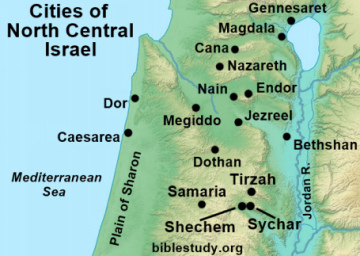
The New Testament records three times the Lord brought someone back to life (there may have been more, see John 21:25). The first was the Nain widow's son, the second was Jairus' daughter (Luke 8:41 - 42, 49 - 56) and the third was Lazarus (John 11).
[How Did Lazarus Ultimately Die?]
The Nain resurrection is unique in that Jesus performed this amazing miracle without being asked! Jairus had asked for the Lord's help for his ailing daughter (Luke 8:41 - 42). Lazarus' two sisters asked for his help when he and his disciples were in northern Israel (John 11:3).
As Jesus entered Nain he ran into a large group of mourners carrying a man's body out of the city for burial (Luke 7:12). Knowing the man was the only son of the widow, and that his death meant the loss of her only means of support, he took pity on her. He then decided, without being asked, to bring the young man back to life!
13. John the Baptist was cast in prison by Herod between the spring Holy Days and Pentecost in 27 A.D. He then, a little more than a year later, sends a few of his disciples to Jesus to ask if he was the Messiah (Luke 7:18 - 19).
[Why Did John the Baptist Doubt Jesus?]
John's time in prison allowed him to reflect on Jesus' mission and to entertain a doubt or two. His doubt is understandable, as the Bible does not record him ever seeing one of Jesus' miracles. This is why the Lord told John's disciples to report back to him the miracles they saw (Luke 7:21 - 22).
John also likely expected, like Jesus' own disciples (see Acts 1:6), that He would free Israel of its enemies and restore its kingdom. He possibly doubted if Jesus was the Messiah since, despite being initially told of his miraculous powers (see Luke 7:18), he had yet to be freed from prison.
14. Jesus, in Luke 7:27, quotes from Malachi 3.
"Behold, I will send My messenger, and he will prepare the way before Me. And the Lord, Whom you seek, shall suddenly come to His temple, even the Messenger of the covenant, in Whom you delight. Behold, He comes," says the Lord of hosts. (Malachi 3:1, HBFV).
15. The generation Jesus spoke of in Luke 7:31 - 35 rejected and criticized John the Baptist because he led an aesthetic life of never drinking alcohol or feasting with others. They then turned around and rejected Jesus for doing the things they saw lacking in John's ministry! Jesus' criticism is that the men of his generation set themselves up to be never satisfied and therefore always upset.
16. The Pharisee in Luke 7:36 - 50, in his heart, criticized Jesus for allowing a known sinner to show love to him by washing and anointing his feet. Jesus' response was to contrast the woman's display of love with the calloused behavior of the Pharisee (the host) toward him!
[Was Mary Magdalene the
Sinful Woman of Luke 7?]
I came into your house, and you did not provide any water to wash My feet; but she has washed My feet with her tears and wiped them with the hairs of her head. You did not give Me a kiss; but she, from the time I came in, has not ceased to ardently kiss My feet.
You did not anoint My head with oil; but she has anointed My feet with ointment (Luke 7:44 - 46, HBFV).
Hosts, as a manner of common courtesy, were expected to have their guests' feet washed when they entered their home (or at least provided water to do so). They were also expected to greet guests with a kiss of affection and provide oil for their dry skin.
According to the Lord, the sinful woman of Luke 7 provided all the courtesies of a host which the Pharisee refused to perform. The religious leader's criticism of her was therefore ridiculous and hypocritical.
Luke 8 Answers
17. Luke 8:2 - 3 mentions three of the many women who followed Jesus and helped financially support his ministry. These women were Mary Magdalene, Joanna and Susanna.
Mary Magdalene is the most well-known female follower of Jesus next to his mother. She was a resident of Magdala which was a city near the Sea of Galilee.
Prior to Mary's first mention in Luke 8 she had been possessed and tormented by seven demons which Jesus mercifully cast out of her. She was unashamedly a follower of Christ even when he was crucified and was one of many who received God's spirit on Pentecost.
Joanna was the wife of Chuza who was one of Herod Antipas' stewards. Nothing more is revealed about her in the New Testament. This is additionally true of Susanna of which the Bible is also silent other than listing her name in Luke 8:3.
18. The Sower in the parable of Luke 8 is Jesus and, by extension, all converted Christians. The seed which is spread is the gospel message. The four places where the seed ultimately lands are symbolic of the most common responses to hearing the gospel.
[Who Were the 120 Gathered at Pentecost?]
The seed that falls by a road symbolizes those who hear the gospel but do not believe it. This is because the devil has made their hearts as hard as a well-worn path which causes them to reject it before it even sprouts (Luke 8:12).
Some seeds of the gospel fall on rocks. This symbolizes those who receive it with joy but before it can take root in them it is destroyed by temptation (Luke 8:13).
Still other "gospel seeds" reach the heart of people who hear it and begin to grow spiritually. Their newly sprouted faith, however, is soon choked to death by the pursuit of carnal pleasures and the cares of this world. It never stays around long enough to produce any fruit (Luke 8:14).
Some of the gospel message ultimately reaches those whose hearts are prepared to both hear it and take it seriously. The truth takes root in their minds and they grow within it until it finally produces the fruit God wants (Luke 8:15). Please see our article on the parable of the Sower and the seed for more information.
19. The Bible reveals, after Jesus' miraculous birth made possible by God's spirit, that Mary and Joseph produced six children. The names of the boys were James, Joses, Simon and Judas (Jude). Although the couple also produced at least two daughters (Matthew 13:55 - 56) their names are unknown.
20. The area of the Gadarenes (also called the Gergesenes), mentioned in Luke 8:26, is centered on the city of Gadara and its surrounding land. Gadara was located roughly six miles (9.6 kilometers) southeast of the Sea of Galilee. It is found east of the Jordan River near Bethabara where John the Baptist first baptized people (John 1:28).
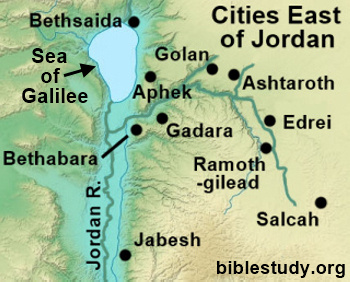
The Gadarenes was one of the few areas Jesus visited where Gentiles (non-Jews) composed most of the population.
21. The Gadarenes was the place where Jesus confronted a man whose possession by demons gave him a level of superhuman strength like Samson (Mark 5:3 - 5, Luke 8:27). The man, who was naked when he saw Jesus, had the added ability of enduring both freezing and sweltering temperatures as well as the pain he inflicted upon himself!
22. The Lord allowed the multitude of demons who controlled the Gadarenes' man, per their request, to possess a nearby herd of pigs. After the demons entered the swine they caused them to kill themselves by rushing into a nearby lake and drowning (Luke 8:33)!
[Who Used Music to Chase Demons?]
Pigs were the primary means the people of the Gadarenes made a living. The death of their animals angered those who owned them. They also feared further losses if Jesus stayed in the area. The people of the area therefore begged the Lord to leave them out of what they felt was economic necessity!
23. Jairus was the ruler (leader) of a synagogue (Luke 8:41). He was one of the incredibly few Jewish leaders at the time who accepted Jesus was the Messiah. He is also one of the incredibly few Jews who actively sought the Lord's miraculous healing power and ability to raise the dead!
[What Were Jesus' Synagogue Miracles?]
[What Were Jesus' Sabbath Miracles?]
24. The woman Jesus healed in Luke 8:43 - 48 suffered for twelve years with a condition that caused her to hemorrhage blood. Her suffering was so great that she spent all her money pursuing physicians to heal her, which they could not do.
The woman's issue of blood, on top of causing her to physically and financially suffer, made her ceremonially unclean (Leviticus 15:25 - 30). This meant she was not only untouchable but also anything she touched or sat upon was made unclean. Anyone who touched her or anything she touched were considered unclean for the rest of the day. All this caused the woman to be marginalized in society and no doubt added to the difficulty of coping with the disease.
25. Luke 8:52 reveals that God's view of death is different to what many humans believe. Humans see death as something they are powerless to stop which permanently cuts them off from continuing a relationship with those they cherished and loved.
[Best Bible Verses
About Life After Death]
God, however, views death like someone sleeping. He can "wake" anyone at any time and bring them back to life, at a time of his choosing, since he has the "keys of death" (the grave, Revelation 1:18, 20:14, 21:4).
Luke 9 Answers
26. Jesus sent his twelve disciples on an evangelistic training mission in the early part of 29 A.D. (Luke 9:1 - 6). Their primary goal, according to Luke, was to preach the Kingdom of God. They were also given the power to heal the sick and cast demons out of people to authenticate their message. Matthew further elaborates that they were also given the authority to raise the dead (Matthew 10:8).
27. John the Baptist was thrown into prison by Herod Antipas sometime between the spring Holy Days and Pentecost in 27 A.D. He is in prison until he is famously murdered by Herod, referenced in Luke 9:9, during Herod's birthday celebration. John, at the time of his martyrdom, had been in prison for a little less than two years.
[Is It Wrong to Celebrate a Birthday?]
[Why Was John the Baptist Killed?]
28. Jesus' feeding of 5,000 people in Luke 9:11 - 17 is unique for a few reasons. For starters, the Lord fed far more than 5,000 people! The Bible mentions the crowd numbered 5,000 men (Luke 9:14) but does not record how many women or children were there. If we include them then the group miraculously provided a meal could have easily numbered 10,000 (Bible Knowledge Commentary) and likely more!
Jesus' miracle in Luke 9 was the largest miraculous mass feeding of people found in the New Testament. It was also one of Jesus' ten non-healing miracles during his ministry.
Lastly, this event is the only miracle Christ performed that is mentioned in all four Gospel accounts (Matthew 14:13 - 21, Mark 6:30 - 42, Luke 9:10 - 17, John 6:1 - 13).
29. Peter is the only apostle who bore witness to Jesus' deity during the Lord's lifetime. He did this not only once but twice, with both occurrences taking place within the same year.
The first profession Peter made affirming Jesus' deity took place between April and Mid-September in 29 A.D. right after many of the Lord's disciples left him (John 6:60 - 71). The second declaration by Peter took place in Luke 9:20 which took place prior to the Transfiguration in late September.
[Why Did Jesus' Disciples Leave Him?]
[Timeline of Jesus' Transfiguration]
30. Jesus and his disciples were in Caesarea Philippi (Matthew 16:13, Mark 8:27) six days before his transfiguration took place (Matthew 17:1, Mark 9:2). He then decided to take three of the disciples to an unspecified high mountain where he would pray (Luke 9:28).
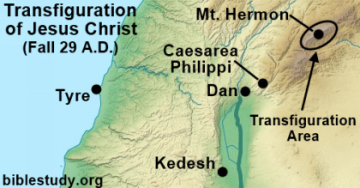
The likely candidate for the mountain on which the transfiguration took place was Mount Hermon (or one of its peaks).
31. The disciples, like many of the Jews, believed the Messiah would come and kick out the hated Romans as well as restore the kingdom to Israel (see Acts 1:6). Believing Jesus would shortly rule the earth, they began to argue which of them deserved various positions of authority within this kingdom.
[Why Did God Hate the Nicolaitans?]
Jesus, in Luke 9:46 - 48, addressed a core misunderstanding of the disciples about his kingdom. Those considered "great" would not be those who are self-seeking and vain (like those in the world) who want to rule over others through a hierarchy. Those great in God's Kingdom are those who have a humble (like a child) and loving spirit which solely pursues serving others.
32. Jesus, in Luke 9:57 - 62, is teaching the principle that nothing should get in the way of a person following him. God and his kingdom, which includes spreading the gospel, must become the greatest priority of a person's life!
Luke 10 Answers
33. Jesus, in Luke 10:1 - 16, selected seventy of his disciples (which did not include the twelve apostles) to send out on an evangelistic training mission. They were sent out to travel south through Samaria sometime between mid-November and late December of 29 A.D.
[Who Were the 70 Disciples Jesus Trained?]
[Why Did the Disciples Preach in Pairs?]
The goal of the seventy was to announce that the kingdom of God is, and will be, drawing near to them (Luke 10:9, 11). To authenticate their message they were given the ability to heal the sick and cast out demons. For more information on this fascinating group please see our article on these special seventy men.
34. Jesus responded, when the seventy disciples he sent out reported demons obeying them, with the following.
And He said to them, "I was watching when Satan fell from heaven like lightning." (Luke 9:18, HBFV).
Jesus, in Luke 9, was not referring to an event that took place while he was a human. He was referencing the devil's explosive ejection from God's throne when he led his evil army to take control of the universe (see Isaiah 14:12 - 15)!
Even though tossed out, the devil was allowed unfettered access to God's throne even to today! The next time he will be forcibly thrown out of heaven, this time permanently, will be in the prophetic end times just ahead of us.
[When Was Satan Cast Out of Heaven?]
And I heard a great voice in heaven say, "Now has come the salvation and the power and the kingdom of our God, and the authority of His Christ because the accuser of our brethren (Satan the devil) has been cast down, who accuses them DAY AND NIGHT before our God (Revelation 12:10, see also verses 7 - 9 and 11 - 13).
35. Luke 10:18 reveals that spirits, be they righteous or evil, must travel to get from one place to another. Even though composed of spirit which transcends the physical universe, they do not have the power to instantly appear in one place (e.g. earth) and then pop up somewhere else (e.g. God's throne). The book of Job confirms this when the Lord asked the devil a simple question.
And the Lord said to Satan, "From where do you come?" Then Satan answered the Lord and said, "From going to and fro in the earth, and from walking up and down in it." (Job 1:7, HBFV).
36. The cities Jesus mentioned in Luke 10:12 - 15 are Sodom, Chorazin, Bethsaida, Tyre, Sidon and Capernaum.
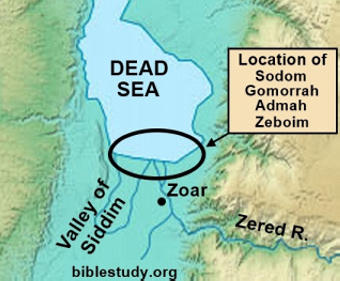
Sodom, as well as Gomorrah, were considered "cities of the plain" (Genesis 10:19). They existed in a fertile valley, south of the Dead Sea, which in modern times is partially covered with water.
[Why Did Abraham Try to Save Sodom?]
Chorazin, mentioned in Luke 10:13, was northwest of the Sea of Galilee near Capernaum. Bethsaida was east of the Jordan River on the northeast corner of the Sea of Galilee. Tyre and Sidon were Mediterranean coastal cities in an area known as Phoenicia (modern Lebanon). Capernaum, the place Jesus moved to after leaving Nazareth, is on the northwestern shore of the Sea of Galilee.
37. After the seventy men selected by Jesus are mentioned in the Bible (Luke 10:1 - 20) they are no longer referenced in the New Testament. That said, the Lord intended that, individually, they were to continue preaching the coming of God's kingdom after their training mission completed. Jesus reiterated, after the seventy returned to him, the authority he expected they continue to use.
Behold, I give you authority to tread upon serpents and scorpions, and upon all the power of the enemy, and nothing shall injure you in any way (Luke 10:19).
38. In Luke 10:27 Jesus quotes from two Old Testament passages.
You shall not avenge, nor bear any grudge against the children of your people, but you shall love your neighbor as yourself. I am the Lord (Leviticus 19:18).
And you shall love the Lord your God with all your heart and with all your soul and with all your might (Deuteronomy 6:5).
39. Jesus reminded the religious leader that part of obeying God was to love their neighbor as themselves (Luke 10:27). The leader responded by asking who was his neighbor (Luke 10:29) as he felt sure he knew the answer that would be given. He thought he would be told that his neighbors were fellow Jews (and no one else), something that he already believed in and therefore could be proud of his righteousness.
Jesus, however, gave the parable of the good Samaritan to drive home the point that our "neighbors" were anyone that helped us (or anyone we could help, see Luke 10:36 - 37). This surprise answer likely shocked the religious leader, as Jews (for a variety of reasons) hated the Samaritans (those living in Samaria). Please see our full explanation of the good Samaritan parable for more information.
Luke 1 to 6 Outline - 7 to 12 Outline
13 to 18 Outline - 19 to 24 Outline
1 to 5 Questions - 11 to 15 Qs - 16 to 20 Qs
21 to 24 Qs - Luke Facts Part 1 - Part 2