[Where Were Books of the Bible Written?]
Luke 1 is the largest single chapter in the entire New Testament with 80 verses. Luke's average word count of 1,081 per chapter is also the highest in this part of the Bible.
The book of Luke belongs to the fourth of the Bible's seven major divisions. This division includes the other gospel accounts as well as the book of Acts.
[Why Are There Only Four Gospels?]
Date Written
Luke's gospel was written around 59 A.D. He was the last of the four gospel writers to complete his book.
The Author
Luke, whose name means "light giving" (Thayer's Greek Definitions #G3065), was likely born in Syrian Antioch roughly around 15 to 16 A.D. He was born a Gentile who converted to Christianity probably through the Apostle Paul (Holy Bible, a Faithful Version, chapter 2).
Luke was a doctor whose faithful service earned him the accolade of "beloved physician" by Paul (Colossians 4:14). He may have learned his profession at a famous school in Tarsus which rivaled those in Alexandria and Athens (1913 Catholic Encyclopedia).
Luke Chapter Outline
Chpt. 1: Luke opens his book by revealing he wrote his gospel for a man named Theophilus. He assures his friend that what follows is a thoroughly researched account of events. The purpose of the detailed account is to offer proof to support the truths of the gospel Theophilus had been taught (v. 1 - 4).
[The Life of John the Baptist!]
Luke begins his account by detailing the circumstances surrounding the miraculous conception of John the Baptist (v. 5 - 25). He then proceeds to reveal how Mary was informed Jesus would be conceived in her womb and the prophecies he would fulfill (v. 26 - 38).
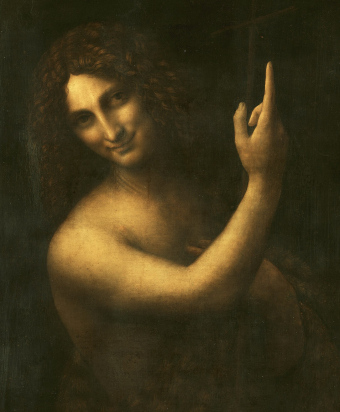
Mary, after Jesus is conceived, rushes to visit her cousin Elizabeth who is pregnant with John the Baptist. After the women meet Mary praises God for his mercy, love and fulfillment of what he promised in what is called the Magnificat (v. 46 - 55).
Luke then details the events surrounding John's the Baptist's birth and the healing of John's father Zacharias after he obeyed the angel who told him to name his son John. Zacharias then proceeds to glorify God and offer prophecies concerning both Jesus and his eight days old son (v. 57 - 80).
Chpt. 2: This chapter begins by recording the reason why Mary and Joseph had to travel to Bethlehem even though Mary was "great with child" (v. 1 - 5).
When Jesus is born in Bethlehem an angel announces his birth to shepherds followed by a host of angelic beings singing praises to God. The shepherds quickly go into Bethlehem and, after finding where Christ was born, glorify God and return to their work (v. 6 - 20).
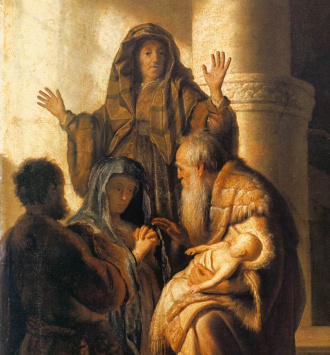
Luke then notes the circumcision of Jesus and his presentation to God at Jerusalem's temple. A man named Simeon, at the temple, after holding the infant Christ in his arms offers prophecies related to Jesus' ministry. A prophetess named Anna, after noticing Jesus at the temple, praises God and spreads the word of his existence to others (v. 21 - 38).
Luke's gospel then reveals the events which caused a twelve-year-old Jesus to gently chastise his parents after they found him at the temple discussing religious topics with the teachers (v. 39 - 52).
[Is Jesus the God of the Old Testament?]
Chpt. 3: Luke 3 begins with John the Baptist calling for people to repent and be baptized for the remission of their sins. He offers various people actions they can take as proof they are repentant and willing to change their ways (v. 1 - 17).
[Who Were John the Baptist's Disciples?]
Jesus travels to see John and be baptized. After his baptism the Holy Spirit descends upon him live a dove to prove to John that Jesus was the Messiah (v. 21 - 22).
[Genealogy of Jesus Through Mary]
Luke then lists Jesus' genealogy by subtlety using Mary's father Eli (Heli) as a stand-in for Mary herself. The Lord's lineage is then traced backed to King David through his son Nathan, and back to Abraham, Adam and ultimately God (v. 23 - 38).
Chpt. 4: Jesus, at the start of his ministry, fasts for 40 days and night and is tempted by Satan the devil the entire time (Luke 4:2). Luke, like Matthew (see Matthew 4:1 - 11) is likely only delineating Satan's last three temptations.
The greatest temptation the devil threw at Jesus was the chance to forgo the trials and painful death that awaited him and instead begin to immediately rule the world. The "catch," of course, was that Christ had to reject God the Father and begin to worship his adversary. Thankfully, the Lord rejected the evil proposal (v. 1 - 13).
[The Three Sources of Temptation!]
Luke skips ahead in time to June 1 in 27 A.D., the Day of Pentecost. Jesus, while in Nazareth for the Holy Day, reads a passage from Isaiah which is a prophecy of his ministry! The passage is normally read on the Day of Atonement to proclaim the start of a Jubilee year. His reading of the passage reveals his ministry, which began on Atonement in 26 A.D. (September 11), had begun on a Jubilee (v. 1 - 21).
[Mysterious Numbers of the Jubilee Year!]
The synagogue in the Lord's hometown who hears his message becomes enraged at his criticism of them and their lack of faith. Their wrath reaches a point where, for the first time in his ministry, Jesus' life is threatened. He ends up escaping the crowd and continuing his travels to Capernaum (v. 22 - 32).
The Lord's casts out of a demon from a man who is attending a Capernaum synagogue (Luke 4:33 - 37). Jesus then heals Peter's mother-in-law as well as many others (v. 38 - 41). Luke closes chapter 4 by revealing Jesus sought refuge in a desert place but the people found where he was and tried to detain him. The Lord, however, left to preach in other parts of Galilee (v. 42 - 44).
It should be noted that Luke 4:33 - 44, chronologically, comes AFTER Luke 5:1 - 11. This is because the Lord first had to call Peter and others, who forsook everything to follow him (Luke 5:1 - 11, Mark 1:16 - 20, Matthew 4:18 - 22), BEFORE he went with Peter to his home and healed his relative (Harmony of the Gospels).
Chpt. 5: Luke reveals that Jesus, on Lake Gennesaret (Galilee), uses Simon Peter's ship to preach the gospel more effectively to the multiple who followed him.
Knowing that Peter and his fellow fishermen had not caught anything all day, the Lord tells the men to cast out their nets one last time. He then miraculously causes so many fish to come to the boats that the nets start to break and come apart! Luke then records that this attention grabbing miracle leads to the calling of Peter, Andrew, James and John to go with Jesus on his first Galilean preaching tour (v. 1 - 11).
[Why Do Fish Symbolize Christians?]
Jesus, while traveling with some of his disciples, heals a leprous man who begs to be cleansed of his disease. After withdrawing to the wilderness to pray, the Lord ends up preaching the gospel in a home packed with people (likely in Capernaum, Mark 2:1).
The faith of four men, who must cut a hole in the roof to lower their paralyzed friend in front of Jesus, is rewarded by the man being forgiven and healed. Religious leaders, who see the miracle, criticize it in their hearts. The Lord, who can read anyone's mind, responds to what the men are thinking by asserting his authority to forgive sins (v. 17 - 26).
[Can the Devil Read Our Minds?]
Matthew, according to Luke, is called to be a disciple. He celebrates his call by hosting a feast for Jesus and his fellow tax collectors. Some religious leaders, who see the feasting, criticize the disciples for eating with "sinners." Jesus then steps in to correct the leaders.
[New Wine into Old Wineskins Parable]
The Jewish religious leaders then ask the Lord why his disciples do not fast like other religious people. Jesus' answer to those who bad mouth his disciples is to give the parable of the wineskins (v. 27 - 39).
Chpt. 6: Jesus and his disciples, on "the second sabbath after the first" (a reference to the last day of the Feast of Unleavened Bread in 28 A.D.) according to Luke, are walking through a grain field. As they walk they pluck heads of wheat to eat them. This act rouses the anger of the Pharisees who believe that what they are doing is work and against God's law.
[What Is Feast of Unleavened Bread?]
The Lord's response to the Pharisees is that King David was considered guiltless when, out of a legitimate emergency need, he ate shewbread that was unlawful to do. Jesus then asserts his right, as Savior, to decide what is and is not acceptable to do to keep a Sabbath or Holy Day (v. 1 - 5).
Later, while teaching in a synagogue on the Sabbath, Jesus heals a man with a withered hand. Luke reveals that He performs this miracle knowing the religious leaders who see it will enrage themselves by his act. Their anger is such that they begin to conspire with each other on how to get rid of the Lord (v. 6 - 11).
[The Conspiracy Against Jesus!]
Jesus, while in Galilee, goes to a mountain to pray all night. He then, out of all those who had been following him, selects and ordains twelve of them to be his apostles (v. 12 - 16). Jesus then spends some time casting out demons and healing all those who were sick (v. 17 - 19).
Luke 6:20 - 49 is a record of some of Jesus' teachings during his famous Sermon on the Mount. This section, chronologically, comes just before the events and teachings of Luke 5:12 - 39 listed above.
Luke 7 to 12 Outline - 13 to 18 Outline
19 to 24 Outline - Luke 1 to 5 Questions
6 to 10 Qs - 11 to 15 Qs - 16 to 20 Qs
21 to 24 Qs - Facts Part 1 - Part 2