God has revealed, in the books of Daniel and Revelation, the world-ruling Gentile (non-Israelite) empires that would exist from the time of Babylon to the Second Coming of Jesus. This period of great kingdoms spans more than 2,600 years! Biblical prophecy predicts no less than fifteen empires and the most influential false religious system the devil can create.
The Bible offers us a sequential timeline of prophetic empires through what God revealed to three individuals. The first of these is King Nebuchadnezzar of Babylon (Daniel 2), who dreamed of a large image of a man. The second, Daniel, dreamed of four great beasts (lion, bear, leopard and one strong beast with iron teeth and ten horns) found in Daniel 7. The prophet also had an important vision of a ram and a male goat in the eighth chapter of his book.
Lastly, God showed the Apostle John visions of a woman riding a beast with seven heads and ten horns (Revelation 13:1 - 8, 17). It reveals, through symbolism, the world empires that would rule starting with Rome's partial restoration in 527 A.D. and ending with the yet future Beast Power's reign that will be overturned by Jesus' Second Coming.
Neo-Babylonian Empire - 612 B.C.
Represented in Bible prophecy as:
Head of Gold (Daniel 2:32, 38)
First Beast like a Lion (Daniel 7:4)
Babylon was the kingdom that ruled the earth at the time when Nebuchadnezzar dreamed an image of a man.
King Nabopolassar of Babylon, in 612 B.C., defeated the Assyrian Empire and sacked its capital city of Nineveh. This victory began Babylon's period as a world empire. The empire's greatest King was Nebuchadnezzar (reigned 605 - 562 B.C.), who conquered the Kingdom of Judah, took the inhabitants as captives to Babylon and, in 586 B.C., burned Jerusalem and destroyed its temple.
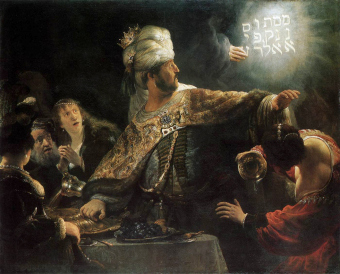
The last king of the Babylonian Empire was Belshazzar. God personally informed the king of his downfall, and that of the empire he ruled, when he famously wrote on a wall near him, "MENE, MENE, TEKEL, UPHARSIN" (Daniel 5:25). Belshazzar was killed on the night he saw the miraculous hand proclaiming his downfall. The mantle of world rule would now solely go to the Persians (Daniel 5:31).
Persian (Medo-Persian) Empire - 549 B.C.
Represented in Bible prophecy as:
Chest and Arms of Silver (Daniel 2:32, 39)
Second Beast like a Bear (Daniel 7:5)
Ram with two horns (Daniel 8:3 - 4, 20)
Persia is the second beast (prophetic kingdom) to rule the earth. This kingdom actually represents two kings ("ram with two horns") - the king of Media and king of Persia.
Astyages became king of Media in 585 B.C. Cyrus the Great became king of Persia (though not an independent ruler) in 559. Like his predecessors, Cyrus had to recognize Median dominance over his kingdom ("one was higher than the other, and the higher one came up last"). Cyrus, in 549, overthrew the Medes and King Astyages (who was a family member, possibly Cyrus' grandfather).
The Persian Empire is considered the most powerful kingdom of the ancient world. At its height, it ruled more than 2.9 million square miles (7.5 million square kilometers) of land that spanned three continents.
The Persians were the largest empire in ancient history in terms of total land controlled. It is estimated that in 480 B.C. Persia had 50 million people living under its authority - or roughly 44% of the entire world's population. It was during the reign of Cyrus the Great that captive Jews were allowed to return to Jerusalem.
Alexander the Great's Empire - 336 B.C.
and division of his kingdom - 323 B.C.
Represented in Bible prophecy as:
Belly, Thighs of Bronze (brass) (Daniel 2:32, 39)
Beast (Leopard) with four Heads (Daniel 7:6)
Male Goat with large horn, four smaller horns (Daniel 8:5 - 8, 21 - 22, 11:3 - 4).
After Alexander the Great's death (the "broken horn") the "four that stood up in its place" to rule his Greek empire in his stead were his four generals. The empire that Alexander built and its subsequent division into four pieces are counted as the third, fourth, fifth and sixth prophetic kingdoms to rule the earth.
Alexander the Great, born in 356 B.C., was an ancient Greek king whose father was King Philip II of Macedon. Soon after ascending to the throne in 336 B.C. due to his father's assassination Alexander began a military campaign to realize his father's expansion plans.
Alexander's conquests included the Persian Empire, Syria, Phoenicia, Judea, Egypt and Mesopotamia. The empire's boundaries stretched as far west as the Ionian Sea and as far east as the Himalayas and India. Alexander never lost a battle (though many times he was outnumbered) and is considered one of the most successful military commanders in history.
The Greek kingdom, after Alexander's death in 323 B.C., was NOT passed to either of his two sons ("but not among his posterity"). Instead, as the prophecies indicated, it was divided up into four separate kingdoms by his generals Ptolemy, Antipater, Seleucus and Antigonus.
Roman Empire - 27 B.C.
Represented in Bible prophecy as:
Two Legs of Iron (Daniel 2:33, 40 - 43)
Fourth Beast with teeth of iron and ten horns (Daniel 7:7, 23 - 24)
The transition of the Roman Republic into the Roman Empire likely occurred in 27 B.C. when the Senate granted extraordinary powers to Augustus. Many consider him the first true Roman Emperor.
The greatest extent of the empire occurred with Trajan's conquest of Dacia in 117 A.D., which gave the kingdom control of 2.5 million square miles of territory (6.5 million square kilometers). Rome is considered the third largest and most powerful of the ancient empires (behind the empires of Persia and the Han dynasty). At the time of Jesus, it is believed Rome controlled a total population of 60 million people.
The kingdom, in 395 A.D., split into two separate pieces. The first was the Eastern (Byzantine) Empire, which lasted until 1453 A.D. and the second was the Western Empire, which lasted until 476 A.D.
The Great False Religious System
Represented in Bible prophecy as:
Little horn among ten causing removal of first three (Daniel 7:8, 20, 24 - 27)
Mystery, Babylon the Great, a whore riding a beast (Rev. 17:1 - 6, 18)
Prophecies represent the Roman Catholic Church and the Papacy. Rome is the "great city" that rules over the kings (kingdoms) of the earth.
The great whore of Revelation 17 did not ride any of the seven prophetic heads (empires) mentioned in Daniel 2 (Babylon, Persia, Greece (four heads) and Rome before its split) nor the first three horns of the fourth beast of Daniel 7. It did, however, mount and ride the fourth beast's last seven horns. These last seven horns of Daniel 7 are the same as the seven heads ridden by the great whore in Revelation 17.
The title "Supreme Pontiff" (Pontifex Maximus or "highest office") was first used around 220 A.D. by Tertullian to refer to the head of the Roman church. It wasn't until the 590's A.D. that this title was used in a formal sense to refer to the Pope.
The Vandals - 439 A.D.
Represented in Bible prophecy as:
First of ten horns related to Rome's classical empire (Daniel 7:24)
First of three horns "plucked up" due to little horn (Daniel 7:8, 20)
The kingdom was overthrown at the behest of the Papacy.
The Vandals migrated to live in Roman territory around 400 A.D. King Geiseric led the tribe to North Africa in 429. They created, in 439, their own kingdom that included parts of Africa that were controlled by Rome plus islands such as Sardinia, Malta and Corsica. They sacked Rome in the year 455.
The Vandals were able to defeat the fleets sent against them from both the Western (460 A.D.) and Eastern (468 A.D.) empires. Their kingdom collapsed, however, in 534 A.D. when Belisarius (commander of Byzantine Emperor Justinian's army) defeated them at the battle of Hippo.
The Heruli - 476 A.D.
Represented in Bible prophecy as:
Second of ten horns (Daniel 7:24)
Second of three horns "plucked up" due to a little horn (Daniel 7:8, 20)
The kingdom was overthrown at the behest of the Papacy.
Under Odoacer (who became the first barbarian King of Italy), the Heruli deposed the last Emperor of the Western Roman Empire in 476 A.D. In 508, their short-lived kingdom ended when they were destroyed by the Lombards.
The Ostrogoths - 493 A.D.
Represented in Bible prophecy as:
Third of ten horns (Daniel 7:24)
Third of three horns "plucked up" due to a little horn (Daniel 7:8, 20)
This prophetic kingdom was overthrown at the behest of the Papacy.
In 493 A.D., Theodoric the Great became the first king of the Ostrogothic kingdom and replaced Odoacer as ruler of Italy. The Ostrogoths considered themselves upholders of the direct line of Roman traditions. In 535 A.D., the Byzantine emperor Justinian attacked the Ostrogoths and started what would become the Gothic War. In 554 the Ostrogothic Empire finally fell.
Roman Empire partial restoration - 527 A.D.
Represented in Bible prophecy as:
Fourth of ten horns (Daniel 7:24)
First of seven heads of scarlet Beast rode by the great religious whore (Rev. 17:1 - 6).
Byzantine (Eastern) emperor Justinian I conquered many of the lands lost by the Western Empire when it collapsed in 476.
Justinian, who reigned 527 to 565 B.C., was the first Eastern Roman (Byzantine) king who sought to reclaim the glory of Rome through conquering lands lost by the Western Empire.
Justinian, as a "Christian" emperor, considered it his divine duty to restore Rome's kingdom to its ancient boundaries. During his reign he fought many wars (Iberian, Vandalic, Gothic, Moorish, etc.) and did conquer many territories formerly controlled by the West (Italy, Africa, southern Hispania, etc.).
Although he considered himself "priest and king" over the Empire, Justinian officially recognized the Roman See (office of the pope) as the highest ecclesiastical authority.
Part 2 of Prophetic Empire Timeline
Charlemagne to End Time Beast Power