Background
The parable of the Pharisee and tax collector (Luke 18:9 - 14) was taught right after the parable of the unjust judge (verses 1 - 8). Both were given between January and February of 30 A.D. Jesus gave this parable while he and his disciples traveled south through the middle of Samaria (Luke 17:11). Luke is the only one of the four gospel writers to record this story.
Jesus directed this parable toward religious leaders like the Pharisees who gloried in their own righteousness and despised all others like tax collectors (Luke 18:9).
The Pharisee
This parable opens with two men, a Pharisee and a tax collector, praying at Jerusalem's temple. The Pharisee's prayer is given first by Jesus.
"God, I thank You that I am not like other men - extortioners, unrighteous, adulterers - or even as this tax collector. I fast twice in the week, and I give a tithe of everything that I gain." (Luke 18:11 - 12, HBFV throughout).
Prayer Problems
The first major problem with the prayer of the Pharisee is that he is comparing himself to other people as the basis for believing he is righteous. Using other people as the standard against which we measure righteousness, and not God, is incredibly foolish!
. . . for those who measure themselves by themselves, and compare themselves with themselves, have no understanding (2Corinthians 10:12).
Jesus, at the start of the Pharisee and tax collector parable, reveals right up front the religious leader of the story symbolized Jewish leaders.
"And to some who trusted IN THEMSELVES that they were righteous . . ." (Luke 18:9).
Unaware
The Pharisee thanked God in this parable he was not an extortioner like others. This was technically true as religious leaders had their own unique methods of cheating or stealing from others. This was especially true toward those in dire circumstances!
Jesus roundly condemned the Pharisees and other Jewish leaders for using their religious positions to extort others.
"But woe to you, scribes and Pharisees, hypocrites! For you devour widows' houses, and as a pretext you offer prayers of great length. Because of this, you shall receive the greater judgment." (Matthew 23:13, see also Mark 12:40).
The Pharisees of Jesus' time routinely took advantage of the helpless condition of naive widows to rob them of what little support they had. They used their hypocritical pretense of piety and knowledge of God's law to gain their confidence. This confidence was then leveraged to receive gifts from the widow or gain control of their property under the guise it would be used for religious purposes.
Overly Righteous
The Pharisee, like other religious leaders of his day, tried to "out righteous" God through their own man-made traditions (see Matthew 23). He truthfully claimed he fasted twice every week and gave a tithe of everything he had (Luke 18:12). The problem is that God had no such requirements in his law!
The Pharisee fasted twice a week and not just once a year as God's law required (Leviticus 16:29). While occasional fasting can be tool in drawing close to God (Matthew 6:18, 9:15), nothing in the Old Testament commanded it should be practice weekly! A twice-weekly fast was a strictly Jewish, and not Biblical, tradition.
The Pharisee also claimed he tithed on everything he owned (Luke 18:12). God's law, however, did not require this! Tithing is based on "increase" (Deuteronomy 14:22). Some believe we are to tithe on gross income (before taxes) while others believe it is based on net income (after taxes, expenses, etc.). No matter which of these two we base tithing, the first century religious leaders were doing far more!
The strictest Jews tithed not only on their increase but on every herb in their garden (Luke 11:42). They also tithed on everything they bought lest the products had not been tithed upon by their first owner (New Commentary on the Whole Bible)! Their attempt to be more righteous than God was warned against by King Solomon.
Do not be righteous over much, neither make yourself overly wise; why should you destroy yourself? (Ecclesiastes 7:16).
The Tax Collector
Tax collectors (publicans) were generally despised by the Jews and even more so with the Pharisees (Matthew 9:10 - 11, 11:19, 18:17). They were viewed as nothing more than puppets of Rome who aided the Romans in their domination over the people and the land. Their reputation also wasn't helped by the fact that many of them grew rich through extortion and theft (Luke 3:12 - 13, 19:7 - 8).
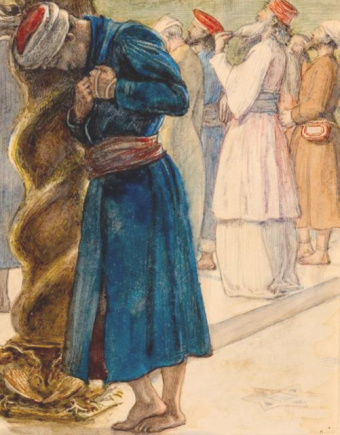
The tax collector (publican), with his head bowed down while he beat his chest, prayed the following to God.
"God, be merciful to me, a sinner (Greek hamartolos)." (Luke 18:13).
The Greek word (Strong's Concordance #G268) translated as "sinner" in Luke 18:13 means someone who is especially sinful or wicked. The tax collector claimed no righteousness of his own. He knew he was a sinner who needed to depend entirely on God's help, mercy and forgiveness.
The Lesson
The Pharisee of this parable vainly boasted he was not like others when, in fact, he was! His severe lack of humility led to despising all others and to God considering him anything but righteous. The tax collector's willingness to humble himself, however, made all the difference. It is the reason why he was justified before God and the Pharisee was not.
The lesson of the parable is that we all need to humble ourselves before our Creator like the tax collector. We have no right to boast, like the Pharisee, that we are better than anyone else. Jesus, in the last verse of this parable, reveals how God will handle those who are vain or humble.
"For everyone who exalts himself (like the Pharisee) shall be humbled; and the one who humbles himself shall be exalted." (Luke 18:14).