Number 3120 and Pentecost
Who were the first 3,120 people God converted on Pentecost in 30 A.D.? How were some of them put to work shortly after they became Christians? From what areas of the world did Jews travel from so that they could keep God's Holy Day in Jerusalem?
First of the First
It was at 9 a.m. (Acts 2:15) on May 28 in 30 A.D., the Day of Pentecost, that God gave his spirit first to 120 believers gathered in Jerusalem (verses 1 - 4). This assembly included the apostles, Jesus' mother Mary and her sons and daughters, Mary Magdalene, the gospel writer Mark as well as others. It would be this first group of Christians who would play a pivotal role in expanding the church to 3,120 members before the day ended!
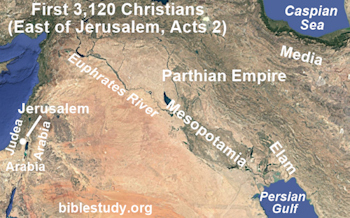
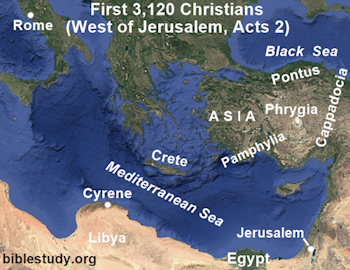
Those who witnessed the miracle of God's spirit resting as a fire above each of the 120 in attendance were astonished. They became further amazed when they heard praises to God in the language in which they were born! People from at least fifteen areas of the world had journeyed to Jerusalem to keep Pentecost.
". . . Parthians and Medes and Elamites, and those who inhabit Mesopotamia, and Judea and Cappadocia, Pontus and Asia,
"Both Phrygia and Pamphylia, Egypt and the parts of Libya which are near Cyrene, and the Romans who are sojourning here, both Jews and proselytes, Cretes and Arabians; we hear them speaking in our own languages the great things of God." (Acts 2:9 - 11).
Putting Them to Work
Peter's testimony about Jesus (Acts 2:14 - 36) struck the consciences of those who heard his words. His call for repentance and baptism, followed by receiving God's spirit, motivated the crowd to action. 3,000 people were baptized before sunset by the 120 people who themselves became Christians earlier in the day. Thus the New Testament Church of God started its existence with 3,120 believers with many more to come!
Where Were They From?
Where did the first Christians, grouped into fifteen distinct areas, come from?
Parthians
Parthia, specifically the Parthian Empire, became a world power in 247 B.C. At its peak it stretched from the northern parts of the Euphrates River down to the Persian Gulf and the Arabian Sea. The Euphrates was its western boundary with the mighty Roman Empire.
It is no surprise that Jews from Parthia traveled to Jerusalem to keep Pentecost. It was, after all, Parthian priests or Magi who made the long journey to worship Jesus shortly after his birth (Matthew 2). In 30 A.D., when the conversion of 3,120 to Christianity took place, Parthia was at peace with Rome.
Medes
The Medes, or Media, were a group of people living primary south of the Caspian Sea. They were conquered and absorbed into the Persian Empire in 550 B.C. After Persia fell in 330 B.C. the Medes were again conquered and this time controlled by the Parthians around 148 B.C. In 30 A.D. they were still were dominated by the Parthians.
Elamites
The Elamites lived near the lower course of the Tigris River. The Medes (Media) were to its north, the Parthians to its east, and those living in Mesopotamia to its west.
Chedorlaomer, the king of Elam, led the first battle recorded in the Bible (Genesis 14). His coalition of three other monarchs carved out a path of destruction on the peoples living near what is known as the King's Highway. Their bloody attacks and plundering were ultimately stopped by a small force of men led by Abraham.
Mesopotamia
Mesopotamia is the entire region between the Euphrates and Tigris rivers going as far south as the Persian Gulf. It composed the eastern part of the Fertile Crescent, a crescent-shaped region where the first civilizations flourished and where the Assyrian and Babylonian empires took root.
It was in Mesopotamia that Abraham grew up and where, many years later, both the Israelites and the Jews were taken into captivity.
Judea
The province of Judea was established by the Romans in 6 A.D. In 30 A.D. it was composed of Galilee, Samaria, Judea, Perea and parts of Idumea (Edom). The first 120 of the 3,120 Christians converted on Pentecost lived in Judea. The province was governed by the prefect Pontius Pilate who held this responsibility from 26 to 36 A.D.
Cappadocia
Cappadocia, set up as a Roman province in 17 A.D., was the easternmost territory controlled by Rome. Its eastern boundary was the Euphrates River, which separated it from the Parthian Empire, and its northern boundary was the Black Sea.
Pontus
The territory of Bithynia was combined with part of Pontus to form Bithynia-Pontus in 64 B.C. Its northern boundary was the Black Sea with its southern boundary shared by the provinces of Asia, Galatia and Cappadocia.
Asia
The Roman province of Asia was created around 133 B.C. Its eastern boundary was Galatia while its western boundary was the Aegean Sea. It was home to many places referenced in the New Testament including the famous seven churches of Revelation (Ephesus, Smyrna, Pergamos, Thyatira, Sardis, Philadelphia and Laodicea).
Phrygia
Phrygia was a region the stratalled part of the eastern part of Asia (Asian Phrygia) and the western part of Galatia (Galatian Phrygia).
Pamphylia
Pamphylia, also called Lycia-Pamphylia, was a province that hugged the Mediterranean Sea as its southern boundary. Its northern boundary was shared by Asia and Galatia while in the east it shared a border with Cilicia. The Apostle Paul traveled through the province during his first, third and fourth missionary journeys.
Egypt
Egypt, in 30 A.D., was an imperial province of the Roman Empire. Its northern border was the Mediterranean Sea. On the east it bordered the province of Judea and the Gulf of Suez.
Parts of Libya Near Cyrene
Libya, among the Greeks, was the name given to Africa (excluding Egypt). The city of Cyrene, referenced in Acts 2, was in the northern part of Africa on the coast of the Mediterranean Sea.
Romans
The King James translation says, "strangers of Rome, Jews and proselytes" for Acts 2:10. This verse is referencing Jews, and those Gentiles newly converted to Judaism, who lived in Rome but who traveled to Jerusalem for Pentecost. Those who traveled from Rome to Jerusalem journeyed more than 1,400 miles (2,253 kilometers) in order to keep God's Holy Day.
Cretes
Cretes were natives of the Mediterranean island of Crete. The island itself is found northeast of Cyrene.
Arabians
In the New Testament, Arabians were nomads who lived either south of Judea or east of the Jordan River as far north as near Damascus.
A Great Number Scattered
The early New Testament church of 3,120, started on Pentecost in 30 A.D., stayed together in Jerusalem for roughly two years. When persecution came in 32 A.D. (Acts 8) the majority of believers fled to Judea, Samaria and ultimately back home.
The 3,120 believers, even though they had tasted some persecution, continued to spread the gospel wherever they went. They preached repentance and God's kingdom to those not only in their hometowns but also to those they passed in their travels.
Now those who had been scattered by the persecution that arose concerning Stephen went through Phoenicia and Cyprus and Antioch, speaking the word to no one except Jews only.
But certain men among them who were Cypriots and Cyrenians came to Antioch and spoke to the Greeks, preaching the gospel of the Lord Jesus. And the hand of the Lord was with them . . . (Acts 11:19 - 21).