Luke 19 to 24 Outline
Chpt. 19: Jesus and the disciples journey to Jericho on their ultimate way to Bethany and Jerusalem (Luke 19:1). They enter the city around late March of 30 A.D. which is less than two weeks before the Lord's arrest and crucifixion.
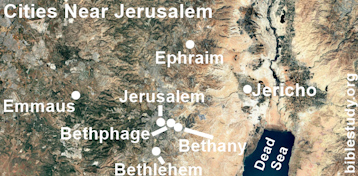
In Jericho the Lord runs into a wealthy and corrupt tax collector named Zaccheus. His encounter with Christ motivates him to repent and dedicate his life to doing good (Luke 19:1 - 10). After leaving the city Jesus gives the parable of the nobleman to dispel the belief that he would soon inaugurate the Kingdom of God on earth (v. 11 - 27).
Jesus and the disciples continue their travels and arrive at Bethany. They then journey to Bethphage where the Lord mounts a colt for his triumphal entry into Jerusalem (Luke 19:28 - 44). He begins to cry, however, on his approach to Jerusalem as he knows its complete destruction is coming (v. 41 - 44).
On Friday March 31 the Lord tosses out the money changers and dove sellers from the temple. Money changers, who exchanged currency for the Temple's coinage, were notorious for being corrupt (Luke 19:45 - 48).

Chpt. 20: Luke 20 begins with Jesus, while teaching in the temple, being asked by certain religious leaders what was the authority behind his ministry. The Lord refuses to answer their question since they refused to answer what was the authority behind John the Baptist's ministry (Luke 20:1 - 8).
Jesus then gives the parable of the vineyard (Luke 20:9 - 18) which is a subtle rebuke of the Jewish religious leaders.
The final assault to entrap Jesus in his words begins in Luke 20:21. After falsely flattering him some men ask whether it is lawful to pay taxes to Caesar or not. The Lord's response was to wisely have his accusers involved in the answer to their own question (v. 24 - 25)!
The Sadducees, who did not believe in the resurrection of the dead, then try to tempt Jesus with a question about the resurrection! His response surprises the leaders to such an extent that they no longer try to entrap him in his words (Luke 20:27 - 40).
[How is the Lord David's God and Son?]
Luke 20 begins it close with Jesus, using Psalm 110:1, offering religious leaders a paradox that left them baffled and speechless (v. 41 - 44). The chapter ends with a warning to beware of the scribes who like to appear righteous but are instead hypocrites (v. 45 - 47)!
Chpt. 21: Luke 21 starts with Jesus and the disciples at Jerusalem's temple. The Lord, after seeing a poor widow donate two low value coins to the temple, says she gave far more than the rich who give out of their abundance (Luke 21:1 - 4).
Jesus, after his disciples comment about the grandeur and beauty of the temple, launches into a long series of prophecies (Luke 21:8 - 36). Known as the Mount Olivet prophecies, they warn of end time violence coupled with earthquakes, famines and signs in the heavens. They also warn of the persecution of Christians, the destruction of Jerusalem and the widespread fear that will grip the world.
[Timeline of Man's Last Days!]
[The Greatest Famines in the Bible]
Jesus closes his discourse in Luke 21 by revealing his return to earth and warning his disciples they must be prepared for when he comes back (v. 27 - 36).
Chpt. 22: Luke 22 begins by revealing that the annual Feast day of Passover was fast approaching (v. 1). This day, in the year Jesus was crucified (30 A.D.), began at sunset on Tuesday April 4 and was observed until sunset the next day. At sunset on Wednesday began the seven-day Feast of Unleavened Bread.
Judas, on Monday April 3, promises to betray Christ for thirty pieces of silver (Luke 22:2 - 6). On the day part of Tuesday the disciples prepare for what will become Jesus' last Passover (v. 7 - 13).
The last Passover takes place after sunset on April 4. During its celebration Jesus institutes the simple symbols of unleavened bread and wine to commemorate his sacrifice that makes the New Covenant possible (Luke 22:14 - 20). He then reveals that the one to betray him is one of his disciples (v. 21 - 22).
[Guidelines for the Christian Passover]
After teaching the proper attitude of Christians toward serving (Luke 22:23 - 27), Jesus reveals that Satan the devil has asked God to "sift as wheat" all the disciples (v. 31 - 32). Peter's impulsive declaration that he would die for Christ will ultimately lead to him denying the Lord three times (v. 33 - 34).
[Why is the Devil Still Alive?]
Jesus and his disciples (minus Judas), after the Passover service is completed, travel to the nearby Mount of Olives to await his arrest (Luke 22:39).

Arriving at Gethsemane, located at the foot of Mount Olivet, Jesus prays not to drink of the cup of God's wrath against sin (Luke 22:40 - 46). Shortly after midnight Judas and a large contingent of men arrive in the garden to arrest the Lord. In the short melee that ensues the ear of a servant is cut off then miraculously healed (v. 47 - 51).
Jesus is arrested and taken to the High Priest's house for his first trial. It is at this trial that Peter denies him three times (Luke 22:54 - 62) and the Lord is both mocked and beaten (v. 63 - 65). He is then escorted for a second trial in front of the entire Sanhedrin. It is at this second trial that he is officially charged with blasphemy (v. 66 - 71).
[Why Were Jesus' Two Trials Illegal?]
Chpt. 23: Luke 23 opens with Jesus being sent to Pontius Pilate (v. 1). Pilate questions him then sends him to Herod Antipas (v. 2 - 7). Herod, unable to get the Lord to perform miracles on demand, sends him back to Pilate (v. 8 - 12).
[The Conspiracies Against Jesus!]
Pilate declares to the religious leaders that he finds Jesus innocent of the charges against him. That said, due to the pressure he receives to have him executed, he leaves the ultimate decision of guilt or innocence up to the public. The Jewish religious leaders coach the public to cry out for Jesus' death. Pilate then reluctantly agrees to free a known criminal but have the Lord crucified (Luke 23:13 - 25).
On his way to Golgotha (the Place of the Skull) the Lord encourages weeping women to cry for themselves due to the coming trials upon Jerusalem (Luke 23:26 - 31). As Jesus is being crucified he prays for those killing him as lots are cast for his clothes (v. 32 - 34). He is then mocked by those watching him including those who are also being crucified (v. 35 - 43).
Jesus' last three hours of life are between noon and 3 p.m. on Wednesday April 5 when darkness covers the land. Near the end of this period the veil in Jerusalem's temple is miraculously split in two. At 3 p.m. the Lord dies and commends his spirit to God the Father (Luke 23:44 - 46).
Joseph of Arimathea requests Jesus' body from Pilate (Luke 23:50 - 52). He then takes it and, with Nicodemus (see John 19:39), hurriedly wraps it in spices and places it in his own newly made tomb. Their efforts are finished just before sunset when no work is allowed on the first day of unleavened bread (Luke 23:53 - 54).
Some of the Lord's female disciples, after they see where his body is laid, also prepare spices for it but then stop all work at sunset (Luke 23:55 - 56).
Chpt. 24: The first verse of Luke 24 reveals that, early on Sunday April 9 (the Wave Sheaf day), women come to Jesus' tomb. They find it open, and his body gone, as the Lord had been resurrected the previous day at sunset in fulfillment of prophecy (Luke 24:1 - 3). Two angels then appear and confirm the Lord has already been brought back to life (v. 4 - 8).
[Did Jesus Delay His Ascension?]
Peter and John (see John 20:3 - 8), after being told by the women that Jesus' body was not in his tomb, race to where it is located. They find, upon arriving, that it was indeed empty (Luke 24:9 - 12). Later the same day two men who knew of Jesus' missing body are traveling to Emmaus (v. 13). The Lord, whose identity is hidden from them, then appears and begins to talk with them.
The men, as they go further toward Emmaus, are told why it was necessary for the Messiah to suffer, die, and enter his glory (v. 25 - 27). Reaching the city, as all three men eat, Jesus reveals who he is and then disappears (v. 28 - 32)!
The two men who had been in Emmaus rush back to Jerusalem to tell the disciples what took place. The Lord, as the two men are speaking to the disciples, then miraculously appears in the room they are all in (Luke 24:33 - 36)!
Jesus shows his disciples (minus Thomas) the wounds he incurred while being crucified. He then requests something to eat and opens their minds to understanding the prophecies concerning himself (Luke 24:37 - 48).
[Is the Holy Spirit Power or a Person?]
As Luke 24 closes there is a gap of time between verse 48 and verses 49 to 53. Verse 48 was spoken on the day the Lord first appeared alive to his disciples (April 9). Verses 49 to 53, however, take place on the day Jesus ascended to heaven (May 18, see Acts 1). He charges them to wait in Jerusalem until (on Pentecost) they receive the power of God's Holy Spirit. The disciples then return to the city with joy and await God's power (v. 52 - 53).
Luke 1 to 6 Outline - 7 to 12 Outline
13 to 18 Outline - Luke 1 to 5 Questions
6 to 10 Qs - 11 to 15 Qs - 16 to 20 Qs
21 to 24 Qs - Facts Part 1 - Part 2