Luke 16
1. What does the parable of the unjust steward teach? (v. 1 - 9) Answer
2. Is it possible to pursue worldly wealth as well as serving God? (v. 13) Answer
3. What is the meaning of Luke 16:17? Answer
4. What is the underlying meaning of the rich man and Lazarus parable? (v.19 - 31) Answer
Luke 17
5. Who are the "little ones" of Luke 17:2? Answer
6. Is Jesus teaching that Christians can never be profitable to God? (v. 7 - 10) Answer
7. What was unique about one of the ten men Jesus healed? (v. 11 - 19) Answer
8. Does Luke 17:21 teach God's Kingdom is within each person? Answer
9. What is the end time prophetic warning of Luke 17:26 - 37? Answer
Luke 18
10. What does God want in regard to prayer? (v. 1 - 8) Answer
11. Why was the Pharisee condemned and not the tax collector? (v. 9 - 14) Answer
12. What traits necessary for God's kingdom are discussed in verses 16 - 17? Answer
13. Why did Jesus say he was not good? (v. 19) Answer
14. What is the basic meaning of the parable in verses 24 to 27? Answer
15. What does verse 34 say about the disciples' understanding of Jesus' sacrifice? Answer
Luke 19
16. How did Zaccheus gain his wealth? (v. 2) Answer
17. Why did Jesus give the parable of the nobleman? (v. 11 - 27) Answer
18. What does Jesus expect of those who follow him? (v. 13, 15 - 19) Answer
19. What was Jesus doing in Bethany? (v. 29) Answer
20. How far is it from Bethphage to Jerusalem? (v. 28 - 29) Answer
21. What prophecy in Luke 19:30 - 36 was fulfilled by Jesus using a colt? Answer
22. What verse were people quoting in their praise of Jesus? (v. 37 - 38) Answer
23. What is unique about Luke 19:39? Answer
24. Why did Jesus cry when he first saw Jerusalem? (v. 41) Answer
25. When did Jesus throw the moneychangers out of the temple? (45 - 46) Answer
Luke 20
26. How did Jesus respond to a blunt question asked of him by religious leaders? (v. 1 - 8) Answer
27. What is the basic meaning of the parable of the vineyard? (v. 9 - 18) Answer
28. Which Bible verse is quoted in Luke 20:17 - 18? Answer
29. What is profoundly contradictory about what religious leaders said to Jesus in verse 21? Answer
30. What was devilishly subtle about the question posed to Jesus in verse 22? Answer
31. What was dishonest about the question Jesus was asked in verses 28 to 33? Answer
32. What was the outcome of the Pharisees, Sadducees, scribes, chief priests and elders attempts to entrap Jesus (Luke 20)? Answer
33. How could Christ be both David's Lord and his descendant? (v. 41 - 44) Answer
Luke 16 Answers
1. Stewards were given extensive authority over the affairs of those who hired them. Their responsibilities were primarily to manage the bosses' employees, keep track of and collect debts owed to him and generally enhance his wealth.
In Jesus' parable of Luke 16:1 - 9 a wealthy man discovers his steward is incompetent and wasting his resources (verse 1). He demands a status of his property and an accounting of his finances after which the steward will be fired. The steward, in response, decides to ingratiate himself with his boss' debtors by lowering what they legitimately owe him (verses 5 - 7).
The wealthy man, after discovering what the steward did, commended him for his crafty dishonesty to make friends (Luke 16:8).
Jesus gave the unjust steward parable to illustrate the principle that we should strive to wisely use our material wealth (honestly, of course) to gain spiritual benefits. Please see our article on this Luke 16 parable for more information.
2. Jesus makes it crystal clear in Luke 16:13 that humans cannot dedicate themselves to both the Kingdom of God (eternal wealth) and the pursuit of money (temporary wealth). Those who wish to follow and obey Jesus must strive with their whole being to enter God's kingdom (Luke 13:24).
[Wealth in King David's Tomb!]
3. Jesus, in Luke 16:17, reveals that God's laws (which many people think no longer apply) continue to be in effect! His statement that it would be easier for heaven and earth to pass away definitively proves they were still active AFTER his death.
[What Did Apostle Paul
Teach about God's Law?]
4. Prior to Jesus' parable in Luke 16:19 - 31 he taught that a person cannot be a lover of money and a lover of God.
No servant is able to serve two masters; for either he will hate the one, and he will love the other; or he will hold to the one and will despise the other. You cannot serve God and mammon (money) (Luke 16:13, HBFV).
The Pharisees, who loved money, heard Jesus' teaching and openly ridiculed him for it (Luke 16:14). It is in this context that the Lord gave the rich man and Lazarus parable in response to the criticism he received.
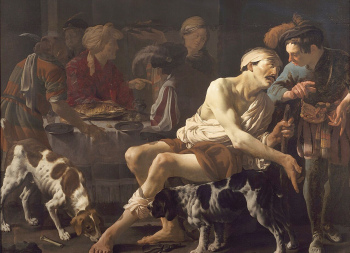
The underlying lesson of the parable, directed at the Pharisees, is that since they did not believe and follow what Moses and the prophets wrote, no miracles would be able to change their minds and alter how they lived. It was the hardness of their hearts that kept them from repenting and serving God.
Please see our article discussing, in-depth, the parable of the rich man and Lazarus for more information.
Luke 17 Answers
5. The phrase "little ones" in Luke 17:2 does not refer to children per se but to new believers who are like children. Jesus was warning his disciples to be sensitive to those new in the faith and not do anything that could cause them spiritual harm or lead them to sin.
[Best Bible Verses About Children]
6. It is first important to note that the servant in Jesus' example (Luke 17:7 - 10) is only fulfilling the basic responsibilities of his position. Since he is doing only what his master commanded him, he doesn't earn any praise or reward from him.
Some Biblical commentaries interpret Luke 17:7 - 10 as Jesus teaching that everything a Christian does in their service to God is their duty. This means that a believer can never, no matter what, be profitable to God or earn his praise. This understanding is not entirely true!
There are two major events that will take place when Jesus, at his Second Coming, carries out the first resurrection of the dead.
Part 1 - All those in the first resurrection are those who repented of their sins and lived a life of obedienace and overcoming until their death. They will all be given the gift of eternal life in a new spiritual body. This is akin to the servant doing only what he is told. Eternal salvation is a gift, which no human can earn, made possible by Jesus' life, suffering, death and resurrection.
Part 2 - God, up and above the gift of eternal life, will reward individuals based on what they produced (their fruit) with the natural talents, spiritual gifts and other resources at their disposal (their "treasure in heaven," see Matthew 6:19 - 21, 19:21).
[What Are the Gifts of God's Spirit?]
The parables of the talents (Matthew 25:14 - 30) and the pounds (Luke 19:12 - 26) reveals that believers CAN earn praise or a reward from God based on what they do! They can be profitable to their Maker!
And his lord said to him, 'Well done, good and faithful servant! Because you were faithful over a few things, I will set you over many things. Enter into the joy of your lord.' (Matthew 25:21).
Then he said to him, 'Well done, good servant; because you were faithful in a very little, you shall have authority over ten cities.' (Luke 19:17).
7. In Luke 17:11 - 19 Jesus met ten men who begged to be healed of their leprosy. The men, after being told to show themselves to the priests, are then healed as they traveled away from the Lord. Only one of the ten men (the others being Jews), a Samaritan whom the religious Jews hated, had enough gratitude to come back and praise God at Jesus' feet!
[Why Did Jews Hate Samaritans?]
8. Luke 7:21, in the King James Bible, suffers from a bad translation.
"Neither shall they say, Lo here! or, lo there! for, behold, the kingdom of God is within you." (Luke 7:21, KJV).
[Is God's Kingdom in Each Person?]
Jesus was NOT telling the self-righteous Pharisees he was addressing that they somehow had God's kingdom within them. A more correct translation of the verse in question is the following.
"Neither shall they say, 'Behold, it is here!' Or, 'Behold, it is there!' For behold, the kingdom of God is standing in the midst of you." (Luke 7:21, HBFV).
Jesus, as the King of Kings and Lord of Lords, represented God's Kingdom as he stood among the Jewish religious leaders.
9. Luke 17:26 - 37 is Jesus' warning about how his Second Coming will come as a complete shock to most people!
[Timeline of Man's Last Days!]
Those living on earth just before Jesus' return will be carrying on their lives as normal just like those before the flood and before Sodom was destroyed! They will also be so occupied in pursuing their carnal, sinful desires that they will be oblivious to the judgment that will come upon them.
[How Violent Was It before the Flood?]
The key teaching in this entire passage is summed up in Luke 17:33.
Whoever shall seek to save his life shall lose it; and whoever shall lose his life shall preserve it (Luke 17:33).
Luke 18 Answers
10. God wants believers to not only pray, but to do so consistently and with a heart that is willing to be patient, persistent and bold. The parable in Luke 18:1 - 8 teaches that persistence in a righteous request can achieve outcomes that would not be achieved otherwise.
[The Three Answers to Prayer!]
[What Are the Best Places to Pray?]
Christians ought always to pray and never lose hope. Sometimes God delays responding to someone's prayer just to see if they are diligent enough to keep asking.
11. Jesus targeted his parable of the Pharisee and the tax collector (Luke 18:9 - 14) toward a certain group of people.
And to some who trusted in themselves that they were righteous, and despised others, He also spoke this parable (Luke 18:9).
The Pharisee of the parable was not chastised for lying about how often he fasted or being meticulous in tithing. He was only partially right, however, about not being an extortioner or adultery. While he, at the time he spoke, may have not done these things, his boast implies that he thought he would never commit such sins!
The Pharisee vainly boasted he was not like other men (Luke 18:11). This meant he felt he had reached a state of righteous character that was beyond temptation. His declaration was self-refuting, however, as it clearly lacked the important trait of humility required of those in God's kingdom (see Matthew 5:3)!
Every human, regardless of their character, is always susceptible to the pulls and temptations of human nature which can lead them to sin.
The tax collector of the parable, however, knew he was sinner who needed God's mercy and forgiveness (Luke 18:13). His willingness to humble himself before his Creator made all the difference. The ultimate lesson of the parable is found in Luke 18.
"For everyone who exalts himself shall be humbled; and the one who humbles himself shall be exalted." (Luke 18:14).
12. In Luke 18:16 - 17 Jesus states those worthy to enter the Kingdom of God must have the traits of a child. What are these traits?
Children understand, at a basic level, that they must depend completely on others for all their needs. They also generally do not have an inflated view of themselves or think they are superior to all others.
[How Does God Save the Children?]
Believers must, like children, be humble and willing to accept entrance into God's kingdom as a gift they could never earn. They must not think of themselves better than others.
Children also possess the trait of simple and honest faith, believing what they are told as the truth. Those given entrance into eternity must have complete faith in God and trust in his perfect love.
13. Jesus, at the time he made his statement in Luke 18:19, was God in the flesh (John 1:1 - 5, 10 - 14). This means, though he had God's spirit without measure, he also had the same human nature as all humans. As long as he had human nature he was susceptible to its pulls and temptations to sin.
Jesus, as a human, was not 100% guaranteed to not sin but had to constantly fight temptation to become our faithful high priest in heaven (Hebrews 5).
God the Father, however, was perfectly good when Jesus made his statement (Luke 18:19). This state was (and is) made possible because his character is sealed to always act righteously. The Father, as a Spirit, is not tempted by evil which makes it impossible for him to sin (see James 1:13, Hebrews 6:17 - 18, 1John 1:5).
It should be noted that after Jesus was resurrected from the dead he was given back the same spiritual existence and sealed perfection as the Father.
14. There are a few possible explanations for what Jesus meant by his analogy using a camel (Luke 18:24 - 27). The most likely explanation is that Jesus was simply using a commonly used saying to underscore the spiritual situation of those who are rich.
[Camel Through Eye of Needle Meaning]
The basic teaching of the parable is that it is as difficult for the wealthy to do what it takes to be saved as it is for a camel to pass through a small needle opening.
Note that this parable from Jesus says it is difficult, but not impossible, for a rich man to enter God's Kingdom. If it were impossible, then wealthy men like Abraham (Genesis 13:2), Isaac (Genesis 26:12 - 14), Jacob (Genesis 30:43) and others would be shut out of eternal life.
15. Luke 18:34 offers the following observation after Jesus told his disciples he would be mocked, scourged, killed and then resurrected three days later.
But they understood none of these things, and this saying was hidden from them, and they did not comprehend what was said (Luke 18:34).
[What Was the Purpose of Jesus' Life?]
Jesus' statement in Luke 18:31 - 33 was given in early 30 A.D. after the group left the city of Ephraim (John 11:54). It was offered less than three months before his crucifixion. Even after being with the Lord every day for about three years, the disciples still lacked a basic understanding of the prophecies concerning him.
The clueless nature of the disciples is understandable, however, as they only had the Holy Spirit WITH them, but not IN them (John 14:17). They would later understand fully what took place and why.
Luke 19 Answers
16. Tax collectors like Zaccheus (Luke 19:2) were considered some of the worst sinners for reasons that are understandable.
Tax collectors were viewed as traitors of Israel since they actively aided the hated Romans in their rule over the people. The method used by them to gain wealth, however, made them particular targets of the people's wrath.
[Herod the Great's Kingdom Map]
It was common at the time for a person to bid for the office of tax collector. Their bid was the amount in taxes they would pay, in advance, the Roman authority for the area in which they wanted to collect money. If their bid was accepted then any amount they collected would be theirs to keep. This practice, along with the usual extortion and theft that went with the profession (Luke 3:12 - 13, 19:7 - 8), meant that many tax collectors were quite wealthy!
In Zaccheus' case, it was known that he was not only rich (Luke 19:2) but also that, based on what he promised Jesus, he had gotten it through sinful means.
[Poverty and the Poor in Proverbs]
"Behold, the half of my possessions, Lord, I give to the poor; and if I have taken anything from anyone by false accusation, I return fourfold." (Luke 19:8).
17. Jesus tells us exactly why he gave the parable of the nobleman in Luke 19:11 - 27.
Now as they were listening to these things, He went on to speak a parable, because He was near Jerusalem, and they thought that the kingdom of God was going to appear immediately (Luke 19:11).
The people of Jericho, like his disciples, thought that Jesus would soon restore the kingdom to Israel and kick out the hated Romans. The parable he gave, with the nobleman symbolizing himself, was meant to convey he would have to go away and come back later before assuming rulership over the earth.
18. Jesus, in his parable of Luke 19:13 - 27, makes clear that he expects a return on his investment of resources he gives each person. These resources are natural gifts a person is born with, the spiritual gifts God gives them (see 1Corinthians 12, Ephesians 4 and Romans 12), and other resources such as time and money.
[Meaning of Parable of the Talents]
The Lord will reward everyone in a fair and equitable way. They will be judged based on what they produced with the resources at their disposal.
19. Jesus traveled from Jericho to Bethany, a trip of roughly 17 miles (27.3 kilometers), to visit his friend Lazarus at his home (John 12:1 - 2). After arriving in Bethany in the early evening of March 29 (Wednesday) in 30 A.D. he had supper with his friend and his two sisters.
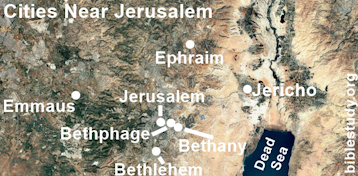
20. Jesus, on the morning after arriving in Bethany, travels to Bethphage which is located near the eastern side of the Mount of Olives. The small village of Bethphage was roughly a Sabbath day's journey (.56 miles or .91 kilometers) away from Jerusalem.
21. Jesus' journey into Jerusalem (Luke 19:30 - 36) fulfilled the prophecy given by the Minor Prophet Zechariah.
[Timeline of the Minor Prophets]
Rejoice greatly, O daughter of Zion; shout, O daughter of Jerusalem; behold, your King comes to you. He is triumphant and victorious, yet meek and riding on a donkey, even on a colt, the foal of a donkey (Zechariah 9:9, HBFV).
22. The praise of the people as Jesus entered Jerusalem, found in Luke 19:37 - 38, was taken from Psalm 118.
[Ministry of Jesus Prophecies!]
Blessed is he who comes in the name of the Lord; we have blessed You out of the house of the Lord (Psalm 118:26, HBFV).
23. Luke 19:39 is the last time Luke mentions the Pharisees in his gospel.
24. Jesus' tears come from the sadness of knowing that the people's rejection of God and his ministry would lead to Jerusalem's utter destruction (Luke 19:42 - 44, see also 13:34 - 35). This destruction would take place forty years later, in 70 A.D., when the Romans burn and level both the city and its glorious temple.
[Attacks on Jerusalem Timeline!]
25. It was on Friday March 31 in 30 A.D. that Jesus threw the moneychangers and other crooks out of the temple just like he had done at the start of his ministry. Five days after this event, on April 5, Jesus is crucified and dies.
Luke 20 Answers
26. Jesus, in Luke 20:2, is asked a rather pointed question by Jewish religious leaders.
"Tell us by what authority You do these things (proclaiming the gospel, cleansing the temple, etc.), and who gave You this authority?" (Luke 20:2).
Jesus wisely refused to answer the above question. He made his response conditional on the leaders first answering a simple and straightforward question.
[Jesus Confronts the Jews Timeline]
[The Conspiracy Against Jesus!]
"The baptism of John, was it from heaven or from men?" (Luke 20:4).
Jesus' question laid bare the political and duplicitous nature of the leaders.
The leaders reasoned that if they said John the Baptist was sent by God they then will be asked why they rejected him (Luke 20:5). If they said John's authority did not come from God they feared reprisals from the people (verse 6). Even though they were the religious authorities of the Jews, their most important goal was not the truth. Their chief concern was keeping their power and positions at all costs!
Since the Jews refused to answer Jesus' question he refused to answer theirs (Luke 20:7 - 8).
27. Jesus' parable of the vineyard (Luke 20:9 - 18) comes right on the heels of his subtle rebuke of Jewish religious leaders (verses 7 - 8). It also comes just a few days before his arrest and crucifixion.
Jesus' parable, which the religious leaders knew was a criticism against them (Luke 20:19), centers around the owner of a vineyard (symbolizing God the Father). The owner sends three servants to gain fruit from his vineyard that is tended by tenant farmers (verses 10 - 12). The farmers, however, beat up all three of the servants.
The owner then decides to send his Son (symbolizing Jesus) in the hope they will respect his authority. The farmers decide to kill the Son in the foolish hope his death will give them complete and unchallenged control of the vineyard (Luke 20:13 - 15). The owner's response to the murder of his son was to kill the sinful farmers and lease his land to others (verse 16).
The parable symbolizes God's rejection of the Jewish religious leaders and his establishment of a new authority (the New Testament church) composed of non-Jews or Jews who became Christians.
28. Jesus, in Luke 20:17 - 18, mainly quotes from the Psalms.
The Stone which the builders rejected has become the Head Stone of the corner. This is the Lord's doing; it is marvelous in our eyes (Psalm 118:22 - 23).
29. The Jewish leaders had experienced many failed attempts to catch Jesus, during his ministry, in saying or doing something they could use against him. The confrontations of Luke 20, which took place on the Sunday before his Wednesday crucifixion, were their last and best attempts to entrap him.
The final attempts of Jewish leaders to find fault with Christ began by flattering him in the hope they could throw him off guard.
[Encouragement versus Flattery]
"Master, we realize that You speak and teach rightly, and do not accept any man's person, but teach the way of God in truth." (Luke 20:21).
If the Jews honestly believed what they said in Luke 20:21 then why did they actively seek to have Jesus condemned (verse 20)? If they really thought he taught God's truth then why did they question his authority in the first place (verse 2)?
Jesus knew the leaders were speaking empty words that they did not believe so that they could trick him into verbally condemning himself.
30. The Jews, in Luke 20:22, thought they finally had backed Jesus into a corner with a trick question. They came up with a seemingly sincere "yes or no" question they felt they could use to condemn Christ no matter how he answered.
"Is it lawful for us to give tribute to Caesar, or not?" (Luke 20:22).
If Jesus answered "yes," that taxes should be paid to the Romans, he would incur the wrath of the Jews including the Zealots. If the average Jew turned against Christ then it would be much easier for Jewish leaders to arrest him without suffering any political blowback. If the Lord answered "no" then the Jewish leaders could accuse him before the Romans of rebelling against Caesar and Rome's authority.
[How Big Was Rome's
Empire in New Testament?]
Jesus response was to wisely have his accusers involved in the answer to their own question (Luke 20:24 - 25)!
31. The Sadducees, surprisingly, did not believe in or teach the resurrection of the dead (Mark 12:18 - 27, Acts 23:6 - 8). It therefore made no sense to question Jesus about something which they thought would never occur (Luke 20:28 - 33)! Their question was both ironic and openly dishonest, barely (if not at all) masking the fact they were fishing for reasons to condemn him.
[What Made the Pharisees
and Sadducees Unique?]
32. The religious leaders, after failing miserably in their final attempts to condemn Jesus, simply gave up using any more verbal entrapment schemes.
And after that they did not dare to ask Him any more questions (Luke 20:40)!
33. Jesus, after the religious leaders gave up on tempting him (Luke 20), asked them a question that left them baffled and speechless! It centers around a quote from Psalm 110:1.
[How Is the Lord both
David's God and Son?]
[What Were the Paradoxes of Jesus?]
"Why do they say that the Christ is the Son of David? Even David himself says in the book of Psalms, 'The Lord said to my Lord, "Sit at My right hand until I make Your enemies a footstool for Your feet." '
"Therefore, since David calls Him Lord, how is He his Son?" (Luke 20:41 - 44, HBFV).
The hated of the leaders of both Jesus and what he taught blinded them to answering the paradox he offered (Luke 20:44). Their refusal to accept he was the prophesied Messiah meant it was impossible for them to even guess at an answer!
[Jesus' Genealogy Through Mary]
The paradox can be explained by the following Biblical facts. Jesus was the God of the Old Testament, the deity in the Godhead who interacted with David and countless others. He was therefore the "my Lord" of Psalm 110.
Jesus was also the member of the Godhead who chose to be miraculously born as a physical descendant of David to save us from our sins. He therefore was both David's Lord and one of his descendants!
Luke 1 to 6 Outline - 7 to 12 Outline
13 to 18 Outline - 19 to 24 Outline
1 to 5 Questions - 6 to 10 Qs - 11 to 15 Qs
21 to 24 Qs - Luke Facts Part 1 - Part 2