Luke 11
1. What Does the Lord's Prayer Mean? (v. 1 - 4) Answer
2. What did Jesus say Christians should diligently pursue? (v. 9 - 10) Answer
3. Who is Beelzebub? (v. 15) Answer
4. What is nonsensical about the criticism Jesus received for casting a demon out of a person? (v. 14 - 22) Answer
5. What amazing bit of information is revealed in Luke 11:18? Answer
6. What is the poignant answer to Jesus' question in verse 19? Answer
7. What would be the only sign given to prove Jesus was the Messiah? (v. 29 - 32) Answer
8. What was Jesus condemning in Luke 11:37 - 44? Answer
9. What is Jesus referencing in verse 51? Answer
10. What does verses 53 to 54 tell us about the view of religious leaders toward Jesus? Answer
Luke 12
11. What was the leaven of the Pharisees? (v. 1 - 3) Answer
12. What does Jesus teach in verse 10? Answer
13. What is the basic meaning of the parable in verses 16 to 21? Answer
14. What great promise is made in Luke 12:22 - 31? Answer
15. What is the great lesson taught in verses 35 to 40? Answer
16. How does Jesus cause division and strife between people? (v. 51 - 53) Answer
Luke 13
17. What false belief is Jesus trying to dispel in verses 1 to 5? Answer
18. What is the meaning of the unproductive fig tree? (v. 6 - 9) Answer
19. Why was the synagogue ruler angry with Jesus for healing a person? (v. 10 - 16) Answer
20. What is the point of the mustard seed parable? (v. 18 - 19) Answer
21. What is the Lord teaching in verses 24 to 27? Answer
22. What is revealed in Luke 13:34 - 35? Answer
Luke 14
23. What didn't the Pharisees answer Jesus' question? (v. 1 - 4) Answer
24. What is the point Jesus is making in verses 12 to 14? Answer
25. What great lesson is taught in Luke 14:16 - 24? Answer
26. What is the meaning of Jesus' warning in verses 26? Answer
27. What does it mean to "carry one's cross?" (v. 27) Answer
28. What is the teaching of verses 34 to 35? Answer
Luke 15
29. What is the basic meaning of the lost sheep parable? (v. 3 - 7) Answer
30. What does verses 8 to 10 tell us about God? Answer
31. What is the basic meaning of the prodigal son parable? (v. 11 - 32) Answer
Luke 11 Answers
1. The Lord's Prayer found in Luke 11 is unique in that it delineates, directly from one member of the Godhead (the Son), how the other member of the Godhead (the Father) should be approached. It is also noteworthy because it was spoken in the middle of a message that, for the first time, more fully revealed the New Covenant (its requirements, blessings, etc.) offered to all humans.
Please see our article on the meaning of the Lord's prayer for more information.
2. Even though God knows what we need before we ask him, he still wants us to communicate what we want through prayer. This creates a bond with him and reminds us he is the Maker and giver of all good things (Luke 11:13).
Prayer can also build character as we are to be diligent, bold and persistent in petitioning him to fulfill what we want.
3. Beelzebub, used in Luke 11:15, is a word which means "dung god" or "lord of the house" (Strong's Concordance #G954). It is used three times each in Matthew and Luke, and once in Mark. It is one of the many names and titles the Bible uses for Satan the devil.
[Different Names for the Devil]
4. Some of those in Luke 11 who saw Jesus cast a demon out of a man accused him, in their hearts, of doing so by the power of Satan! As the Lord pointed out, this kind of reasoning makes no sense whatsoever.
Satan the devil is all about destroying everything God made and ruling the universe in his place so that he can be worshipped. He would be working against his own goals of destruction and domination, and weakening his kingdom, if he freed someone of a fellow demon possessing them.
As a side note, since multiple demons can possess a single person (see Luke 8:30), an evil spirit does not need to leave or be cast out of someone for another to also exist in the same person (Luke 11:24 - 26).
5. Jesus reveals that Satan the devil has a kingdom just like humans who rule over earth-based kingdoms. Those he rules over are called demons. They were at one time righteous angels who, with Lucifer, were sent to earth to fulfill God's will.
Lucifer, through vanity and lust, turned himself into God's adversary. The angels with him, whom he successfully deceived, turned themselves into evil spirits.
[Does the Devil Rule the World?]
How big is the devil's kingdom? Revelation 12:4 reveals one-third of all the angels were deceived by him into rebelling against God. Daniel 7:10 and Revelation 5:11, taken literally, would mean the remaining two-thirds (possibly 100 million or so angels) stayed righteous. This leaves the devil with a spiritual kingdom composed of 50 million demonic spirits.
6. Jesus, in Luke 11:19, asks those who criticized him in their hearts the following question.
And if I by Beelzebub cast out demons, by whom do your sons cast them out? (Luke 11:19, HBFV).
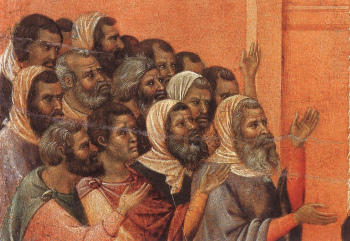
The unspoken answer to the Lord's question in Luke 11 was that the sons of those criticizing him were unable to cast demons out of people! Jesus was pointing out how foolish it was to chastise him for successfully casting out demons when those who found fault (or their sons) had failed to do so themselves (see Acts 19:13 - 16)!
7. The only prophetic sign Jesus gave to prove he was the Messiah was the sign of Jonah. This sign was that he would be dead and unconscious for three complete days (72 hours) before being resurrected from the dead by God. Jesus' statement in Luke 11:29 - 32 was given less than six months before his crucifixion in early April of 30 A.D.
[Was Jesus Dead for Three Full Days?]
8. Jesus, in Luke 11:37 - 44, addresses the Pharisees' obsession with wanting to look righteous in front of others (vanity) instead of focusing their attention on true righteous character. Such purely ritual tasks like washing cups and dishes that were already clean gave the Pharisees reasons to think they were holy when, in fact, their hearts were full of greed, wickedness and pettiness!
9. Jesus is referencing two separate incidents in Luke 11:51. The first is the murder of righteous Abel by Cain (Genesis 4:8). The second incident is the murder of Zechariah the priest toward the end of King Joash's rule over the kingdom of Judah (835 to 796 B.C.).
And the Spirit of God came upon Zechariah the son of Jehoiada the priest, who stood above the people and said to them, "Thus says God, 'Why do you transgress the commandments of the Lord so that you cannot be blessed? Because you have forsaken the Lord, He has also forsaken you.' "
And they conspired against him and stoned him with stones at the command of the king in the court of the house of the Lord (2Chronicles 24:20 - 21).
[Kings of Ancient Israel and Judah]
[Inspired Order of Bible Books]
The originally inspired order of Bible books, completed by Ezra, places 2Chronicles as the last writing of the Old Testament. Abel is the first shedding of innocent blood found in the Old Testament while Zechariah symbolizes its last martyr.
10. Luke 11:53 - 54 shows that Jewish religious leaders were knowingly and actively seeking ways to entrap Jesus. They were looking for anything he said that they could use to accuse him either of sin or of going against the Roman authorities!
[What Was the Conspiracy Against Jesus?]
Luke 12 Answers
11. Jesus warned his disciples, in Luke 12:1 - 3, against the "leaven" of the Pharisees which is hypocrisy.
A hypocrite is someone who pretends, like an actor, to be something they are not. Leavening is the process of using a substance like yeast to add gas to something through fermentation. This gas makes whatever it is in appear bigger than normal.
The "leaven" of the Pharisees is hypocrisy expressed in their unbiblical teachings (ceremonial washing of cups, etc.) used to promote a false (puffed up or leavened) appearance of piety and holy living. The reality, however, is that they have the same carnal attitudes as those who make no claim to following God!
12. Jesus, in Luke 12:10, is teaching about the unpardonable sin. This type of sin is not committed by accident. It is not the same as the sin all humans are susceptible to through temptation, weakness or deception (1Corinthians 10:13).
[What Is the Unpardonable Sin?]
The Holy Spirit is the righteous power the Godhead uses to carry out its will. The person who blasphemes against the Holy Spirit (Luke 12:10), therefore, is someone who deliberately and knowingly rejects the perfect righteousness manifested by God. This sin is unpardonable because the person who commits it has hardened their heart to the point where they will never ask for a pardon (forgiveness).
13. In Luke 12:16 - 21 Jesus gives a parable of a wealthy man whose obsession with material riches motivates him to build bigger storage areas to place his stuff. The main teaching of the parable is found in verse 15.
"Watch out, and keep yourselves from covetousness, for no one’s life is in the abundance of the things that he possesses." (Luke 12:15, HBFV).
The man was a fool because he thought that his riches were all that he needed to insure a long and easy life. God's response, however, to him putting his faith in greed (instead of being rich toward him) was to take his life. The man's wealth could not and did not save him.
14. As humans, it is easy for us to become overly concerned and even worried about providing for our basic needs like food and clothes (Luke 12:22). God's promise for those who whole-heartedly pursue his kingdom is that he will take care of them.
But seek the kingdom of God, and all these things shall be added to you (Luke 12:31).
15. In Luke 12:35 - 40 Jesus teaches that Christians should be ready for his return at any time. Believers need to be diligent in watching and working even if the Lord unexpectedly returns in the second watch (9 p.m. to midnight) or the third (midnight to 3 a.m.).
[What Is the First Resurrection?]
[How Many Resurrections Are There?]
Jesus' teaching applies to all Christians and not just to those who are physically alive at his Second Coming. Jesus "comes" to each believer, upon their death, as their next conscious moment will be meeting him in the first resurrection (1Corinthians 15:51 - 52, 1Thessalonians 4:16 - 17).
16. Jesus spoke Luke 12:51 - 53 to warn that believing in and obeying him comes with consequences. Those who are true Christians should not be surprised if their behavior and beliefs are not only misunderstood but lead to divisions in their families.
Luke 13 Answers
17. The Jews, at the time of Jesus, believed calamities or misfortunes that adversely affected someone were the result of God specially punishing them for some sin.
The belief in the relationship between sin and unfortunate events, delineated in Luke 13, was also strong among Jesus' disciples. This is proven by the fact that, when the Lord passed a man born blind, his disciples thought the man was being punished for some sin he (in the womb?) or his parents committed (see John 9:1 - 3)!
[Was Apostle Paul the Greatest Sinner?]
Jesus used two recent tragic events, in Luke 13, to refute the belief that bad things that happen to people are always (or usually) punishments from God for sin.
"Do you suppose that these Galileans were sinners above all Galileans, because they suffered such things? No, I tell you . . .
"Or those eighteen on whom the tower in Siloam fell, and killed them, do you suppose that these were debtors above all men who dwelt in Jerusalem? No, I tell you . . ." (Luke 13:2 - 5, HBFV).

Jesus taught that time and chance, being in the wrong place at the wrong time, happens to all humans. If a person repents, however, God's grace can (based on his will) spare them from such severe random occurrences as they are under his personal care.
18. Fig trees can take up to three years of growth before they produce their fruit. Jesus used such trees in his parable (Luke 13:6 - 9) to underscore God's expectation that a person's repentance should produce fruit (obedience and good works).
[Why Did Jesus Curse a Fig Tree?]
The necessity of righteous works, and not just repentance and faith, was also taught by James.
My brethren, what good does it do, if anyone says that he has faith, and does not have works? Is faith able to save him? . . . In the same way also, faith, if it does not have works, is dead, by itself (James 2:14, 17).
The man who owned the fig tree in Jesus' parable of Luke 13 planted it for the express purpose of it producing fruit. To him, the tree's lack of fruit after three years meant it was as good as dead to him. This parable should give all Christians pause as to the seriousness God places on producing noticeable fruit in their lives!
19. The synagogue ruler in Luke 13 was angry with Jesus' healing because he performed it on the Sabbath day. Jewish tradition (not God's law!) believed such an act was work that was prohibited on the day. The problem with such a belief is that while the law forbids us to work on the Sabbath, it does not forbid God from doing spiritual work!
[What Were Jesus' Synagogue Miracles?]
The right to spiritually work on the Sabbath was asserted by Jesus in the following astonishing statement. It was given in response to yet another criticism against him for healing on the day of rest.
"My Father is working until now, and I work." (John 5:17).
Jesus, in Luke 13, rightly pointed out the hypocrisy of the ruler's interpretation of Scripture.
The Jews, on the one hand, allowed the work of leading an animal to water on the Sabbath as an act of mercy (which also saved their property!). Yet, on the other hand, they balked at the merciful and miraculous spiritual act Jesus performed to free a woman of a debilitating infirmity!
20. The mustard seed parable of Luke 13:18 - 19 is meant to illustrate one of the characteristics of God's kingdom.
[Meaning of Mustard Seed Parable]
Mustard seeds are some of the smallest in the plant world. Despite its size, however, it can produce huge plants when it matures. God's kingdom is like a mustard seed in that, even though it starts out quite small, it will ultimately grow to fill the earth at Jesus' return!
21. Jesus makes the point, yet again in Luke 13:24 - 27, that being in his presence and believing in him is NOT enough to have a relationship with him!
The goal of God's plan of salvation is to have all humans possess the same perfect and righteous character as the Godhead. This requires constant work and the conscious determination to do what it takes to fulfill God's will and produce fruit.
"Strive (Greek agonizomai meaning to struggle and fight for a prize) with your whole being to enter in through the narrow gate; for many, I say to you, will seek to enter in, but shall not be able." (Luke 13:24).
22. Luke 13:34 - 35 reveals that Jesus was the God of the Old Testament, as he many times wanted to embrace Jerusalem. These verses also hint at the destruction of Jerusalem and its temple by the Romans in 70 A.D.
[When Did Jesus Know He Was God?]
Luke 14 Answers
23. Jesus, in Luke 14:1 - 4, is at the home of a Pharisee for a Sabbath meal. With other Pharisees in attendance he notices a man with dropsy appears in front of him. He then asks the religious leaders a simple question.
"Is it lawful to heal on the Sabbath?" (Luke 14:3).
The answer to Jesus' question was deafening silence (Luke 14:4). The Pharisees in attendance certainly could have justifiably said healing was lawful as God's law did not forbid it. The Pharisees, however, were a very politically minded group of leaders.
[Best Bible Verses About Healing]
If the Pharisees answered that Sabbath healing was allowed they would be condemning themselves and undermining their authority among the people as interpreters of God's law. They would also be undermining their own efforts to entrap Jesus with his words and have him condemned.
If the Pharisees said healing was not allowed they risked the rejection and wrath of the people who swarmed to Jesus for such miracles.
The lack of an answer on the part of the Pharisees (see Luke 14:4) meant they could not justifiably condemn Jesus after the healing took place.
24. The point Jesus is making in Luke 14:12 - 14 is that godly generosity involves helping the less fortunate. It isn't hard or noteworthy for people to be generous to those they expect to someday return the favor. It is an act of perfect love, however, for someone to help those who could never repay them for their charity.
[Poverty and the Poor in Proverbs]
[How Should We Treat the Poor?]
Acts of selfless love toward others lays up treasure in heaven which God will reward at the resurrection of the just.
25. The three people of Jesus' parable in Luke 14:16 - 24, on the surface, seemed to have valid excuses for rejecting an invitation they initially accepted.
The person who said he needed to inspect some land he bought (Luke 14:18) had the flimsiest reason to reject the supper invitation. His personal inspection of property, bought to expand his business, could easily have been carried out by others or by him at another time.
The man who said he needed to test five oxen he bought (Luke 14:19) shows he was a wealthy landowner. He clearly could have had one of his employees test the oxen but feigned he had to test the animals himself and therefore could not attend the dinner.
The third and last person who begged off attending a special dinner claimed that he had to first take care of his new wife (Luke 14:20). It is true that the Old Testament allowed a young man to skip military service, for a time, to be with a new wife (Deuteronomy 20:7, 24:5). This does not apply, however, to the young man of the parable as he initially accepted the invitation. The event he was invited to would have lasted only a brief time.
Jesus, in the parable of Luke 14:16 - 24, yet again stresses the importance of obeying God and pursuing his kingdom above all else.
26. In Luke 14:26 Jesus first warns that those who wish to follow him must be willing to pay the highest cost. They must be ready to place their belief in and obedience to the Lord as more important than their familial relationships.
Followers of Christ must also "hate" their own life. This teaching can have two meanings. The first, and most obvious, meaning is that believers should be willing to follow Jesus and obey him even if it means they become martyrs.
The second, and more subtle, meaning is that Christians should "hate" their daily life which is constantly tempted to think and act sinfully by the world, the devil and even their own human nature!
For Christians, living in the flesh isn't so much life as it is an existence. It is a necessary training ground to prepare us for the true abundant living promised by Jesus (John 10:10) that will come only in the resurrection.
27. Luke 14:27 is where the phrase, "taking up (or carrying) one's cross" originated in popular culture.
The Romans, as Jesus' listeners knew, would cause those who committed crimes worthy of crucifixion to carry the heavy beam (stake) that would be used to kill them. The Lord used this well-known act to illustrate that believers must be willing to bear the weight of their own personal afflictions, problems and difficulties to follow him.
[Did Jesus Die on a Stake or Cross?]
[Who Nailed Jesus to the Cross?]
Since God usually calls the "weak of the world" (1Corinthians 1:26 - 28), it should come as no surprise that Christians must deal with a plethora of difficulties. Those the world views as "weak" include those considered unwise, uneducated, physically or mentally weak (e.g. from genetic defects), poor, powerless (e.g. widows and orphans) and so on.
[Is It Wrong to Wear a Cross?]
According to Christ, those who refuse to "carry their cross" for the sake of the kingdom of God cannot be one of his true disciples (Luke 14:27).
[How Are We the Salt of the Earth?]
28. Luke 14:34 - 35 teaches that Christians are expected to perform good works that make a noticeable difference in the lives of people. They are to be the "salt" or flavor that makes life for others a little bit better.
Luke 15 Answers
29. A version of the parable of the lost sheep (also known as the parable of the good Shepherd) was first given in the middle of 29 A.D. (Matthew 18:12 - 14). It was given a second time, in Luke 15:4 - 7, early in 30 A.D.
[Meaning of Lost Sheep Parable]
The first parable of Luke 15 reveals that God loves people on an individual basis. It isn't enough that 99 sheep are safe and protected out of 100. The Lord is willing to do whatever it takes to find even a single sheep (person) who has lost their away. Once found, the sheep (person) is not berated or punished for losing its way, but rather is gently taken back into the fold.
30. The coin lost by the woman in Luke 15:8 - 10 is called a drachma in the Greek. It is roughly equivalent to one day's wages.
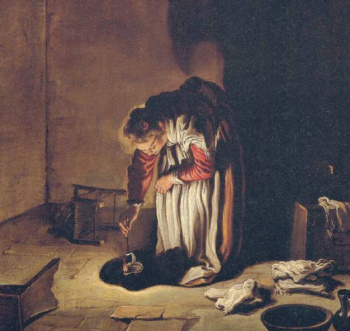
Both the sheep in Luke 15:3 - 7 and the coin in verses 8 to 10 symbolize people. This parable, like the one that came before it, is meant to symbolize the thoroughness of God's search for someone who is lost. Once found, the repentant sinner is rejoiced over in heaven!
[Biblical Weight and Measures]
31. In this parable of the prodigal son (Luke 15:11 - 32), the younger of a man's two sons asks that he be given his share of his inheritance. The father acquiesces and gives his son his share.
The youngest son, after receiving what was due him, foolishly spends it on fulfilling his carnal desires for women and partying (Luke 15:13, 30). After he realizes the gross error he has made he eventually, humbly, returns home. His father, instead of chastising him, rejoices that he was still alive and returned to him.
[Family Inheritance and the Bible]
The prodigal son symbolizes sinners in general who, after living a riotous life, realize that they have done wrong. When they finally repent they are rejoiced over in heaven. Please see our full article on the meaning of the prodigal son parable for more information.
Luke 1 to 6 Outline - 7 to 12 Outline
13 to 18 Outline - 19 to 24 Outline
1 to 5 Questions - 6 to 10 Qs - 16 to 20 Qs
21 to 24 Qs - Luke Facts Part 1 - Part 2