Sequence in Chronology: 9 of 26
Topics Covered: Jesus declares he is Lord of the Sabbath and challenges erroneous Sabbath beliefs, a man with a withered hand is healed, religious leaders begin to conspire about killing Christ.
Multitudes are healed near the Sea of Galilee, after Jesus prays the twelve apostles are selected and commissioned, a Roman Centurion's great faith saves his servant, the Lord's popularity grows out of control!
Bible References: Matthew 8:5 - 13, 12:1 - 23, Mark 2:23 - 28, 3:1 - 21, Luke 6:1 - 19, 7:2 - 50, 8:19 - 21.
Previous Timeline - Next Timeline
April 5 (Monday)
28 A.D.
Lord of the Sabbath
Jesus and his disciples, hungry while walking through a grain field on the last day of Unleavened Bread (April 5), pluck heads of wheat and eat them. This simple act, done out of need, roused the anger of the Pharisees who believed it was "work" that broke the Holy Day. The Lord responds by mentioning David, out of a legitimate human need, ate shewbread that other times was unlawful to consume (Luke 6:1 - 5, Mark 2:23 - 28, Matthew 12:1 - 8). He then chastises them by stating the following.
Now if you had known what this means, 'I desire mercy and not sacrifice,' you would not have condemned the guiltless (Matthew 12:7, HBFV).
The Lord closes his discussion with the religious leaders by stating he has the authority, as Creator and Lord of the Sabbath, to determine what is and is not acceptable to do on such special days.
Mid-April to
Early Summer
28 A.D.
Confronting Religious Leaders
Jesus, while teaching in a synagogue, notices a man with a withered hand. He also knows that the scribes and Pharisees, also in attendance, erroneously believe due to their traditions (which nullified God's law, see Matthew 15 and Mark 7) that healing on the Sabbath is a sin.
And the scribes and the Pharisees were watching Him, whether He would heal on the Sabbath, so that they might find an accusation against Him (Luke 6:7).
The Lord, wanting to clarify the true meaning of the Sabbath, has the man stand in the center of the room. Then, in an undeniable direct provocation of the religious leaders, asks if it is lawful to do good or evil on the Sabbath day. Amazingly, those in attendance, who are considered the spiritual leaders of the nation, offer no response!
Christ, angered and grieved at the hard hearts that refuse to acknowledge the truth for their own selfish reasons, heals the withered hand. The religious leaders, enraged at seeing what they felt was a sin, and that their authority was openly challenged and exposed as not coming from God, begin to actively conspire to destroy Jesus (Matthew 12:9 - 14, Mark 3:1 - 6, Luke 6:6 - 11).
Healing the Multitudes
Jesus, aware that the Pharisees and others are discussing how they could kill him, withdraws (likely) from Capernaum. He travels to the Sea of Galilee where he heals countless people. He then commands what he has done not be known publicly so that the following prophecy from Isaiah 42 could be fulfilled.
"Behold My Servant, Whom I have chosen; My Beloved, in Whom My soul has found delight. I will put My Spirit upon Him, and He shall declare judgment to the Gentiles.
"He shall not strive nor cry out, neither shall anyone hear His voice in the streets. A bruised reed shall He not break, and smoking flax shall He not quench, until He brings forth the judgment unto victory. And the Gentiles shall hope in His name." (Matthew 12:18 - 21).
Jesus then heals of a man who was not only demon possessed but also blind and deaf. Those with demons, when they see him, cry out that he is the Son of God (Matthew 12:15 - 23, Mark 3:7 - 12, Luke 6:17 - 19).
Picking the Twelve Apostles
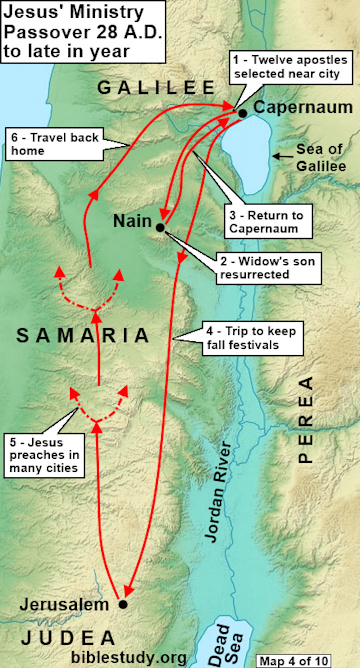
While in Galilee the Lord goes up a local mountain and prays all night. He then officially selects and ordains twelve of his disciples to be his apostles.
And when it was day, He called His disciples to Him and chose from them twelve, whom He also named apostles: Simon, whom He also named Peter, and his brother Andrew; James and John; Philip and Bartholomew;
Matthew and Thomas; James, the son of Alpheus, and Simon who was called Zealot; Judas, brother of James; and Judas Iscariot, who also became the betrayer (Luke 6:13 - 16, see also Mark 3:13 - 19).
After Jesus selects his apostles he is mobbed by a large crowd, composed of both Jews and Gentiles, seeking to be healed.
And after descending with them, He stood on a level place with a crowd of His disciples; and a great multitude of people from all Judea and Jerusalem, and from the seacoast of Tyre and Sidon, came to hear Him and to be healed of their diseases;
And those who were tormented by unclean spirits also came; and they were healed. And all the crowd sought to touch Him, for power went out from Him and healed all. (Luke 6:17 - 19).
How Many Disciples Were There?
Jesus, during his ministry, had many more followers than those who would become the twelve apostles. Several women, for example, which included Mary Magdalene, accompanied him on his journeys (Luke 8:2 - 3). Many of those who followed and believed in him would later abandon their faith when they heard Christ teach something they couldn't accept (John 6:60 - 61, 64, 66).
A Man of Great Faith
The Lord, after he and the disciples journey to Capernaum, is told that a certain Roman centurion's servant was ill and near death. As he travels to heal the servant the centurion has his friends tell Christ he is not worthy to have him in his house. He, instead, recognizes Jesus' authority and humbly requests he simply command the servant be healed.
"Lord, I (a non-Israelite Centurion) am not worthy that You should come under the roof of my house; but speak the word only, and my servant shall be healed. For I also am a man under authority, having soldiers under me; and I say to this one, 'Go,' and he goes; and to another one, 'Come,' and he comes; and to my servant, 'Do this,' and he does it."
Now when Jesus heard these words, He was amazed; and He said to those who were following, "Truly I say to you, nowhere in Israel have I found such great faith . . ." (Matthew 8:8 - 10).
Jesus, impressed by the centurion's faith, commands his servant be made whole (Matthew 8:5 - 13, Luke 7:2 - 10).
Christ's popularity has now grown to such an extent that people constantly mob his house and make it impossible for him to even eat a meal!
Then a multitude gathered together again, so that they were not able even to eat bread. And after hearing of it, those who were contrary to Him (Jesus) went to restrain Him; for they said, "He is out of His mind!" (Mark 3:20 - 21).