Sequence in Chronology: 7 of 26
Topics Covered: John the Baptist is thrown into prison, when, where and why John was imprisoned, Jesus and disciples travel north to Galilee and Cana, a child is healed by a simple command, the Lord spreads the gospel in Galilee and then travels to Nazareth.
At Pentecost a 600+ year old Jubilee year prophecy is fulfilled, Jesus escapes being killed by those in his hometown, Capernaum becomes the Lord's new home in fulfillment of prophecy.
Bible References: Matthew 4:12 - 16, Mark 1:14, Luke 3:19 - 20, 4:14 - 31, John 3:22 - 24, 4:1 - 54.
Previous Timeline - Next Timeline
Middle of May
27 A.D.
John Is Thrown in Prison
It is after Jesus' encounter with the Samaritan woman at Jacob's well (John 4:5 - 42), and his two days of preaching the gospel (John 4:40), that we learn John the Baptist had been thrown in prison.
But Herod the tetrarch, after being reproved by him for marrying Herodias, the wife of Philip his brother, and for all the evils that Herod had done, added this to all that: he locked up John in prison. (Luke 3:19 - 20).
When Was John Put in Prison?
The spring Holy Days in 27 A.D. ran from April 9 to 16. After Jesus and his disciples observe these days in Jerusalem they leave for the Jordan River in the rural part of Judea. His disciples then baptize people for an unknown period. During their baptizing training John the Baptist is not yet in prison.
After these things, Jesus and His disciples came into the land of Judea; and there He stayed with them and was baptizing.
And John was also baptizing in Aenon, near Salim because there was much water there; and the people were coming and were being baptized, for John had not yet been cast into prison. (John 3:22 - 24).
Therefore, when the Lord knew that the Pharisees had heard that Jesus was making and baptizing more disciples than John, (although Jesus Himself was not baptizing, but His disciples) . . . (John 4:1 - 2).
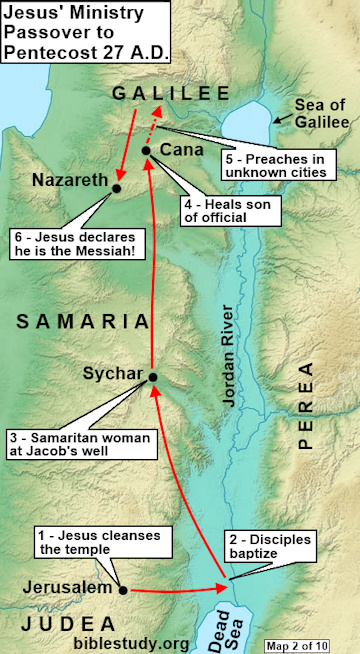
The Lord then travels to Jacob's well, stays a couple of days, and continues to travel north. The New Testament states that Jesus did not enter Galilee until AFTER John was put in prison (see Mark 1:14 and Matthew 4:12). All this means it is highly likely John the Baptist was tossed into prison sometime in the middle of May in 27 A.D.
John was likely held at Machaerus, a palatial fortress rebuilt and expanded by Herod the Great, which is located east of the Dead Sea in Perea.
Why Was John Imprisoned?
Herod Antipas and Herod II (also called Herod Philip I) were half-brothers. Both men were married, with Herod II wed to a woman named Herodias. Antipas fell madly in love with Herodias and arranged with Herod II to divorce their current mates so that they could marry each other's wife.
John the Baptist, after the marriage of Herod Antipas and Herodias, openly condemned their union as sinful on the grounds it was both adulterous and incestuous. God's law forbids a man from marrying his brother's (of half-brother's) wife.
You shall not uncover the nakedness of your brother's wife. It is your brother's nakedness (Leviticus 18:16).
And if a man shall take his brother's wife, it is an unclean thing (Leviticus 20:21).
John's righteous condemnation of Herod's sin led to him being thrown in prison.
Arriving in Galilee
When Jesus finally arrives in Galilee he receives a warm welcome by those who heard him preach and saw his miracles in Jerusalem.
Therefore, when He came into Galilee, the Galileans received Him, having seen all the things that He did in Jerusalem during the feast, for they also had gone to the feast. (John 4:45).
The First Healing
Jesus and his disciples eventually travel to Cana (John 4:46). A royal official from Capernaum, who knew Christ was in the city, requests his sick and dying son be healed. Instead of visiting the child, however, Jesus simply declares the son will live! This spectacular show of power and mercy is the first healing miracle recorded during Jesus' ministry!
The royal official said to Him (Jesus), "Sir, come down before my little child dies." Jesus said to him, "Go; your son shall live." And the man believed the word that Jesus said to him and went away.
Now as he was going down to his house, his servants met him and reported, saying, "Your child is alive and well." Then he inquired of them at what hour he began to improve. And they said to him, "Yesterday, at the seventh hour, the fever left him." Therefore, the father knew that it was at the hour that Jesus said to him, "Your son shall live." (John 4:49 - 53).
Proclaiming God's Kingdom
Jesus continues to preach with power throughout Galilee. One of his methods for spreading the gospel was through synagogues (Luke 4:14 - 15).
Now after the imprisonment of John, Jesus came into Galilee, proclaiming the gospel of the kingdom of God . . . (Mark 1:14).
Now when Jesus had heard that John was put in prison, He went into Galilee. (Matthew 4:12, see also Luke 4:14 - 15).
June 1
(Pentecost)
27 A.D.
Jesus and the Jubilee Year
Jesus travels from somewhere in Galilee to his hometown of Nazareth and, while in the city on the Day of Pentecost, visits a local synagogue (Luke 4:16 - 20). Asked to read from Scripture, he finds and selects a well-known passage from Isaiah the prophet concerning the Jubilee Year.
The Spirit of the Lord is upon Me; for this reason, He has anointed Me to preach the gospel to the poor; He has sent Me to heal those who are brokenhearted, to proclaim pardon to the captives and recovery of sight to the blind, to send forth in deliverance those who have been crushed, to proclaim the acceptable year of the Lord (Luke 4:18 - 19 quoting from Isaiah 61:1 - 2).
Christ then declares, after reading this 600+ years old prophecy, to the utter surprise and amazement of his audience, that "Today, this scripture is being fulfilled in your ears" (Luke 4:21)! Although his ministry began in the fall of 26 A.D., Jesus waited until Pentecost in 27 A.D. (due to its symbolism) to publicly announce he was the Messiah during a Jubilee year!
What Is the Jubilee Year?
God established what is called a Jubilee year. It took placed every fiftieth year with its start proclaimed on the Day of Atonement (Leviticus 25:9 - 10). It was a time when Israel's land was to remain uncultivated (Leviticus 25:11). It was to be a joyous time when all Israelite debts were forgiven, Israelite slaves were freed and a person's land inheritance would be returned to him.
And you shall make the fiftieth year holy, and proclaim liberty throughout the land to all its inhabitants. It shall be a jubilee to you, and you shall return each man to his possession, and you shall return each man to his family (Leviticus 25:9 - 10, HBFV).
The Jubilee year symbolized Jesus' ministry which would ultimately lead to freeing people from the consequences of sin and separation from God.
An Amazing Coincidence?
Jesus turned thirty years old (likely) on September 2 of 26 A.D. On September 11 of the same year, the Day of Atonement, his ministry began with fasting for 40 days while being tempted by the devil. September 11 also marked the start of the Biblical Jubilee year which the Lord declared in his Pentecost message of 27 A.D. (Luke 4).
Using 26 A.D. as the start of a Jubilee year, and counting backwards, the Jubilee took place twenty-nine times from 1398 B.C. to 1 B.C. The year 1398 B.C. is important as that is when Joshua completed the division of the Promised Land among the children of Israel (Joshua 14).
Jubilee (and Sabbatical) years were tied to the ownership of land (Leviticus 25). They therefore could only be celebrated after each Israelite tribe had received their inheritance of territory God promised to them.
The 30th Jubilee Year since the Israelites received land in Canaan started when Jesus had just turned 30 years old. The Lord and his ministry are therefore further intrinsically linked to the ultimate fulfillment of healing and freedom promised in the Jubilee!
Faithless Friends
The Nazareth synagogue crowd, many of whom knew Christ as a child, have a hard time accepting what he is teaching despite knowing about his Capernaum miracles. The Lord's chastisement of their faithless attitude so enrages those worshipping on this special Holy Day that they gather to push him off a cliff!
Now all in the (Nazareth) synagogue who heard these things (Jesus' chastisement of their hard hearts) were filled with indignation.
And they rose up and cast Him out of the city, and led Him to the edge of the mountain on which their city was built, in order to throw Him down headlong; But He passed safely through their midst and departed (Luke 4:28 - 30).
Jesus, after escaping the rejection and wrath of his neighbors in Nazareth, travels to Capernaum (Luke 4:31).
A New Home
It is at this point in Jesus' ministry that he makes Capernaum his home in fulfillment of prophecy!
And after leaving Nazareth, He came and dwelt in Capernaum, which is on the seaside, on the borders of Zabulon and Nephthalim; That it might be fulfilled which was spoken by the prophet Isaiah, saying,
"The land of Zabulon and the land of Nephthalim, by the way of the sea, beyond the Jordan, Galilee of the Gentiles; The people who were sitting in darkness have seen a great light; and to those who were sitting in the realm and shadow of death, light has sprung up." (Matthew 4:13 - 16).
An Insignificant City
Jesus' hometown of Nazareth is believed to have had a population of 15,000 to 20,000 people when the Lord lived in it (Illustrated Bible Dictionary). The city itself is not directly referenced in the Old Testament. Its insignificance was such that it was also not mentioned in any of Jewish historian Josephus' writings, or in the Jewish Talmud, or in any known intertestamental Jewish writings.
Nathanael, the fifth disciple called by Christ, reflected the common negative perception of Nazareth when first told Jesus lived in the city. He found it hard to accept that anything good, let alone the Messiah, could come out of it!
Philip found Nathanael and said to him, "We have found Him of Whom Moses wrote in the Law, and also the prophets, Jesus, the son of Joseph; He is from Nazareth."
And Nathanael said to him, "Can any good thing come out of Nazareth?" . . . (John 1:46 - 47).