Sequence in Chronology: 6 of 26
Topics Covered: Jesus travels from Cana to Capernaum, the Lord and his disciples go to Jerusalem to celebrate Passover, Jesus appears at Jerusalem's temple and cleanses it of crooks, the problems with moneychangers at the temple.
Nicodemus secretly meets with Christ, the disciples are trained at Jordan River to baptize, the group heads north through Samaria, Jesus meets woman at Jacob's well and preaches the gospel, the group continues north to Galilee.
Bible References: John 2:12 - 4:43.
Previous Timeline - Next Timeline
December 26 A.D.
to March 27 A.D.
In Capernaum
After Jesus' first public miracle in Cana he travels, with his disciples and family, through Galilee to Capernaum (John 2:12). He likely stays in the city until late March of 27 A.D.. The Bible is unfortunately silent regarding his activities during this period.
Capernaum's first chronological mention in the New Testament is found in John 2:12. The city is recorded, by name, sixteen times in sixteen King James Bible verses, with it listed the most in John's gospel (five times).
Galilee
The Biblical region referenced as Galilee, according to the first century Jewish historian Josephus, was divided into an Upper and Lower part (Wars of the Jews, book 3, chapter 3, sections 1 and 2).
The part known as Upper Galilee included the New Testament cities of Chorazin (Matthew 11:21), Capernaum (Matthew 4:13), Magdala (Matthew 15:39), Gennesaret (Matthew 14:34) and Dalmanutha (which may have been a city or an area near Magdala, Mark 8:10). This part was also known as "Galilee of the Gentiles" (Matthew 4:16).
Lower Galilee included the cities of Tiberias (John 6:23), Nazareth (Luke 1:26), Cana (John 2:1) and Nain (Luke 7:11).
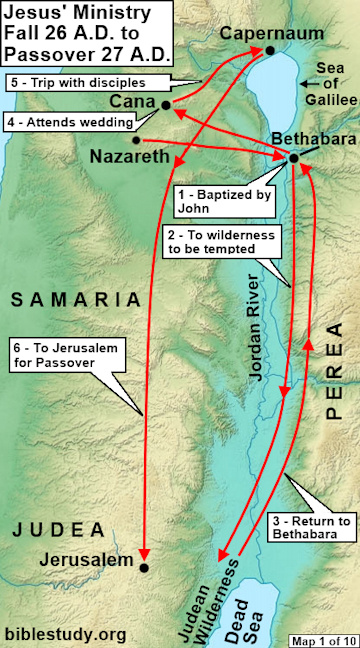
Galilee, during the entirety of Jesus' earthly life, was governed by Herod Antipas. Many of the Lord's miracles were performed in this area, including two of his three resurrections of the dead (Luke 7:11 - 18, 8:49 - 52). He devoted most of his ministry to Galilee and was commonly referred to as "Jesus the Galilean" (Matthew 26:69).
April to May
27 A.D.
Jesus Visits the Temple
Jesus and his disciples leave Capernaum (John 2:12) and travel south toward Jerusalem. They leave as the Passover, which begins at sunset on April 8, is approaching (verse 13).
Jesus, after arriving in the city, visits the temple in fulfillment of Biblical prophecy.
"Behold, I will send My messenger, and he will prepare the way before Me. And the Lord, Whom you seek, shall suddenly come to His temple, even the Messenger of the covenant, in Whom you delight. Behold, He comes," says the Lord of hosts (Malachi 3:1).
What Jesus sees, however, in the Court of the Gentiles angers him.
The Problem With Moneychangers
The buying and selling of animals, the exchanging of money and so on were services needed to facilitate worship at the temple. Pilgrims who wanted to offer God an animal sacrifice or who needed a lamb to keep the Passover (Exodus 12) benefitted from a convenient place to purchase such beasts.
Those visiting Jerusalem from around the world, who wished to make a monetary offering, had to convert their "pagan" currency (e.g. Roman) into special coinage that was acceptable to the temple. People providing these currency exchange services charged a fee for what they offered.
Jesus was not upset, strictly speaking, with the services offered in the Court of the Gentiles. He was angered, however, because people were being ripped off. Worshippers were charged exorbitant fees, or otherwise being cheated, by those greedy for gain. It was the behavior of those who turned the area into a den of robbers and thieves (Matthew 21:13, Luke 19:46), who indulged in unrighteous profiteering, that Christ rejected.
Ejecting the Crooks!
Christ immediately makes a whip out of some cords and drives away the animals, while also overturning the tables of the moneychangers so that the temple could be cleansed. The Jews, seeing what he did, demand Jesus show them a sign to prove his divine authority for such actions.
As a result, the Jews answered and said to Him, "What sign do You show to us, seeing that You do these things?"
Jesus answered and said to them, "Destroy this temple, and in three days I will raise it up." Then the Jews said, "This temple was forty-six years in building, and You will raise it up in three days?" But He spoke concerning the temple of His body. (John 2:18 - 21).
The Jews' misunderstanding that the Lord was referencing the physical temple in Jerusalem would be used against him. Three years later, when on trial for his life, two false witnesses will further twist his words to justify putting him to death!
Now the chief priests and the elders and the whole Sanhedrin sought false evidence against Jesus, so that they might put Him to death . . .
Then at the last, two false witnesses came forward and said, "This Man said, 'I have the power to destroy the temple of God, and to rebuild it in three days.' " (Matthew 26:59, 61, see also Mark 14:55 - 58).
Jesus performs several unknown miracles during the spring Holy Day season (John 2:23).
Nicodemus' Secret Meeting
The Lord, while still in Jerusalem, is approached by a man named Nicodemus who was a Pharisee and member of the Sanhedrin. Nicodemus chooses to meet Jesus at night in a likely attempt to avoid being seen with someone who recently angered them. His opening words reveal that many of the Jewish religious leaders know that God is with Christ.
"Rabbi, we know that You are a teacher Who has come from God; because no one is able to do the miracles that You are doing unless God is with him." (John 3:2).
The Lord's response appears disconnected and odd, in part, because it seems to have no relationship or connection with what was initially stated to him.
Jesus answered and said to him, "Truly, truly I say to you, unless anyone is born again, he cannot see the kingdom of God." (John 3:3).
One possible explanation for the Lord's puzzling response is that He was immediately addressing the "real" reason for the visit which was to inquire about the Kingdom of God.
Jesus teaches that a person must be "born again" or resurrected from the dead as a spirit being to fully enter God's Kingdom. He also reveals to Nicodemus that he will die through crucifixion and explains how much God loves humanity (John 3:1 - 21).
For God so loved the world that He gave His only begotten Son, so that everyone who believes in Him may not perish, but may have everlasting life. For God sent not His Son into the world that He might judge the world, but that the world might be saved through Him (John 3:16 - 17).
Baptizing
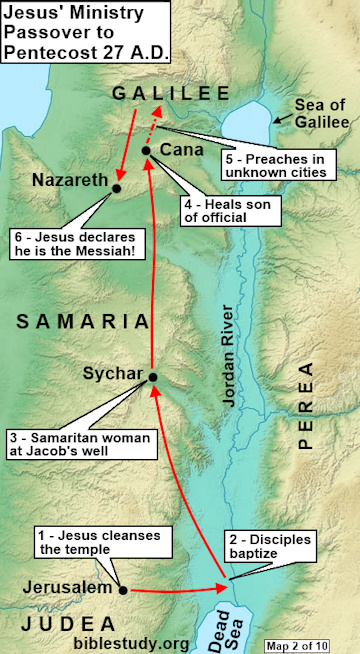
A short time after the spring Holy days in 27 A.D. (which ended at sunset on April 16) Jesus and his disciples leave Jerusalem for the rural part of Judea near the Jordan River. Jesus then trains the disciples by having them baptize people. They quickly baptize more people than John the Baptist who is doing so in Aenon (John 3:22 - 24, 4:1 - 2).
John declares it is God's will that the Lord's ministry should increase while his decreases. He also denies he is the long-awaited Messiah. He then closes his discourse by revealing several profound truths.
"You yourselves bear witness to me that I said, 'I am not the Christ,' but that I am sent before Him. The one who has the bride is the bridegroom; but the friend of the bridegroom, who stands by and hears him, rejoices greatly because of the voice of the bridegroom; in this then, my joy has been fulfilled.
"It is ordained that He increase, and that I decrease." . . .
"The one who has received His testimony has set his seal that God is true; For He Whom God has sent speaks the words of God; and God gives not the Spirit by measure unto Him.
"The Father loves the Son and has given all things into His hand. The one who believes in the Son has everlasting life; but the one who does not obey the Son shall not see life, for the wrath of God remains on him." (John 3:28 - 30, 33 - 36).
Traveling Through Samaria
The Lord and his followers, after spending a short time in Judea, travel through Samaria on their way to Galilee.
Therefore, when the Lord knew that the Pharisees had heard that Jesus was making and baptizing more disciples than John, (although Jesus Himself was not baptizing, but His disciples,) He left Judea and departed again into Galilee. Now it was necessary for Him to pass through Samaria (John 4:1 - 4).
Woman at Jacob's Well
Jesus and his disciples, while traveling north, stops near the city of Samaria (Sychar). Jesus then rests by Jacob's Well while the disciples go into the town to buy food. When they are gone, he shocks a Samaritan woman approaching the well by asking her for a drink. The woman is amazed that a Jew is willing to talk with her as most first century Jews steered clear of such interactions with Samaritans. Jesus, during his brief talk with the Samaritan, admits that he is the Messiah!
The woman said to Him, "I know that Messiah is coming, Who is called Christ; when He comes, He will tell us all things." Jesus said to her, "I Who speak to you am He." (John 4:25 - 26).
After the woman informs those in Samaria about the Lord, they flock to talk to him. After two days of preaching the gospel to the Samaritans he leaves for Galilee (John 4:5 - 43).