Sequence in Chronology: 20 of 26
Topics Covered: Jesus learns Lazarus is sick but stops for two days, traveling south the Lord arrives in Bethany when Lazarus has been in grave four days, Lazarus is resurrected from the dead, Jews fearful of Roman response to Jesus' popularity, the Lord and the disciples flee to Ephraim.
Pharisees seek to entrap Jesus through question on divorce, rich young ruler asks about eternal life, warning given about riches, twelve disciples promised rewards for their faith, the group travels to Jericho.
Mother of James and John requests her sons be given authority, a Jericho tax collector meets Jesus and repents, the group leaves Jericho for Bethany.
Bible References: Matthew 19:3 - 30, 20:1 - 34, Mark 10:2 - 52, Luke 18:15 - 43, 19:1 - 28, John 11:1 - 57.
Previous Timeline - Next Timeline
February to
Late March 30 A.D.
Resurrection of Lazarus
Lazarus' resurrection in Bethany was a carefully timed miracle designed to maximize the glory it would generate for God (John 11:4). It will also play a role in the planning that would lead to Jesus' arrest and crucifixion (verse 53).
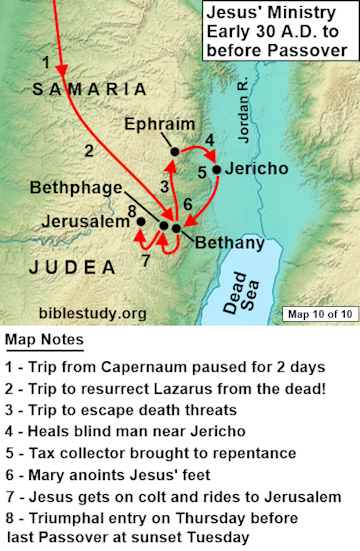
Jesus and his disciples are traveling south from Capernaum. A messenger is sent from Mary and Martha in Bethany to inform the Lord that Lazarus is gravely ill. Christ, after being told of the death, makes the unusual choice to stay where he is at for two days (John 11:6). When he and his disciples finally arrive in Bethany Lazarus has been lying in his tomb for four days (John 11:17, 39).
A large group of mourners, many from nearby Jerusalem, are gathered in the city to comfort and console Mary and Martha. After the Lord talks with the two sisters he is taken to where their brother is buried. After he has the stone sealing the tomb moved aside, he commands, "Lazarus, come forth!" (John 11:43). Lazarus then comes out of the tomb still wrapped in grave clothes which are quickly removed.
Why Wait Four Days?
Why did Jesus wait four days before resurrecting Lazarus? Four days was long enough for Lazarus' body to begin generating a pungent odor due to his decaying flesh (John 11:39). This delay was planned so that even Jesus' harshest critics would be unable to explain away the unique and awesome miracle he performed (see verses 46 - 48).
How did we get four days in the tomb for Lazarus? The key to Lazarus being buried for four days when Jesus arrives (John 11:17, 39) is that, after Mary and Martha sent a messenger to the Lord, their brother died the same day. Lazarus then, still likely on the same day, was put in his tomb per Jewish tradition.
When the messenger reaches Jesus he knew his friend was already dead (see John 11:11 - 14). He then stops in his tracks somewhere outside the boundaries of Judea (verse 7) and stays for two days (verses 1 to 6). After this he restarts his trip by traveling a day's journey to Bethany.
The resurrection of Lazarus almost certainly took place during daylight hours since those near the tomb were able to see him walk out still bound in his grave clothes (John 11:45).
What Will the Romans Think?
Some who witness the raising of Lazarus run to the Pharisees in Jerusalem to inform them of Jesus' miracle. A group of Jewish religious leaders then quickly convene a meeting (John 11:46 - 47). Instead of rejoicing over this incredibly rare miracle and display of God's power, they complain that it will jeopardize their relationship with the Romans!
What shall we do? For this Man does many miracles. If we allow Him to continue in this manner, all will believe in Him, and the Romans will come and take away from us both this place and the nation (John 11:47 - 48).
The Temple's High Priest, in the middle of the discussion, unknowingly predicts the Lord's death when he states the following to those gathered.
You have no understanding, nor consider that it is better for us that one man die for the people, than that the whole nation should perish (John 11:49 - 50).
Those gathered in the meeting agree that they must find a way to put Jesus to death (John 11:53).
Escape to Ephraim
Jesus, knowing the Jews actively seek his life, leaves Bethany with his disciples and travels to the nearby city of Ephraim. This trip affords him a short escape from the concentrated efforts to find him in Jerusalem. He will end up staying in the city for an unknown period of time.
For this reason, Jesus no longer walked publicly among the Jews, but went away from there into the country near the desert to a city called Ephraim; and He stayed there with His disciples. (John 11:54).
Is Divorce Lawful?
Some Pharisees, in Ephraim, find Christ and try to entrap him by asking whether it is lawful to divorce for any reason. Jesus' answer is that God's perfect will is that people stay married for life with one possible exception.
Then the Pharisees came to Him and tempted Him, saying to Him, "Is it lawful for a man to divorce his wife for any cause?"
But He answered them, saying, "Have you not read that He Who made them from the beginning made them male and female, and said, 'For this cause shall a man leave his father and mother, and shall be joined to his wife; and the two shall become one flesh'?
"So then, they are no longer two, but one flesh. Therefore, what God has joined together, let not man separate." . . .
"Because of your hardheartedness, Moses allowed you to divorce your wives; but from the beginning it was not so. And I say to you, whoever shall divorce his wife, except it be for sexual immorality, and shall marry another, is committing adultery . . ." (Matthew 19:3 - 6, 8 - 9, see also Mark 10:2 - 12).
The disciples, amazed at what Jesus taught, state that it would be better to not marry and instead stay single. Jesus' response is that the life of a single person was not meant for everyone.
But He said to them, "Not everyone can receive this word, but only those to whom it has been given.
"For there are eunuchs who were born that way from their mother’s womb, and there are eunuchs who were made eunuchs by men, and there are eunuchs who have made themselves eunuchs for the sake of the kingdom of heaven. The one who is able to receive it, let him receive it." (Matthew 19:11 - 12).
Little children are then brought to him to bless (Matthew 19:10 - 15, Mark 10:13 - 16, Luke 18:15 - 17).
How to Inherit Eternal Life
A rich young man, who is a ruler, approaches Christ and asks what it will take for him to have eternal life. Jesus' initial answer was that he needed to keep God's commandments!
Now at that time, one came to Him and said, "Good Master, what good thing shall I do, that I may have eternal life?" And He said to him, "Why do you call Me good? No one is good except one - God. But if you desire to enter into life, keep the commandments." (Matthew 19:16 - 17).
Since he was already keeping God's commandments (Matthew 19:20, Mark 10:20), the rich ruler is told he needed to give up the wealth that was a priority in his life and follow the Lord. The man, unwilling to forego his worldly wealth, leaves quite sad.
Jesus, after the rich man leaves, warns the disciples not to set their hearts on riches. He also reveals it is incredibly difficult (though possible with God!), like a camel going through a needle, for those with wealth to enter God's kingdom (Mathew 19:16 - 26, Mark 10:17 - 27, Luke 18:18 - 27).
Then Jesus said to His disciples, "Truly I say to you, it is extremely difficult for a rich man to enter into the kingdom of heaven. And again I say to you, it is easier for a camel to pass through the eye of a needle than for a rich man to enter into the kingdom of God." (Matthew 19:23 - 24).
Blessings for Believing
Peter, after hearing the Lord proclaim how difficult it is for the rich to enter God's kingdom, declares that he and the disciples have given up everything to follow him. The Lord's response is to promise that anyone who sacrifices themselves to follow him will be blessed abundantly both in this life and in the next.
"Truly I say to you who have followed Me: in the regeneration when the Son of man shall sit upon the throne of His glory, you also shall sit on twelve thrones, judging the twelve tribes of Israel.
"And everyone who has left houses, or brothers, or sisters, or father, or mother, or wife, or children, or lands, for My name's sake, shall receive a hundredfold, and shall inherit eternal life. But many of the first shall be last, and the last first." (Matthew 19:28 - 30, see also Mark 10:28 - 31 and Luke 18:28 - 30).
Jesus then gives the parable of the workers in the vineyard (Matthew 20:1 - 16).
Leaving Ephraim
Jesus and the disciples leave Ephraim for Jericho. The Lord reminds his disciples that he will soon be betrayed, suffer, die and then be raised from the dead three days later.
"Behold, we are going up to Jerusalem, and the Son of man shall be betrayed to the chief priests and scribes, and they shall condemn Him to death; and they shall deliver Him up to the Gentiles to mock Him, and to scourge Him, and to crucify Him; but He shall rise again the third day." (Matthew 20:18 - 19, see also Mark 10:32 - 34 and Luke 18:31 - 34).
Who Are the Greatest?
The mother of James and John, sometime after Jesus leaves Ephraim, requests that her sons have authority, directly under him, in his Kingdom. His answer, surprisingly, is not directed at the mom but at the brothers.
But Jesus answered and said, "You do not know what you are asking. Are you able to drink the cup that I am about to drink, and to be baptized with the baptism that I am baptized with?" They said to Him, "We are able."
And He said to them, "You shall indeed drink of My cup, and shall be baptized with the baptism that I am baptized with; but to sit at My right hand and at My left hand is not Mine to give, but shall be given to those for whom it has been prepared by My Father." (Matthew 20:22 - 23).
The other disciples become infuriated at the brothers when they hear about the request. Jesus quells the dissension by teaching all those who will be considered the greatest in God's kingdom are those who serve everyone (Matthew 20:20 - 28, Mark 10:35 - 45).
Late March 30 A.D.
Jericho's Tax Collector Repents!
Jesus and his disciples then journey to Jericho on their way to Bethany and Jerusalem. As they approach the city a blind man cries out for mercy and is miraculous healed (Luke 18:35 - 43).
As the Lord walks through Jericho a wealthy but corrupt tax collector named Zaccheus wants to see him. His short stature, however, doesn't allow him to see much of anything through the multitudes gathered in the city. His solution is to climb a sycamore tree, away from the crowds, where he believes Christ will pass. As the Lord walks past the tree he notices Zaccheus and states he will visit him at his house!
Zaccheus not only repents of growing rich through sin but also vows to repay those he stole from and even help the poor!
Then Zaccheus stood and said to the Lord, "Behold, the half of my possessions, Lord, I give to the poor; and if I have taken anything from anyone by false accusation, I return fourfold." (Luke 19:8).
March 29
(Wednesday)
30 A.D.
Leaving Jericho
The Lord and his disciples leave Jericho for Bethany, a journey of roughly seventeen miles (27.3 kilometers). As they are leaving the city two blind men cry out for Jesus to have pity and mercy upon them. He hears their cries and out of compassion heals their blindness (Matthew 20:29 - 34, Mark 10:46 - 52).
Jesus, while drawing close to his destination as Passover approaches (John 11:55 - 57), gives the parable of the pounds (Luke 19:11 - 28).