Sequence in Chronology: 24 of 26
Topics Covered: Judas, on the day Jesus would die, arrives in the garden of Gethsemane and betrays him with a kiss, the disciples flee from Christ after which he is questioned, condemned and mistreated by Jewish leaders, Peter denies Jesus three times.
Judas commits suicide, the Romans reluctantly condemn Jesus to death, the Lord is mocked and tortured before taken to Golgotha, our Savior endures six hours of crucifixion before dying, Jesus is buried near sunset in a rich man's tomb.
Bible References: Matthew 26:45 - 75, 27:1 - 61, Mark 14:41 - 72, 15:1 - 47, Luke 22:47 - 71, 23:1 - 55, John 18:1 - 40, 19:1 - 42, Acts 1:15 - 19.
Previous Timeline - Next Timeline
Oldest Prophecy, Ultimate Irony
Jesus' arrest, suffering and murder on the day he died fulfilled many prophecies including the oldest one in the Bible. The prophecy, which he himself pronounced to Satan the devil in Eden, predicted he would be temporarily "bruised" (dead for a short time) by his adversary.
"And I will put enmity between you (the serpent representing the devil) and the woman, and between your seed and her Seed (Jesus); He will bruise your head, and you shall bruise His heel." (Genesis 3:15).
It was Jesus, as a member of the Godhead, who created man and gave him the "kiss" of life (Genesis 2:7). Ironically, man would return the favor by using a kiss to seal the fate of his Creator.
What the devil wanted, the death of God, he could not achieve when he rebelled (see Isaiah 14:13). He was allowed, however, to reach his goal (albeit for a short time) by deceiving God's greatest creation.
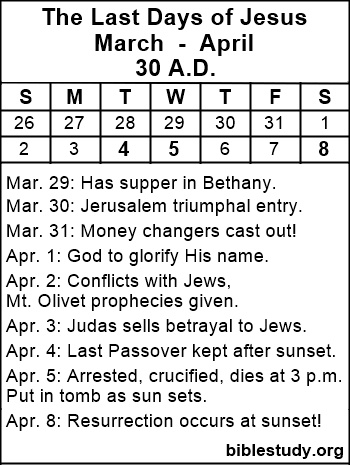
April 5
(Wednesday)
Betrayed With a Kiss
Jesus announces to his disciples, roughly at 12:30 a.m., that those wanting to arrest him are now coming into the garden!
Then He came to His disciples and said to them, "Sleep on now, and take your rest. Behold, the hour has drawn near, and the Son of man is betrayed into the hands of sinners. Arise! Let us be going. Look, the one who is betraying Me is approaching." (Matthew 26:45 - 46, see also Mark 14:41 - 42).
Judas arrives in the Garden of Gethsemane accompanied by armed officers and other men provided by the religious leaders. Judas, as a signal of which person to arrest, gives Jesus a kiss (Matthew 26:45 - 49, Mark 14:41 - 45, Luke 22:47 - 48, John 18:1 - 3).
Now the one who was betraying Him gave them a sign, saying, "Whomever I shall kiss, He is the One. Arrest Him!" And as soon as he came to Jesus, he said, "Hail, Rabbi," and earnestly kissed Him.
But Jesus said to him, "Friend, for what purpose have you come?" Then they came and laid their hands on Jesus, and arrested Him. (Matthew 26:48 - 50, see also Mark 14:41 - 45, Luke 22:47 - 48, John 18:1 - 3).
Jesus is the I AM!
Jesus then asks those who came to the garden whom they are seeking (John 18:4). What happens next, though often overlooked, is one of the many proofs that Jesus was God in the flesh and the Deity of the Old Testament!
They answered Him, "Jesus the Nazarean." Jesus said to them, "I AM." (I AM was God's name revealed to Moses - Exodus 3:13 - 14!). And Judas, who was betraying Him, was also standing with them.
But when He said to them, "I AM," they went backward and fell to the ground.
Then He asked them again, "Who are you seeking?" And they said, "Jesus the Nazarean." Jesus answered, "I told you that I AM. Therefore, if you are seeking Me, allow these to go their way" (John 18:4 - 8).
Jesus' request to have his disciples spared from being arrested fulfills his own prophecy that he would not lose one of those who followed him (see John 6:39, 17:12, 18:9).
Impulsive Peter
Peter, immediately after the authorities lay hands on Jesus to arrest him, impulsively pulls out his sword and cuts off the ear of a servant. The Lord quickly responds by chastising Peter and healing the servant.
Then Jesus said to him, "Put your sword back in its place; for all who take up the sword shall die by the sword. Don’t you realize that I have the power to call upon the Father at this time, and He will furnish Me with more than twelve legions of angels?
"But how then shall the Scriptures be fulfilled? For this is ordained to be." (Matthew 26:52 - 54, see also Mark 14:46 - 49, Luke 22:49 - 53, John 18:10 - 12).
Abandoned and Taken Away
Jesus' eleven disciples then abandon him, as was predicted, and run away (Zechariah 13:7, Matthew 26:56, Mark 14:50).
A young man, wearing nothing by a sheet, is also in the garden when Jesus is arrested. After the disciples flee he is also grabbed but escapes naked (Mark 14:51 - 52). The Lord is then led away to Annas' house (Matthew 26:57, Mark 14:53, Luke 22:54, John 18:13 - 14). Peter now reappears and follows the crowd until he arrives in the priest's courtyard (Matthew 26:58 - Mark 14:54, Luke 22:54 - 55, John 18:15 - 16, 18).
Questioned by Annas
Annas questions Jesus about his teachings. Jesus responds by stating he openly taught in public and in synagogues. One of the guards, upon hearing this answer, slaps the Lord. He is then sent to meet the entire Sanhedrin which includes the High Priest.
" . . . Why do you question Me (Jesus)? Ask those who have heard what I spoke to them; behold, they know what I said." But after He said these things, one of the officers who was standing by struck Jesus on the face, saying, "Do You answer the high priest in that way?"
Jesus answered him, "If I have spoken evil, testify of the evil; but if well, why do you strike Me?" (John 18:21 - 23).
Questioned and Condemned
Jesus is sent to be tried before the Jewish Sanhedrin at approximately 2 a.m. False witnesses are sought to testify against him but none of them can agree on what the Lord did wrong. Finally, two witnesses testify, falsely, that Christ threatened to tear down God's temple (Matthew 26:59 - 61, Mark 14:55 - 59, Luke 22:63 - 65). After the Lord refuses to answer the charges against him the High Priest adjures him to answer.
And the high priest rose up and said to Him, "Have You no answer for what these are testifying against You?"
But Jesus was silent. And the high priest answered and said to Him, "I adjure You by the living God that You tell us if You are the Christ, the Son of God." (Matthew 26:62 - 63, see also Mark 14:60 - 61).
Jesus affirms that he is the Messiah, God's Son (Matthew 26:64, Mark 14:62). His answer so angers the High Priest that he tears his clothes and cries out that Christ has committed blasphemy (Matthew 26:65, Mark 14:63). The High Priest then immediately asks the council for a verdict, to which they unanimously shout that the death penalty should be carried out.
Then the high priest ripped his own garments, saying, "He has blasphemed! Why do we need any more witnesses? Behold, you have just now heard His blasphemy. What do you think?" They answered and said, "He is deserving of death!" (Matthew 26:65 - 66, see also Mark 14:63 - 64).
The Lord, right after the guilty verdict, is blindfolded and experiences people spitting on him, hitting him with their fists and with rods, and blasphemously deriding him (Matthew 26:67 - 68, Mark 14:65, Luke 22:63 - 65).
Peter's Painful Denial
Peter, who during the trial was in the courtyard where the Sanhedrin met, is asked three times about his relationship with Jesus. All three times, as was predicted, he denied even knowing Christ!
And a certain maid saw him sitting by the light; and after looking at him intently, she said, "Now this one was with Him." But he denied Him, saying, "Woman, I do not know Him."
And after a little while, another saw him and said, "You also are one of them." But Peter said, "Man, I am not."
Now after about an hour had passed, a certain other man strongly affirmed, saying, "In truth, this one also was with Him, for he is indeed a Galilean." And Peter said, "Man, I do not know what you are talking about." And immediately, while he was yet speaking, the cock crowed. (Luke 22:56 - 60, see also Matthew 26:69 - 75, Mark 14:66 - 72 and John 18:17, 25 - 27 ).
It was after his third denial that Luke tells us Jesus, likely after he was beaten and bruised, looked directly at Peter!
Then the Lord turned and looked at Peter; and Peter remembered the word of the Lord, how He had said to him, "Before the cock crows, you shall deny Me three times." And Peter went outside and wept bitterly. (Luke 22:61 - 62).
Another Trial
At approximately 5 to 6 a.m., because Jewish law demanded two sessions of the Sanhedrin hear and try a defendant, a second trial of Jesus was held. This second trial, however, seems little more than a "rubber stamp" or automatic approval of the first trial's decision. Jesus is bound and sent to Pontius Pilate, the Roman Prefect of Judea, for punishment around 6 a.m. (Matthew 27:1 - 2, Mark 15:1, Luke 22:66 - 23:1, John 18:28).
Judas Commits Suicide
Judas Iscariot, at sunrise, repents of betraying Christ but his revulsion of his sins leads to him committing suicide. The Chief Priests decide to buy a potter's field with the thirty pieces of silver Judas gave back to them. This act is a fulfillment of prophecy (Zechariah 11:13).
Now when Judas, who had betrayed Him, saw that He was condemned, he changed his mind and returned the thirty pieces of silver to the chief priests and the elders, saying, "I have sinned and have betrayed innocent blood."
But they said, "What is that to us? You see to it yourself." And after throwing down the pieces of silver in the temple, he went out and hanged himself. (Matthew 27:3 - 5, see also Acts 1:15 - 19).
Jesus Before the Romans
At approximately 7 a.m., instead of blasphemy, the Jewish leaders bring Jesus to Pontius Pilate under the charge of treason against Rome. They do this in order to improve their chances of the Romans putting him to death.
While Pilate first questions Jesus (Matthew 27:11 - 14, Mark 15:1 - 5, Luke 23:1 - 7, John 18:29 - 30) he discovers he is from Galilee and sends him to Herod Antipas (Tetrarch of Galilee and son of Herod the Great) for judgment. Herod questions him but receives no answers. Herod and his soldiers mock the Lord, put a splendid robe on him, and send him back to Pilate (Luke 23:8 - 12).
Pontius Pilate, at roughly 8 a.m., tells the Jewish religious leaders that he and Herod Antipas find Jesus innocent. Although he wishes to release him (Luke 23:13 - 15, John 18:31 - 38), he relies on a tradition that frees one prisoner before the Passover Feast in the hope that the people of Jerusalem will choose to set Christ free.
The people, however, stirred up by the Jewish leaders who hate Jesus, cry out that they want Barabbas (a convicted murderer) freed and the Lord killed.
Therefore, when they had gathered together, Pilate said to them, "Whom do you desire that I release to you? Barabbas, or Jesus Who is called Christ?" . . .
But the chief priests and the elders persuaded the multitudes to demand Barabbas, and to destroy Jesus. Then the governor answered and said to them, "Which of the two do you desire that I release to you?" And they said, "Barabbas."
Pilate said to them, "What then shall I do with Jesus Who is called Christ?" They all said to him, "Let Him be crucified!" And the governor said, "Why? What evil did He commit?" But they shouted all the more, saying, "Let Him be crucified!" (Matthew 27:17, 20 - 23, see also Mark 15:6 - 14, Luke 23:16 - 23, John 18:39 - 40).
Pilate, while listening to the response of the crowd, receives a message from his wife stating she had a troubling dream that warned Jesus should be left alone as he was a righteous man.
Now as he sat on the judgment seat, his wife sent a message to him, saying, "Let there be nothing between you and that righteous Man, for I have suffered many things today in a dream because of Him." (Matthew 27:19).
Pilate, unable to convince the crowd to free Jesus, washes his hands with water symbolizing that he was guiltless of what happens to Christ. He also tells the crowd that they should crucify him (Matthew 27:24 - 25). Pilate frees Barabbas and then delivers Jesus to his Roman soldiers to scourge him.
After the scourging the soldiers then create a crown of thorns, put it on the Lord's head, throw a purple robe over him and give him a rod as a mock scepter. They then proceed to spit in his face, strike him with the rod they gave him, and mock him by kneeing before him and feigning worship. They also take the opportunity to slap the Lord's face multiple times. After they finish their mocking they send him back to Pilate (Matthew 27:26 - 31, Mark 15:15 - 20, Luke 23:24 - 25, John 19:1 - 5).
Pilate, however, still has second thoughts about crucifying Jesus. He presents the Lord to the crowd who again cry they want him crucified. After talking to Jesus he continues to want to release him. The Jews, however, then scream that releasing him is tantamount to acting against the Roman Emperor!
"If you release this Man, you are not a friend of Caesar. Everyone who makes himself a king speaks against Caesar." (John 19:12).
Pilate goes to his judgement seat with Jesus for one final appeal to have him released. The Jews, however, scream out that they have no king but Caesar. Pilate finally gives up and has the Lord sent to be crucified (John 19:6 - 15).
Myths
Crucifixes today show Jesus on a cross with his groin region covered by some cloth. The truth, however, is that the Lord was killed on a stake (upright pole) with his outstretched arms above his head. Additionally, the Romans always stripped people naked and then crucified them. This was done to enhance their warning to all others that disobedience to Rome would not only be painful but also publicly humiliating.
Taken to Golgotha
The soldiers take Jesus to Golgotha, also known as Calvary and the Place of the Skull, to be crucified. Along the route they force Simon of Cyrene to carry his stake (Matthew 27:32 - 33, Mark 15:21 - 22, Luke 23:26 - 31, John 19:16 - 17). As Jesus walks the rest of the way to Golgotha he runs into some women who are crying over him. He stops for a moment and offers them a chilling prophecy.
And following Him was a great multitude of people with many women, who also were bewailing and lamenting Him. But Jesus turned to them and said, "Daughters of Jerusalem, do not weep for Me, but weep for yourselves and for your children.
"For behold, the days are coming in which they shall say, 'Blessed are the barren, and the wombs that did not bear, and the breasts that did not give suck.' Then shall they begin to say to the mountains, 'Fall on us'; and to the hills, 'Cover us.' For if they do these things in the green tree, what shall take place in the dry?" (Luke 23:27 - 31).
Tortured in Public
Jesus, from 9 a.m. to noon, is nailed to his stake. He is crucified along with two thieves (Matthew 27:38, Mark 15:27 - 28, Luke 23:32 - 33, John 19:18). He is given wine (vinegar) mixed with gall to drink while being crucified which he refuses (Matthew 27:34, Mark 15:23). He asks God to forgive those killing him even as the Roman soldiers cast lots for his clothes (Luke 23:34).
Pontius Pilate has the charge against Jesus, in spite of the protestations of the Jews, written as, "This is Jesus, the King of the Jews" (Matthew 27:37). The charge is in Hebrew, Greek and Latin and hung on his stake (Matthew 27:37, Mark 15:26, Luke 23:38, John 19:19 - 22).
Mocked and Watched
Some in the crowd, where Christ is crucified, stare at him in amazement. Others such as Roman soldiers, members of the Sanhedrin (chief priests, scribes, elders) and even the two thieves crucified with him, mock him.
Now the people stood by observing, and the rulers among them were also deriding Him, saying, "He saved others; let Him save Himself, if this is the Christ, the chosen of God."
And the soldiers also mocked Him, coming near and offering Him vinegar, and saying, "If You are the King of the Jews, save Yourself." . . . Then one of the malefactors who was hanging there railed at Him, saying, "If You are the Christ, save Yourself and us." (Luke 23:35 - 37, 39, see also Matthew 27:39 - 45 and Mark 15:29 - 33).
John Given Care of Mary
At about noon darkness comes over the entire land and lasts until 3 p.m. (Matthew 27:45, Mark 15:33, Luke 23:44). Family and friends, at a distance, watch Jesus suffer on the cross.
Now there were many women who were watching from a distance, who had followed Jesus from Galilee, ministering to Him; with whom were Mary Magdalene, and Mary the mother of James and Joses, and the mother of the sons of Zebedee. (Matthew 27:55 - 56, see also Mark 15:40 - 41 and Luke 23:48 - 49).
Jesus tells his mother, Mary, to now consider the apostle John her son and tells John to take care of his mother Mary.
And Jesus' mother stood by the cross, and His mother’s sister, Mary the wife of Cleopas, and Mary Magdalene.
When Jesus saw His mother, and the disciple whom He loved standing by, He said to His mother, "Woman, behold your son." Then He said to the disciple, "Behold your mother." And from that time, the disciple took her into his own home. (John 19:25 - 27).
Jesus Dies
At 3 p.m. Jesus Christ, the Savior of man, is forsaken by God and cries out with a loud voice: "Eli Eli, lama sabachthani?" Some in the crowd think he is calling out to the prophet Elijah (Matthew 27:46 - 47, Mark 15:34 - 35). He accepts vinegar (sour wine) to wet his lips. A spear is thrust into his side and He cries out with a loud voice "It is Finished!" His last words are, "Father, into Your hands I commit My spirit."
And some of those who were standing there heard and said, "This one is calling for Elijah."
And immediately one of them ran and, taking a sponge, filled it with vinegar and put it on a stick, and gave it to Him to drink. But the rest said, "Let Him alone! Let us see if Elijah comes to save Him."
Then another took a spear and thrust it into His side, and out came water and blood. And after crying out again with a loud voice, Jesus yielded up His spirit. (Matthew 27:47 - 50).
The moment the Lord dies the veil inside the temple, which separated the Holy of Holies with the rest of the temple area, is miraculously torn in two. An earthquake also takes place which opens the tombs of many people. Some of these people, after Jesus is resurrected, are brought back to a physical life and appear to many.
Then suddenly the veil of the temple was ripped in two from top to bottom, and the earth shook, and the rocks were split, so that the tombs were opened. And many bodies of the saints who had died, were resurrected after His resurrection; and they came out of the tombs. Then they entered into the holy city, and appeared to many. (Matthew 27:51 - 53, see also Mark 15:36 - 38, Luke 23:45 - 46, John 19:28 - 30, 37 - 38).
A Roman Centurion guarding Jesus, when he saw and heard what was happening, acknowledged the Lord was God's Son (Matthew 27:54, Mark 15;39, Luke 23:47).
The Jews, desiring the death of those crucified before the the high Holy Day begins (around 6 pm), asks Pilate to break their legs. Pilate agrees. The legs of those crucified with Jesus are broken, but his are not since he is already dead (John 19:31 - 37).
Buried in Rich Man's Tomb
Pilate, just before sunset, allows Joseph of Arimathea, a rich member of the Sanhedrin, to take the body of Jesus. Joseph and Nicodemus quickly wrap his body in fine linen with a mixture of myrrh and aloes and place him in the brand new tomb Joseph had made for himself (Matthew 27:57 - 61, Mark 15:42 - 47, Luke 23:50 - 55, John 19:38 - 42). At sunset the First Day of Unleavened Bread, a high Holy Day where no work is allowed, begins.