Sequence in Chronology: 16 of 26
Topics Covered: Jesus and the disciples leave Capernaum and secretly travel through Galilee, the Lord's brothers encourage him to go to Jerusalem for the upcoming Feast to publicize his ministry, Jesus secretly travels to Jerusalem and appears at the temple in the middle of the Feast of Tabernacles.
Jews are told they do not keep God's laws and asked why they seek to kill Christ, debate rages as to whether Jesus is the Messiah or not, during Last Great Day salvation is offered to anyone, officers sent to arrest the Lord refuse to do so, religious leaders bring an adulterous woman to him to judge.
Christ escapes being stoned after claiming to be God, a man born blind is healed by Jesus then excommunicated from the synagogue for the healing, parable of the Good Shepherd taught.
Bible References: Matthew 17:22 - 24, Mark 9:30 - 32, Luke 9:43 - 45, John 7:2 - 53, 8:1 - 59, 9:1 - 41, 10:1 - 21.
Previous Timeline - Next Timeline
Early October 29 A.D.
Secret Journey to Jerusalem
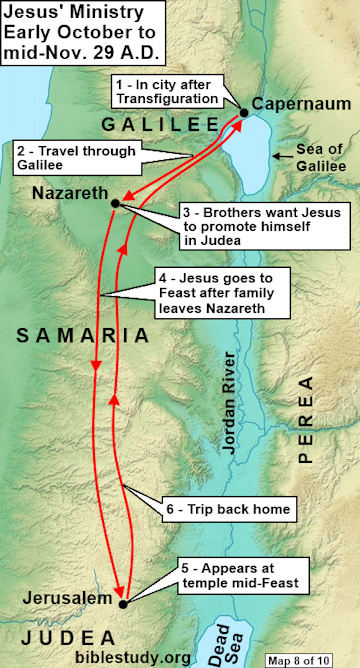
The Lord and the disciples leave Capernaum, after he returned from his transfiguration, and secretly travel through Galilee. Jesus tells his disciples about his upcoming betrayal, death and resurrection.
And while they were dwelling in Galilee, Jesus said to them, "The Son of man is about to be betrayed into the hands of men, and they shall kill Him; but the third day He shall be raised up." And they were exceedingly sorrowful. (Matthew 17:22 - 23, see also Mark 9:30 - 32 and Luke 9:43 - 45).
On his journey heading south through Galilee He meets up with his half-brothers, possibly in Nazareth. They strongly admonish him to expand his popularity by openly performing miracles in Jerusalem during the Feast of Tabernacles.
"Leave this place and go into Judea, so that Your disciples may see the works that You are doing; Because no one does anything in secret, but seeks to be seen in public. If You do these things, reveal Yourself to the world." (John 7:3 - 4).
Jesus rejects his family's suggestion to go immediately to the Feast and publicly show himself. His decision, in part, was likely due to the Jews seeking to kill him (John 7:8, 19 - 20, 25). A few days after they leave, however, he travels secretly to Jerusalem (verse 10).
Feast of Tabernacles
October 11 to 18, 29 A.D.
Keeping the Feast
The Lord, after stealthily traveling to Jerusalem and arriving during the middle of the Feast (John 7:14), goes the temple and begins preaching. The Feast of Tabernacles, in 29 A.D., ran from sunset October 10 (Monday) to sunset on the 17th (Monday), with the Last Great Day running from this sunset to sunset the next day (October 18). He begins to preach even though the Jews are watching for him (John 7:11 - 13).
Jesus reveals to the Jews that they, despite what they believe, do not keep God's laws and then asks why they seek to take his life. He additionally affirms that what he has taught has come directly from God (John 7:16 - 29).
My doctrine is not Mine, but His Who sent Me. If anyone desires to do His will, he shall know of the doctrine, whether it is from God, or whether I speak from My own self . . .
Did not Moses give you the law, and not one of you is practicing the law? Why do you seek to kill Me? . . . (John 7:16 - 17, 19).
The Jewish religious leaders desperately want to arrest Jesus. They soon learn, to their own consternation, that those celebrating the feast are actively debating whether Jesus is the Messiah.
Because of this saying, they were looking for a way to take Him (Jesus); but no one laid a hand on Him because His time had not yet come. Then many of the people believed in Him, saying, "When the Christ comes, will He do more miracles than those that this Man has done?" (John 7:30 - 31).
After the Jews send officers to arrest the Lord (John 7:32) they are told they soon will not find him!
Then Jesus said to them, "I am with you yet a little while, and then I go to Him Who sent Me. You shall seek Me, but shall not find Me; and where I am going, you are not able to come." (John 7:33 - 34).
Last Great Day
October 18, 29 A.D.
The Greatest Day
Jesus, during the morning portion of the Last Great Day, loudly proclaims the following for everyone to hear at the temple.
If anyone thirsts, let him come to Me and drink. The one who believes in Me, as the scripture has said, out of his belly shall flow rivers of living water (John 7:37 - 38).
Officers are dispatched to arrest Jesus. When asked by religious leaders why they did not carry out their duties they give an unusual response!
As a result, when the officers came to the chief priests and the Pharisees, they said to them, "Why did you not bring Him? (Jesus)"
The officers answered, "Never has a man spoken like this man." Then the Pharisees answered them, "Are you also being deceived? . . ." (John 7:45 - 47).
Nicodemus, a Pharisee who hears the report of the officers, tries to remind his fellow Sanhedrin leaders that those who are accused deserve a fair hearing (Deuteronomy 1:16 - 17). Their hatred of Jesus and his teachings, however, colors their judgment. They not only reject Nicodemus' admonishment they also insult him!
Then Nicodemus (being one of them, the one who came to Him by night) said to them, "Does our law judge any man without first hearing from him in person, and knowing what he does?"
They answered and said to him, "Are you also from Galilee? Search and see, for no prophet has ever come out of Galilee." (John 7:50 - 52).
Irony
The Pharisees were known to look down upon all others who did not receive the same religious training they did. They felt spiritually superior to all others whom they felt did not know God's law and prided themselves in "correctly" interpreting it (John 7:48 - 49). Their inflated view of themselves and negative attitude toward others is illustrated in their response to officers who chose not to arrest Jesus.
The officers answered, "Never has a man spoken like this man." Then the Pharisees answered them, "Are you also being deceived? Has even one of the rulers or of the Pharisees believed in Him? But these people who do not know the law (like they do!) are accursed." (John 7:46 - 49).
The Pharisees then chide Nicodemus by saying no prophet has ever come out of Galilee (John 7:52). Ironically, it was these religious leaders who did not know their Bibles!
The minor prophet Jonah was from Gath-hepher, a city in Zebulun's inheritance that was in Galilee (Joshua 19:13, 2Kings 14:25). The minor prophet Hosea was likely from the Galilee region, as well as Elijah the Tishbite, who was considered the greatest Old Testament prophet!
End of the Holy Day
After sunset, which ends the Last Great Day (and the fall festivals for the year), the people leave their temporary dwellings and go back home (John 7:53). Jesus, however, goes back to the Mount of Olives for the night (John 8:1).
October 19, 29 A.D.
An Adulterous Woman Judged
Jesus, at dawn on October 19, leaves the Mount of Olives and enters Jerusalem to teach at the temple (John 7:53 - 8:2). While teaching he is brought an adulterous woman caught by some religious leaders (John 8:3). They seek to know how he would judge her and her sin, given that Old Testament law demanded her life (verse 5, see also Leviticus 20:10, Deuteronomy 22:22 - 24).
Then the scribes and the Pharisees brought to Him a woman who had been taken in adultery; and after setting her in the center, they said to Him, "Teacher, this woman was caught in the very act of committing adultery. And in the law, Moses commanded us that those who commit such a sin should be stoned. Therefore, what do You say?" . . . (John 8:3 - 6).
Jesus' brief response to those wishing to entrap him, coupled with words he writes on the ground (which the Bible does not reveal), convicts the consciences of the self-righteous leaders gathered around him. They, one by one, starting from the oldest to the youngest, leave the area until all those who accused the woman are gone.
But Jesus stooped down and wrote on the ground with His finger. And as they continued to ask Him, He lifted Himself up and said to them, "Let the sinless one among you cast the first stone at her."
And again He stooped down and wrote on the ground. But after hearing this, they were convicted each by his own conscience, and went out one by one, beginning with the older ones until the last. And Jesus was left alone, with the woman standing in the center. (John 8:6 - 9).
Escaping Being Stoned
The Pharisees, on likely the same day as the incident with the adulterous woman, verbally attack Jesus while he is teaching in the temple treasury area (John 8:12 - 29). He responds to their accusations by stating they will die in their sins (verse 21). The Jews later respond that they are both physically and spiritually the descendants of Abraham (verses 33 - 41).
Jesus' answer to the claim that the Pharisees are Abraham's spiritual children is one of the most damning condemnations in the entirety of the Bible!
Therefore, Jesus said to them, "If God were your Father, you would love Me, because I proceeded forth and came from God. For I have not come of Myself, but He sent Me . . .
"You are of your father the devil, and the lusts of your father you desire to practice. He was a murderer from the beginning, and has not stood in the truth because there is no truth in him. Whenever he speaks a lie, he is speaking from his own self; for he is a liar, and the father of it." (John 8:42, 44).
After the Lord is twice accused of being possessed by a demon, he rightfully labels his accusers as liars. He then reveals directly to his accusers that he is the "I AM" or God of the Old Testament!
"Abraham your father was overjoyed to see My day; and he saw it, and rejoiced." Then the Jews said to Him, "You are not even fifty years old, and You have seen Abraham?"
Jesus said to them, "Truly, truly I say to you, before Abraham was born, I AM" (John 8:56 - 58).
Those who hear Jesus' words know full well what he is claiming. They immediately begin to gather stones to kill him for blasphemy! Christ, however, because it was not yet his time to die, escapes out of the temple (John 8:52 - 59).
October 22 to
Mid-November 29 A.D.
Punished for the Truth
Jesus, on a weekly Sabbath day, heals a man born blind by having him wash in the pool of Siloam located in Jerusalem (John 9:1 - 41). After quizzing him regarding the healing, the Jewish religious leaders simply cannot accept the fact that God was behind the miracle!
Therefore, the Pharisees in turn also asked him how he had received sight. And he said to them, "He (Jesus) put clay on my eyes, and I washed; and now I see."
Then some of the Pharisees said, "This man is not from God because He does not keep the Sabbath." Others said, "How can a man who is a sinner do such miracles?" (John 9:15 - 16).
The man healed then presents those questioning him with inescapable logic to prove Jesus had to be from God!
"This is truly an amazing thing, that you do not know where He has come from, yet He has opened my eyes. Now we know that God does not hear sinners. But if anyone is God-fearing and is doing His will, He hears him.
"From the beginning of the world it has never been heard of that anyone has opened the eyes of one who was born blind. If this man were not from God, He could do nothing." (John 9:30 - 33).
The breathtaking hardness of the Jews' hearts against Jesus, which refuses to believe the obvious facts before them, leads them to cast the man out of the synagogue! The Lord finds the man whom he healed and reveals he is the Messiah (John 9:35 - 39). He then tells him the following.
"For judgment I have come into this world so that those who do not see might see, and those who see might become blind." (John 9:39).
Some Pharisees, who are with the Lord, believe they are also being referenced as those who did not see. Jesus clarifies, however, that the exact opposite is true!
Jesus said to them, "If you were blind, you would not have sin. But now you say, 'We see.' Therefore, your sin remains." (John 9:41).
Back to Capernaum
After Jesus gives his disciples the parable of the good Shepherd (John 10:1 - 21) the group journeys the long distance back to Capernaum (Matthew 17:24).