Sequence in Chronology: 21 of 26
Topics Covered: Jesus travels to Bethany and is anointed for his burial, Jewish leaders seek to kill both Jesus and Lazarus, the Lord makes his triumphal entry into Jerusalem, religious leaders protest praises toward Jesus, a chilling prophecy regarding Jerusalem's destruction is given, the Lord throws out moneychangers from the temple.
Bible References: Matthew 21:1 - 18, Mark 11:1 - 19, Luke 19:29 - 48, John 12:1 - 19.
Previous Timeline - Next Timeline
March 29th
(Wednesday)
30 A.D.
Jesus Travels to Bethany
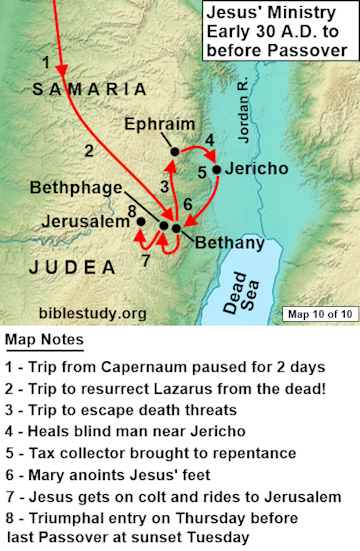
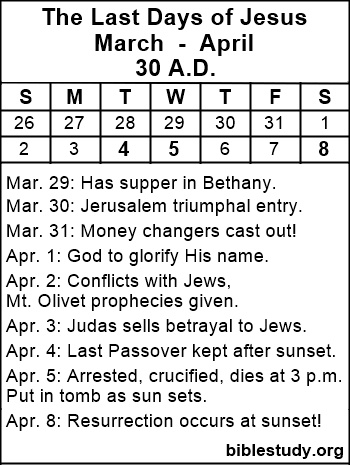
The last six days in the life of Jesus, before his last Passover, begin near sunset. His trip to Lazarus' house in Bethany began in Jericho, which is 17 miles (27.3 kilometers) away. In the early evening, after arriving in the home, he has supper (John 12:1 - 2).
Lazarus' sister Mary, after supper, anoints Jesus' feet with very expensive ointment. Judas (who carries the group's money bag) complains that what was spent on ointment could have been used to help the poor. The real reason Judas complained to Jesus was that he was a thief who wanted more money to steal.
"Why was this ointment not sold for three hundred silver coins, and given to the poor?" Now he (Judas) said this, not because he cared for the poor, but because he was a thief, and had the bag, and carried what was put in it. (John 12:5 - 6).
Jesus defends Mary's action by stating she did what she did to prepare him for his burial.
Then Jesus said, "Let her alone; she has been keeping it toward the day of My burial. For you have the poor with you always, but you do not always have Me." (John 12:7 - 8).
Put Back in the Grave?
Some Jews discover where Jesus is staying and seek out both him and Lazarus. They are absolutely fascinated at meeting someone who was dead then brought back to life. The Lord's incredibly rare and powerful miracle convicts the hearts of many Jews, including those who are religious leaders (Pharisees, priests, etc.), such that they renounce Judaism and believe in Christ!
The loss of those who once firmly believed in Judaism alarms some of the chief priests. Their loss of power, coupled with their venomous dislike of Christ, leads them to plot how to put Lazarus back in his grave!
Then a great crowd of the Jews found out that He was there. And they came, not only because of Jesus, but also that they might see Lazarus, whom He had raised from the dead.
But the chief priests took counsel in order that they might kill Lazarus also; Because by reason of him, many of the Jews were leaving them and believing in Jesus. (John 12:9 - 11, see also Luke 19:47).
March 30
(Thursday)
Triumphal Entry into Jerusalem
Jesus, on the morning of March 30, travels from Lazarus' house in Bethany to Bethphage. The trip is considered a Sabbath day's journey (1,000 yards or .91 kilometers) away from Jerusalem. He then mounts a colt for his prophetic triumphal entry into the city.
But this all took place so that it might be fulfilled which was spoken by the prophet, saying, "Say to the daughter of Sion, 'Behold, your King comes to you, meek and mounted on a donkey, and on a colt the foal of a donkey.' " (Matthew 21:4 - 5, see also John 12:15).
The gathering crowd, as he travels, begins to praise him and God (Mark 11:9 - 10). They also place their clothes and cut palm tree branches on the road in front of him.
The Pharisees hear the crowd's praises and ask Jesus to tell them to shut up! He replies that if they did not cry out praises the stones would!
. . . all the multitude of the disciples began to rejoice and to praise God with a loud voice for all the works of power that they had seen, saying, "Blessed be the King, Who comes in the name of the Lord. Peace in heaven and glory in the highest!" And some of the Pharisees in the multitude said to Him, "Master, rebuke Your disciples."
But He answered and said to them, "I tell you that if these were silent, the stones would cry out." (Luke 19:37 - 40, see also Matthew 21:1 - 11, Mark 11:1 - 10 and John 12:12 - 19).
Jesus begins to cry, something he rarely did in public, as his nears Jerusalem. He then offers the following chilling prophecy about the city's future.
"If you had known, even you, at least in this your day, the things for your peace; but now they are hidden from your eyes. For the days shall come upon you that your enemies shall cast a rampart about you, and shall enclose you around and keep you in on every side,
"And shall level you to the ground, and your children within you; and they shall not leave in you a stone upon a stone, because you did not know the season of your visitation." (Luke 19:42 - 44).
Jesus goes to the temple and teaches, and in the evening he retreats to Bethany with his disciples (Mark 11:11). Jesus' habit during his last days was to teach each day at the temple (Luke 19:47 - 48) but then leave the city at night (see Matthew 21:17, Mark 11:19 and Luke 21:37 - 38).
March 31
(Friday)
Throwing Out the Thieves!
Jesus, in the morning, travels back to Jerusalem. As he walks he grows hungry. He spots a fig tree and goes to it hoping to find figs. Finding only leaves he says to the tree "Let no one eat fruit from you ever again" (Mark 11:14). He then arrives at the temple and casts out the money changers like he did at the start of his ministry.
Then they came into Jerusalem; and after entering the temple, Jesus began to cast out those who were buying and selling in the temple; and He overthrew the tables of the money exchangers and the seats of those who were selling doves.
Moreover, He did not allow anyone to carry a vessel through the temple. And He taught, saying to them, "Is it not written, 'My house shall be called a house of prayer for all nations'? But you have made it a den of robbers." (Mark 11:15 - 17, see also Matthew 21:12 - 13 and Luke 19:45).
Money changers, notorious for being corrupt, exchanged currency for the Temple's half-shekel coin needed to pay the yearly temple tribute. Those who were poor bought doves and used them to make a temple offering.
Children begin to shout "Hosanna to the Son of David!" (Matthew 21:15) while Jesus heals at the temple. The chief priests and scribes, hearing the children, make themselves quite angry and tell him to make them stop. The Lord, in response, quotes Psalm 8 and chides the religious leaders by stating the children are fulfilling prophecy.
But when the chief priests and the scribes saw the wonderful things that He did, and the children shouting in the temple and saying, "Hosanna to the Son of David," they were indignant, and said to Him, "Do You hear what they are saying?"
Then Jesus said to them, "Yes! Have you never read, 'Out of the mouths of little children and infants You have perfected praise'?" (Matthew 21:15 - 16, see also Mark 11:12 - 17 and Luke 19:45 - 48).
Jesus then returns to Bethany for the night (Matthew 21:17, Mark 11:19).