Sequence in Chronology: 18 of 26
Topics Covered: Jesus and the disciples travel to Perea and Judea, in Bethany the Lord gently chastises Martha, Christ is accused of using Satan's power to cast out demons after which he gives the sign of Jonah to prove he preaches the truth and that he is the Messiah.
Religious leaders are warned of vanity and other sins, a large crowd warned of Pharisaic hypocrisy and the unpardonable sin, Jesus teaches God will take care of those dedicated to him and that he came to bring division, time and chance can happen to all, several parables are given, the Lord discusses whether few people will be saved and then predicts Jerusalem and its temple will be destroyed.
Bible References: Luke 10:38 - 42, 11:1 - 54, 12:1 - 59, 13:1 - 35.
Previous Timeline - Next Timeline
Travel to Perea and Judea
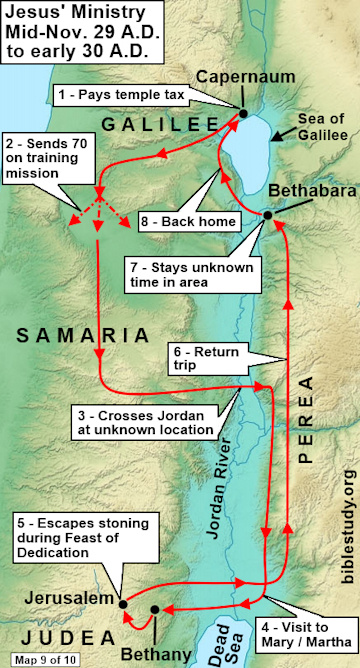
Jesus continues traveling south through Samaria and at some unknown point crosses over to the eastern side of the Jordan river (Matthew 19:1, Mark 10:1). He travels south through Perea then crosses back over to continue his journey to Bethany. While in the city he is the dinner guest of Mary and Martha. He ends up gently correcting Martha for trying to get her sister to help her.
But Martha was distracted because of much serving; and she came to Jesus and said, "Lord, is it of no concern to You that my sister (Mary) has left me to serve alone? Now then, speak to her, so that she will help me."
Then Jesus answered and said to her, "Martha, Martha, you are full of care and troubled about many things; but there is one need above all else; and Mary has chosen the good part, which shall not be taken from her." (Luke 10:40 - 42).
Accused of Demon Possession!
The Lord teaches the disciples to pray and that the Father will give the Holy Spirit to those who ask him (Luke 11:1 - 13). He then casts a demon out of a man only to be accused of possessing one himself!
But some of them said, "He is casting out demons by the power of Beelzebub, prince of the demons." . . .
But He, knowing their thoughts, said to them, "Every kingdom divided against itself is brought to desolation; and a house divided against a house falls. And if Satan also is divided against himself, how shall his kingdom stand? Consider now, because you are saying that I cast out demons by Beelzebub.
"And if I by Beelzebub cast out demons, by whom do your sons cast them out? Because of this, they shall be your judges." (Luke 11:15, 17 - 19).
What is the unspoken answer to Jesus' question concerning by whom the Jew's sons cast out demons? The answer is that they could not do so! The Lord's answer, given the nasty condemnations he received, was meant to be a bit facetious.
Seven Times Worse
The Lord reveals a fascinating characteristic of demon possession unknown to humans. He warns that someone freed of a demon must replace it with God in his or her life or else they will be worse off!
"When the unclean spirit has gone out of a man, it goes through waterless places, seeking rest; and when it does not find any, it says, 'I will return to the house from which I came out.'
"And when it comes, it finds it swept and adorned. Then it goes and takes seven other spirits more wicked than itself, and they enter in and dwell there; and the last state of that man is worse than the first." (Luke 11:24 - 26).
Jesus' Only Sign
The Jews who lived at the time of Jesus wanted a miraculous sign to confirm his authority, truthfulness and that he was the promised Messiah. Their faithless demand that an immediate miracle be performed (which was tempting God) was rejected.
The Jews first demanded a sign from Jesus in the summer of 28 A.D. (Matthew 12:38 - 42). The second time they did so was after he miraculously fed 4,000+ people in mid-29 A.D. (Matthew 16:1 - 4, Mark 8:10 - 13). Their request in Luke 11 is the third and last time the gospels record such a demand.
"This is an evil generation, seeking after a sign; but no sign shall be given to it except the sign of Jonah the prophet. For as Jonah was a sign to the Ninevites, in the same way also shall the Son of man be a sign to this generation . . ." (Luke 11:29 - 30).
Jonah experienced three days in a large fish, symbolic of death, before being freed and appearing alive to preach to the Ninevites. Jesus offered the sign of Jonah to his generation to prove who he was. This sign entailed him being dead and buried for three complete days before being resurrected (freed from death) and allowed to continue his ministry.
Religious Vanity!
Jesus, after offering the sign of Jonah, gives the parable of the light of the world (Luke 11:33). He is then invited to a Pharisees' house for a meal (verse 37). Christ, during the meal, warns the religious leaders in attendance about their vanity, pettiness and other sins.
"Now, you Pharisees cleanse the outside of the cup and the dish, but inside you are full of greediness and wickedness. Fools, did not He Who made the outside also make the inside? . . .
"But woe to you, Pharisees! For you pay tithes of mint and rue and every herb, but you pass over the judgment and the love of God. It is obligatory for you to do these things, and not to set aside those lesser things.
"Woe to you, Pharisees! For you love the chief seat in the synagogues and the salutations in the marketplaces. Woe to you, scribes and Pharisees, hypocrites! . . ." (Luke 11:39 - 40, 42 - 44).
The Lord then chastises the doctors of the law who felt he was insulting them!
"Woe to you also, doctors of the law! For you weigh men down with burdens heavy to bear, but you yourselves do not touch the burdens with one of your fingers. Woe to you! For you build the tombs of the prophets, whom your fathers killed . . .
"Woe to you, doctors of the law! For you have taken away the key of knowledge; you yourselves did not enter, and you prevented those who were entering." (Luke 11:46 - 47, 52).
Beware of Hypocrisy!
A large crowd, gathered outside the Pharisee's home who hosted Jesus, are warned to be wary of the hypocrisy of religious leaders (Luke 12:1 - 3). They are also taught about fearing God and the unpardonable sin.
"And I tell you, everyone who shall confess Me before men shall the Son of man also confess before the angels of God; But the one who has denied Me before men shall be denied before the angels of God.
"And everyone who shall say a word against the Son of man, it shall be forgiven him; but the one who has blasphemed against the Holy Spirit shall not be forgiven" (Luke 12:8 - 10).
A Precious Promise
Jesus also warns that life is more than possessions (Luke 12:13 - 21) and that the highest priority one can have is seeking God's Kingdom. He then promises that if we make the Kingdom first in our lives, he will take care of us.
And He said to His disciples, "Because of this, I tell you, do not be anxious about your life, what you shall eat; nor about your body, what you shall put on. The life is more than food, and the body is more than clothing . . ."
"Then do not be seeking what you shall eat or what you shall drink, and do not be anxious. For all the nations of the world seek after these things; and your Father knows that you have need of these things. But seek the kingdom of God, and all these things shall be added to you. (Luke 12:22 - 23, 29 - 31).
He further teaches that believers should be watching and prepared for his return at any time (Luke 12:35 - 48).
The Lord then makes the rather eye-opening statement that his appearance on earth was not to bring it peace but to spur division between the converted and those who are not.
"Do you think that I came to bring peace on the earth? No, I tell you, but rather division; Because from this time forward there shall be five in one house divided, three against two and two against three. Father shall be divided against son, and son against father . . ." (Luke 12:51 - 53).
Jesus then chastises his generation for not knowing the importance of the time they are living in (Luke 12:54 - 57). He also warns to settle quickly with one's adversary or risk losing everything in a judgment against them (verses 58 - 59).
Time and Chance
It was commonly believed, in the first century A.D., that those who were rich were made so through blessings God granted them for pleasing him. Conversely, it was also felt that the calamities and trials that a person experienced were a direct result and "reward" for sinning against God (see John 9:1 - 3, Mark 10:23 - 26). Jesus refuted this popular belief by stating time and chance (being at the wrong place at the wrong time) can adversely affect any human at any time.
Now at the same time, there were present some who were telling Him about the Galileans, whose blood Pilate had mingled with their sacrifices. And Jesus answered and said to them, "Do you suppose that these Galileans were sinners above all Galileans, because they suffered such things? No, I tell you . . . (Luke 13:1 - 3).
The Lord then gives the parable of the unfruitful fig tree (Luke 13:6 - 9).
Rebuke and Parables
Later, while teaching in a synagogue, the Lord mercifully heals a woman who had been physically bent over for eighteen years. The ruler of the synagogue rebukes Jesus based on the erroneous Jewish tradition that healing was work prohibited by the Sabbath! His misguided zeal is sharply criticized by the Lord.
Then He laid His hands on her; and immediately she was made straight, and she glorified God.
But the ruler of the synagogue answered with indignation because Jesus had healed on the Sabbath, and said to the people, "There are six days in which men are obligated to work; therefore, during those days come and be healed, but not on the Sabbath day."
Therefore, the Lord answered him and said, "Hypocrite! Does not each one of you on the Sabbath loose his ox or his donkey from the manger and lead it away to drink? And is it not just as necessary for this woman, being a daughter of Abraham, whom Satan has bound, lo, eighteen years, to be loosed from this bond on the Sabbath day?" (Luke 13:13 - 16).
Following this event the parables of the mustard seed and the hidden leaven (Luke 13:18 - 21) are taught.
Only a Few Saved?
Someone approaches Jesus wondering if only a few people will be ultimately saved. In response, he gives a parable about a narrow gate and warns that salvation cannot be received simply by knowing who he is and what he teaches. Those who claim they are Christians and believe in Jesus must also obey him and God's law!
"Strive with your whole being to enter in through the narrow gate; for many, I say to you, will seek to enter in, but shall not be able. Once the Master of the house has risen up and has shut the door, and you begin to stand outside the door and knock, saying, 'Lord, Lord, open to us'; then shall He answer and say to you, 'I do not know you or where you are from.'
"And you shall begin to say, 'We ate and drank in Your presence, and You have taught in our streets.' And He shall say, 'I tell you, I do not know you or where you are from. Depart from Me, all you workers of unrighteousness.' (Luke 13:24 - 27).
Later the same day he informs the Pharisees that not only will his life be taken in Jerusalem, the city and its magnificent temple will soon be attacked and destroyed (Luke 13:31 - 35).