Sequence in Chronology: 12 of 26
Topics Covered: At the Sea of Galilee Jesus gives the parable of the Sower, the Sower parable baffles the disciples, Jesus explains why he uses parables, the Sower parable is explained.
Concentration of Matthew 13 parables such as the tares, the growing seed, the mustard seed and others, explanation of how Galilee's sea formed, the Lord calms a stormy sea.
Bible References: Matthew 13:1 - 53, Mark 4:1 - 41, Luke 8:4 - 18, 22 - 25.
Previous Timeline - Next Timeline
A Perplexing Parable
After arriving back in Capernaum the Lord travels the short distance to the Sea of Galilee. He gets on a boat and begins preaching to a large crowd gathered on the land. He then gives the parable of the Sower.
"The sower went out to sow his seed; and as he sowed, some seed fell by the road; and it was trampled upon, and the birds of heaven devoured it. And other seed fell upon the rock; and after it had sprung up it withered because it did not have any moisture.
"And other seed fell among the thorns; and after springing up together, the thorns choked it. And other seed fell upon the good ground, and after springing up produced fruit a hundredfold." (Luke 8:5 - 8, see also Matthew 13:1 - 9 and Mark 4:1 - 9).
Why Parables?
The meaning of the parable of the Sower baffles Jesus' disciples. Their cluelessness motivates them to ask the Lord why he teaches using parables. His response reveals they are given to HIDE spiritual truth from the public!
Only those God is working with can fully understand the profound spiritual information hidden within Jesus' parables. His use of such a teaching tool, and the response it receives, is a fulfillment of the prophecy recorded in Isaiah 6:9 - 10.
"Because it has been given to you to know the mysteries of the kingdom of heaven, but to them (those who God is not working with) it has not been given.
"For this reason I speak to them in parables, because seeing, they see not; and hearing, they hear not; neither do they understand. And in them is fulfilled the prophecy of Isaiah, which says, 'In hearing you shall hear, and in no way understand; and in seeing you shall see, and in no way perceive . . .' (Matthew 13:11, 13 - 14, see also Mark 4:10 - 12 and Luke 8:9 - 10).
Explaining the Sower
The Lord explains the parable of the Sower to his disciples.
"Now this is the parable: The seed is the Word of God; And those that fell by the road are the ones who hear, but the devil comes and takes away the Word from their heart, lest they should believe and be saved.
"And those that fell upon the rock are the ones who, when they hear, receive the Word with joy; but these do not have any root, who believe only for a while, and in time of trial fall away.
"And those that fell into the thorns are the ones who have heard, but are choked while pursuing the cares and riches and pleasures of life, and do not bring any fruit to maturity.
"And those that fell on the good ground are the ones who, in a right and good heart, hear the Word and keep it, and bring forth fruit with endurance." (Luke 8:11 - 15, see also Matthew 13:18 - 23 and Mark 4:13 - 20).
The Teachings Continue
Jesus next gives the light of the world parable (Mark 4:21, Luke 8:16) and declares everything that is done in secret will one day be manifested to all.
For there is nothing hidden that shall not be made manifest; nor has any secret thing taken place, but that it should come to light (Mark 4:22, see also Luke 8:17).
He also teaches the believers are responsible for what they hear.
"Take heed to what you hear: for with whatever measure you use, it shall be measured back to you; and to those who hear, it shall be added.
"For whoever has, to him shall more be given; but the one who does not have, even that which he has shall be taken from him." (Mark 4:24 - 25, see also Luke 8:18).
Still More Parables!
Jesus continues his teaching of his disciples by giving the parable of the tares (Matthew 13:24 - 30), a growing seed (Mark 4:26 - 29), a mustard seed (Matthew 13:31 - 32, Mark 4:30 - 32) and leaven (Matthew 13:33). He then reiterates the purpose of his parables (Matthew 13:34 - 35).
The Lord, after dismissing the crowd and going back home to Capernaum, explains the parable of the tares (Matthew 13:36 - 43, Mark 4:33 - 34). He then offers the parables of hidden treasure (Matthew 13:44), a pearl of great price (verses 45 - 46) and a fisherman's net (47 - 50).
After confirming his disciples understand his teachings (Matthew 13:51) he gives the parable of the householder (verse 52) and leaves the area (verse 53).
Concentration of Wisdom
Matthew 13 is fascinating as it contains eight parables. This represents the highest concentration of such stories in a single New Testament chapter! It also records the largest number of unique parables, six, not found in the other three gospel accounts.
The unique parables of Matthew 13 are the tares, leaven, the hidden treasure, the pearl of great price, the fisherman's net and the householder.
Calming the Sea
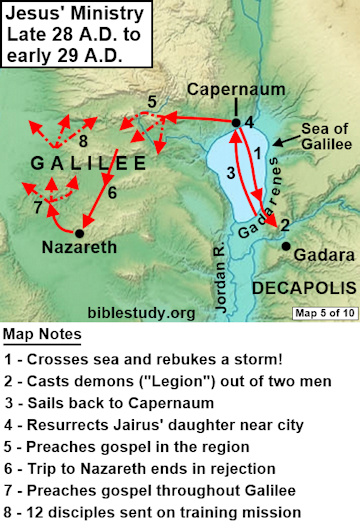
Jesus, noticing great crowds of people beginning to gather, informs his disciples it is time for them to sail from Capernaum to the other side of the sea. Before the group leaves he teaches two men that they must make him a priority in their lives (Matthew 8:18 - 22).
Jesus and the disciples get on a boat and begin to travel east on the Sea of Galilee toward the Gadarenes, an area where the city of Gadara was located. When the Lord falls asleep a violent windstorm rocks the ship and causes huge waves to rapidly fill the vessel with water. After he is woke up by the disciples, he chastises them for their lack of faith and quiets the storm.
Now a great tempest suddenly arose in the sea, so great that the ship was being covered by the waves; but He was sleeping. And His disciples came to Him and awoke Him, saying, "Lord, save us! We are perishing."
And He said to them, "Why are you afraid, O you of little faith?" Then He arose and rebuked the winds and the sea, and there was a great calm. (Matthew 8:24 - 26, see also Mark 4:35 - 41 and Luke 8:22 - 25).
The Sea of Galilee
The Sea of Galilee is also known as the Sea of Chinnereth (Numbers 34:11), Chinneroth (Joshua 12:3), the Sea of Tiberias (John 6:1) or Lake Gennesaret (Luke 5:1). It is the lowest freshwater lake on the planet and the second-lowest lake overall. The lowest lake on earth is the Dead Sea.
The Dead Sea Rift is a series of faults that run south from modern southeastern Turkey through the Jordan Valley to the Dead Sea. The rift forms the boundary between two large masses of land known as the African (west of the Jordan River) and Arabian (which lies east of the river) continental plates. Galilee's sea was formed by the motion of these plates.
Most of the events in the life and ministry of Jesus took place in Galilee and either on or near its sea. It was the Lord's relationship with the region and its body of water, including his calling of several fishermen (Peter, Andrew, James, John), that lent to the use of the Ichthus (fish) symbol to represent Christians.