Sequence in Chronology: 4 of 26
Topics Covered: Chronological basis for timeline, John the Baptist's ministry begins, John denies he is the Christ and affirms his calling, religious leaders are warned to produce fruits worthy of repentance, the crowds listening to John are given examples of what they must do to show they have repented of their sins.
Jesus travels from Nazareth to Bethabara and is baptized at the age of thirty, serving God and the number thirty, the Lord is uniquely tempted by Satan the devil for 40 days, angels help Jesus after which he travels back to Bethabara where John is baptizing.
Bible References: Matthew 3:1 - 4:11, Mark 1:1 - 13, Luke 3:1 - 18, 21 - 22, 4:1 - 13, John 1:6 - 27.
Previous Timeline - Next Timeline
Chronological Template
The gospel accounts reveal a basic framework of events with known dates that can greatly help us comprehend the events of Jesus' ministry and their relationship with one another. This outline, primarily centered on God's annual Feast (Holy) Days which Jesus and the early New Testament Church kept, allows us to construct a fairly accurate timeline (most of the time) from the Lord's baptism to his ascension to God's right hand.
March 26 A.D.
John's Ministry Begins!
John the Baptist's ministry begins about six months before Jesus' ministry starts (see Matthew 3:1 - 12, Mark 1:1 - 8, Luke 3:1 - 18 and John 1:6 - 27). This means it started in the early to middle part of March just before Passover was celebrated on March 22.
John's purpose is to prepare the people for Jesus' ministry, which is a fulfillment of the prophecy given in Isaiah 40:3. He begins, in the wilderness of Judea, by calling people to repent of their sins.
Now in those days John the Baptist came preaching in the wilderness of Judea, And saying, "Repent, for the kingdom of heaven is at hand."
For this is he who was spoken of by Isaiah the prophet, saying, "The voice of one crying in the wilderness, 'Prepare the way of the Lord, make straight His paths.' "
Now John himself wore a garment of camel’s hair, and a leather belt around his waist; and his food was locusts and wild honey. Then went out to him those from Jerusalem, and all Judea, and all the country around the Jordan, and were being baptized by him in the Jordan, confessing their sins. (Matthew 3:1 - 6).
Denying He Was Christ
Jewish religious leaders, after John's ministry begins, press him to reveal who he is and the purpose of his preaching. John openly denies he is not the Christ many expected, or Elijah, or even "the Prophet" spoken of by Moses (see Deuteronomy 18:15).
And this is the testimony of John, when the Jews sent priests and Levites from Jerusalem to ask him, "Who are you?" Then he freely admitted, and did not deny, but declared, "I am not the Christ."
And they asked him, "Then who are you? Are you Elijah?" And he said, "I am not." Then they asked, "Are you the Prophet?" And he answered, "No." Therefore, they said to him, "Who are you? What do you say about yourself so that we may give an answer to those who sent us?"
He said, "I am a voice crying in the wilderness, 'Make straight the way of the Lord,' as Isaiah the prophet said." (John 1:19 - 23).
Link to Abraham Not Enough!
John's public preaching draws huge crowds which include religious leaders like the Pharisees and Sadducees. He is moved to warn these leaders that merely being a physical descendant of Abraham was not enough to insure their entrance into the Messiah's kingdom. They must prove any repentance by changing their ways and doing what is right!
But after seeing many of the Pharisees and Sadducees coming to his baptism, he said to them, "You brood of vipers, who has forewarned you to flee from the coming wrath? Therefore, produce fruits worthy of repentance;
"And do not think to say within yourselves, 'We have Abraham for our father'; for I tell you that God is able from these stones to raise up children to Abraham." (Matthew 3:7 - 9, see also Luke 3:7 - 9).
John also offers examples, to the crowds hearing his preaching, of what constitutes fruits worthy of repentance (Luke 3:10 - 14). He also reveals that the coming Messiah (Jesus) will have the ultimate authority of judgment over all humans (Matthew 3:10 - 12, Mark 1:7 - 8, Luke 3:9, 16 - 17).
September 2 (Monday)
to 10 (Tuesday), 26 A.D.
Birthday and Baptism
On Monday, September 2 Jesus turns thirty years old. This is by far the most important birthday of his entire life!
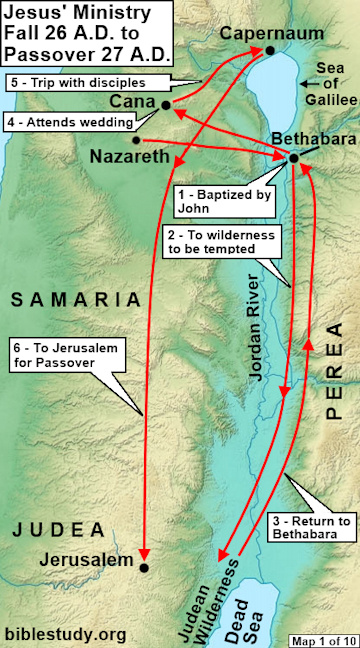
The Lord, after turning this momentous age, travels from his boyhood home of Nazareth (Mark 1:9) to Bethabara (John 1:28) to be baptized. It is the place where John the Baptist, for the past six months, has been calling for people to repent of their sins and be baptized (John 1:19 - 27).
Interestingly, John does not know in advance who exactly is the Messiah (John 1:31, 33). God has told him, however, to look for a special sign denoting who is His only Son. This sign (likely only visible to John), which will occur after the baptism, will be the Holy Spirit descending out of heaven and remaining on the person (ultimately Jesus).
John witnesses the sign of the Messiah immediately after the baptism when Jesus comes up from the Jordan River (Matthew 3:16, Mark 1:10). He sees God's spirit, like a dove, descend and remain upon Christ (Matthew 3:16, Mark 1:10, Luke 3:21 - 22, John 1:32 - 34). John then hears a voice from heaven which says the following.
This is My Son, the Beloved, in Whom I have great delight (Matthew 3:17, see also Mark 1:11, Luke 3:22).
This marks the first time God the Father (likely through an angel, since no one has heard his actual voice at any time - see John 5:37), from heaven, audibly confirms Jesus is His Son and endorses His ministry.
Why Thirty?
Jesus was thirty years old when he was baptized by John the Baptist (Luke 3:23). Why was it important for Jesus to wait until this age to begin his ministry?
Thirty was the minimum age a Levite had to reach before entering into the priestly service (Numbers 4:3, 23, 47). This age was considered the start of a man's prime when he achieved maturity in both body and mind.
Thirty was the age where it was felt a man could handle major responsibilities. It was also a tradition at the time that a rabbi could not begin his public teaching ministry until his thirtieth year.
The Wilderness of Judea
God's spirit, after his baptism, leads Jesus to travel from Bethabara south, along the eastern side of the Jordan, all the way down to the Judean wilderness located on the western side of the Dead Sea (Matthew 3:13 - 17, Mark 1:9 - 11, Luke 3:21 - 22).
Jesus' 40 days of fasting and temptation by the devil took place in the wilderness (Matthew 4:1, Mark 1:12, Luke 4:1). Tradition places this area between Jerusalem and the Dead Sea.
The Biblical definition of a wilderness, however, differs with our modern understanding of these areas. Wildernesses, today, are defined as areas that are uncultivated and uninhabited by humans (Merriam-Webster dictionary). They are places that have not been significantly modified by human activity (Wikipedia).
Wilderness areas in Scripture, however, did have people living in them. The Judean location of the temptation, at the time of Joshua, was labeled a wilderness area even though it possessed six cities and their surrounding towns that were given to Judah as a Promised Land inheritance (Joshua 15:61).
September 11
(Wednesday)
26 A.D.
Tested in the Wilderness
Jesus arrives in the Judean wilderness and begins his forty days of fasting which kicks off his ministry. During this period he will experience unparalleled temptations at the hands of God's great adversary. His fast, and the devil's forty-day long marathon to tempt him, likely began on the Day of Atonement (Yom Kippur) which occurred on Wednesday, September 11.
September 11 is especially appropriate for the beginning of Jesus' awesome struggle as it was also the start of the 50th or Biblical Jubilee Year that was to be heralded on the Day of Atonement. The Jubilee year is a time when liberty from debt, servitude and loss was to be proclaimed throughout the land (see Leviticus 25 and 27).
September 11 (Wednesday)
to October 20 (Sunday) 26 A.D.
Fasting and Temptations
Both Matthew and Luke each list three specific temptations, directed at our Savior, toward the end of his fast. Satan's last subtle lies were chosen to appeal to any human-based weaknesses and desires Jesus might choose to indulge (Matthew 4:1 - 11, Mark 1:12 - 13, Luke 4:1 - 13).
The first of the devil's last three temptations centered around trying to get Jesus to prove he was God in the flesh by immediately alleviating his hunger through a miracle (Matthew 4:3 - 4, Luke 4:3 - 4). His next temptation was to challenge the Lord to prove his Father's love by jumping off a high location to see if he would be kept from injury (Matthew 4:5 - 7, Luke 4:9 - 12).
The last, and perhaps greatest, temptation that came to Christ was to forego the prophetic trials, pain and tortuous death that awaited him and instead immediately rule over mankind. The "catch" was that he had to worship the devil as if he were god and serve him instead of his Father.
After that, the devil took Him to an exceedingly high mountain, and showed Him all the kingdoms of the world and their glory, and said to Him, "All these things will I give You, if You will fall down and worship me."
Then Jesus said to him, "Begone, Satan! For it is written, 'You shall worship the Lord your God, and Him alone shall you serve.'" (Matthew 4:8 - 10, see also Luke 4:5 - 8).
Unique and Intense Temptation
Jesus' temptation is unique for its length, as the Lord was tempted to sin (while fasting!) not just for a day or two but during the ENTIRE 40 day period! Other well-known 40-day fasts (e.g. Moses, Elijah) did not entail enticements to sin!
It was also uniquely intense as the devil almost certainly threw every subtle lie and half-truth at Christ he had used to turn ALL of the angels he supervised into enemies of God (Revelation 12:4). Satan also constantly appealed to the Lord's physical needs as a human and sought to exploit against him every trace of human nature he inherited from Mary.
The devil even tried to leverage Jesus' divine perfect love for humanity by offering him a chance to immediately rule the earth and avoid the pain and suffering that awaited him (Luke 4:5 - 7).
Satan the devil, lastly, was uniquely allowed to manifest himself in his true spiritual form to personally, and directly, tempt a human face-to-face!
October 20
26 A.D.
The Trial Ends . . . for Now
Satan's concentrated temptations finally ended on Sunday, October 20, exactly forty days after they began. The devil, of course, continues his laser-focused attempt to tempt Christ to sin a short time later.
After overcoming the temptation of the adversary, the "god of this world" (John 12:31, 2Corinthians 4:4), Jesus is in a weakened physical state. God sends angels to help minister to him.
Then the devil left Him; and behold, angels came and ministered to Him. (Matthew 4:11, see also Mark 1:13).
After what was likely a few days of regaining his strength, Jesus makes the journey back to Bethabara and arrives there near the end of October (John 1:28).