Sequence in Chronology: 14 of 26
Topics Covered: John the Baptist is beheaded, twelve disciples return from training mission, Jesus miraculously feeds 10,000 people then later feeds 4,000+, the Lord walks on water and enables Peter to also do so, in Capernaum many disciples lose faith and stop following the Lord, disciples warned about the vain traditions of Jewish religious leaders.
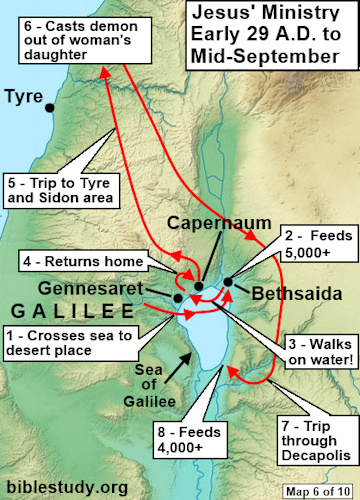
Jesus and the disciples travel to the region of Tyre where a woman's daughter is healed, the group then travels to the eastern side of the Sea of Galilee and through the Decapolis, countless people are healed.
Bible References: Matthew 14:1 - 36, 15:1 - 39, 16:1 - 12, Mark 6:14 - 56, 7:1 - 37, 8:1 - 26, Luke 9:7 - 17, John 6:1 - 71, 7:1.
Previous Timeline - Next Timeline
Early 29 A.D.
Martyr for the Truth
John the Baptist is beheaded by Herod Antipas at an unknown time before Passover (April 16) in 29 A.D. He is murdered at the palatial fortress called Machaerus during the famous celebration of Herod's birthday.
Now when they were celebrating Herod’s birthday, the daughter of Herodias (produced through Antipas' half-brother Herod Philip I) danced before them; and it pleased Herod. Therefore, he promised with an oath to give her whatever she might ask. Then, being urged by her mother, she said, "Give me, here on a platter, the head of John the Baptist" (Matthew 14:6 - 8, see also verses 1 - 11, Mark 6:14 - 28, Luke 9:7 - 9).
Machaerus was located east of the Dead Sea in Perea. It was initially built by Alexander Jannaeus, then destroyed by Rome, then rebuilt and expanded by Herod the Great as his personal refuge.
After John dies his disciples retrieve his body and bury it. They then travel to tell Jesus what had happened (Matthew 14:12, Mark 6:29). John's ministry, both active and inactive (while he was in prison), lasted roughly three years.
April to
Mid-September
29 A.D.
Reporting Back
Jesus' twelve disciples, after the Lord learns of John's death, come back to him and report all they did during their training mission (Mark 6:30, Luke 9:10).
A Failed Attempt to Rest
The news of John the Baptist's death, coupled with the huge crowd gathering around him, motivates Jesus to leave the area. He and his disciples get on a boat and sail across the Sea of Galilee until they reach its northeastern shore. They then travel to a wilderness area near Bethsaida. A swarm of people, however, follow the boat from land and meet up with the Lord (Matthew 14:13 - 14, Luke 9:11)!
Miraculously Feeding 10,000?
The crowd that followed Jesus as he journeyed near Bethsaida numbers 5,000 men with an unknown number of women and children. This means there could have easily been as many as 10,000 or more who heard the Lord preach and were fed!
Jesus, after preaching to the crowd, miraculously feeds them all with just five loaves of bread and two fishes (Matthew 14:13 - 21, Mark 6:30 - 42, Luke 9:10 - 17, John 6:1 - 13). Perceiving the people wanted to make him king, the Lord tells his disciples to sail back across the sea while he dismisses the crowd. He then goes up to a mountain to pray (John 6:14 - 17, Mark 6:45 - 46, Matthew 14:22 - 23).
Jesus Walks on Water!
The disciples' boat soon runs into strong winds which drag it south and off course despite their efforts to bring it until control. Jesus, noticing what is taking place from the shore, decides to walk on water to the boat! When he is sighted through the darkness of the lake at around 3 a.m. (Mark 6:48) the disciples are greatly frightened and think they are seeing an apparition.
And when the disciples saw Him (Jesus) walking on the sea, they were troubled and said, "It is an apparition!" And they cried out in fear (Matthew 14:26).
Impulsive Peter, who recognizes it is the Lord, boldly asks to walk on water toward him. Peter's trip is cut short, however, when his lack of faith causes him to begin sinking!
. . . And after climbing down from the ship, Peter walked upon the waters to go to Jesus. But when he saw how strong the wind was, he became afraid; and as he was beginning to sink, he cried out, saying, "Lord, save me!"
And immediately Jesus stretched out His hand and took hold of him, and said to him, "O you of little faith, why did you doubt?" (Matthew 14:29 - 31, see also Mark 6:47 - 52, John 6:18 - 21).
The sea immediately becomes calm the moment Christ steps in the boat!
Sailing to Gennesaret
The ship Jesus and the disciples are on soon arrives at the land of Gennesaret located near the city of the same name (Matthew 14:34, Mark 6:53). Jesus, once the group comes ashore, is mobbed by people seeking, if possible, to touch his clothes so that they can be healed!
And when they came out of the ship, those who dwelt there immediately recognized Him. Then they ran through all the country around, and began to carry those who were sick on stretchers, taking them wherever they heard that He was.
And wherever He entered into villages or cities or fields, they laid in the marketplaces those who were sick; and they besought Him that they might only touch the border of His garment; and all those who touched Him were healed. (Mark 6:54 - 56, see also Matthew 14:34 - 36).
Jesus and his followers eventually make their way back to Capernaum.
True Bread from Heaven
Many of those fed by Christ, unaware where he went after leaving Bethsaida, track him down to Capernaum's synagogue (John 6:24, 59). When they arrive Jesus teaches them, along with his followers who are in attendance, what is the true work of God.
Therefore, they said to Him, "What shall we do, in order that we ourselves may do the works of God?" Jesus answered and said to them, "This is the work of God: that you believe in Him Whom He has sent." (John 6:28 - 29).
The Lord then teaches that he is the true Bread, or manna, from heaven. This bread, he states, gives life to all those who eat it.
Then Jesus said to them, "Truly, truly I say to you, Moses did not give you the bread from heaven; but My Father gives you the true bread from heaven.
"For the bread of God is He Who comes down from heaven and gives life to the world." . . .
Jesus said to them, "I am the bread of life; the one who comes to Me shall never hunger; and the one who believes in Me shall never thirst at any time." (John 6:32 - 33, 35).
Jesus further stresses he came to do God's will and that his goal is to save all those who believe in him. He also reveals that no one can come to him (Jesus) unless God the Father draw him.
"And this is the will of the Father Who sent Me: that of all whom He has given Me, I should not lose any, but should raise them up in the last day . . .
"No one can come to Me unless the Father, Who sent Me, draws him; and I will raise him up at the last day." (John 6:39, 44).
Catalyst for Rejection
Jesus follows up his teachings with a profound spiritual truth that shocks and offends most of his listeners!
. . . Jesus said to them, "Truly, truly I say to you, unless you eat the flesh of the Son of man, and drink His blood, you do not have life in yourselves.
"The one who eats My flesh and drinks My blood has eternal life, and I will raise him up in the last day; For My flesh is truly food, and My blood is truly drink." (John 6:53 - 55).
Those who hear the Lord's words (John 6:22 - 71) are dumbfounded and astonished. They are unable to understand the true meaning and symbolism of what is being taught. Many of them, no doubt, thought Jesus was teaching cannibalism!
Jesus, of course, knew what would be the effect of his teaching on the crowd. He was fully aware his statements would cause those whom God was not working with, who lacked faith in him, to recoil and choose not to follow him any longer.
Therefore, after hearing these words, many of His disciples said, "This is a hard saying. Who is able to hear it?" But Jesus, knowing that His disciples were complaining about this, said to them, "Does this offend you? . . . "
"But there are some of you who do not believe." For Jesus knew from the beginning who were the ones that did not believe, and who would betray Him . . . From that time, many of His disciples went back and walked no more with Him (John 6:60 - 61, 64, 66).
Jesus' personally selected disciples, however, continue to follow him. He begins to travel through Galilee on his way to Capernaum so that he can continue to avoid those in Judea seeking to kill him (John 7:1).
Vain Traditions
A group of Jewish religious leaders from Jerusalem visit Jesus and criticize him for his disciples not ceremonially washing their hands before each meal.
Why do Your disciples transgress the tradition of the elders? For they do not wash their hands when they eat bread (Matthew 15:2).
Jesus' response is to ask them a pointed question.
Why do you also transgress the commandment of God for the sake of your tradition? (Matthew 15:3).
The Bible then points out that there are many other practices the Jews promote which they (erroneously) teach are as binding as God's laws. These include the ceremonial washing of plates, utensils and even tables (Mark 7:4, 8). Jesus then zeroes in on the practice of Corban.
"Full well do you reject the commandment of God, so that you may observe your own tradition.
"For Moses said, 'Honor your father and your mother'; and, 'The one who speaks evil of father or mother, let him be put to death.' But you say, 'If a man shall say to his father or mother, "Whatever benefit you might receive from me is corban" (that is, set aside as a gift to God), he is not obligated to help his parents.'
"And you excuse him from doing anything for his father or his mother, nullifying the authority of the Word of God by your tradition which you have passed down; and you practice many traditions such as this." (Mark 7:9 - 13).
Corban is the practice of irreversibly dedicating money to the temple. Jesus states that this Jewish (not Biblical) tradition nullifies the fifth commandment. He then explains that it does so by teaching money dedicated to the temple was far more important than a person's obligation to take care of their needy parents (Matthew 15:4 - 6).
Spiritual Defilement
Jesus then reveals to his followers that humans are not spiritually defiled if they do not practice the man-made rules promoted by the Jews. A person is spiritually unclean before God through the evil thoughts and intents of their heart which motivates them to sin in word and deed (Mark 7:14 - 23, Matthew 15:10 - 20).
Crumbs from the Table
The Lord then leaves Galilee, travels to the area near Tyre and Sidon, then stays at an unknown house. A Canaanite (non-Israelite) woman discovers where he is located and, kneeling at his feet, begs for him to cast a demon out of her daughter. Jesus, rather oddly, does not say a word to her. She again makes her request and receives the following response.
But He answered and said, "It is not proper to take the children’s bread and throw it to the dogs." And she said, "Yes, Lord, but even the dogs eat of the crumbs that fall from their master’s table" (Matthew 15:26 - 27, HBFV).
Jesus, impressed with the woman's persistence and faith, heals her daughter (Matthew 15:22 - 28, Mark 7:24 - 30).
Taking the Long Way Home
The Lord, instead of taking the direct route back home, decides to travel to the eastern side of the Sea of Galilee. He then journeys through a region known as the Decapolis (ten cities) then makes his way to the Sea of Galilee. Arriving near the sea he heals a deaf man (Mark 7:31 - 37). Continuing his journey as he skirts around the sea, he finds an elevated area in which to preach and subsequently heals countless people (Matthew 15:29 - 31).
Miraculously Feeding 4,000+
After preaching for three days Christ is concerned those listening to him have had nothing to eat. Utilizing seven bread loaves and a few fish he miraculously feeds more than 4,000 people (Matthew 15:32 - 38, Mark 8:1 - 9) and then sends them home!
Jesus and the disciples then get in a boat and sail to the western Galilee port of Magdala (Matthew 15:39).
Some religious leaders, after he comes ashore, demand Christ produce a sign from heaven to prove who he is. The Lord refuses to perform such an on-demand miracle and decides to sail east on the Sea of Galilee toward Bethsaida (Matthew 16:1 - 4, Mark 8:10 - 13).
Jesus warns his disciples, after their boat makes land, to be aware of the "leaven" (false teachings) of the Pharisees and Sadducees (Matthew 16:1 - 12, Mark 8:10 - 21). The group then travels to Bethsaida where a blind man is healed (Mark 8:22 - 26).