Sequence in Chronology: 11 of 26
Topics Covered: Jesus and the disciples travel to Jerusalem to keep the fall Feast of Tabernacles, disabled man of 38 years is healed, Jews seek to persecute and kill Christ, Jesus claims God is His Father and that his goal is to carry out His will.
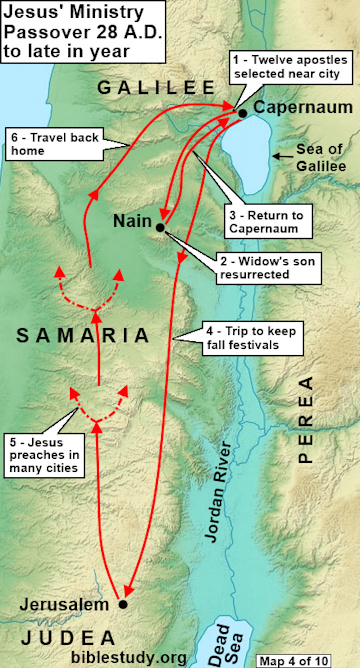
After Feast of Tabernacles the Lord and his disciples travel north and preaches the gospel, many women travel with and financially support Christ, Jesus preaches is many unknown locations.
Bible References: Luke 8:1 - 3, John 5:1 - 47.
Previous Timeline - Next Timeline
September 28 A.D.
Healing Leads to Persecution
Jesus, shortly before the fall festival season (likely the Feast of Tabernacles which begins Thursday September 23, John 5:1), travels to Jerusalem.
After arriving in the city he meets a man, on a Sabbath day (John 5:2 - 6), who had been suffering from an infirmity for 38 years. The man, for many years, had sadly attempted and failed to take advantage of a rare miracle which took place in a pool near the temple.
For from time to time, an angel descended into the pool and agitated the water; and the first one to enter after the agitation of the water was made well from whatever disease he had (John 5:4).
The man's failure was due to a lack of friends to help him (John 5:7). The Lord, taking pity on the man, heals him then tells him he can now take his bedroll and walk away (verse 8)! When certain Jews learn about the miracle, instead of rejoicing, they criticize the man for breaking the Sabbath by transporting his bedroll! This is because the Jews believed (contrary to the Bible) that carrying a bedroll on the Sabbath constituted work.
For this reason, the Jews said to the man who had been healed, "It is the Sabbath day. It is not lawful for you to take up your bedroll." He answered them, "The One Who made me whole said to me, 'Take up your bedroll and walk.' "
Then they asked him, "Who is the One Who said to you, 'Take up your bedroll and walk'? " But the man who had been healed did not know Who it was, for Jesus had moved away, and a crowd was in the place.
After these things, Jesus found him in the temple and said to him, "Behold, you have been made whole. Sin no more, so that something worse does not happen to you." (John 5:10 - 14).
The Jews' view that Jesus was encouraging Sabbath-breaking leads them to decide to persecute and seek Jesus' death (John 5:1 - 16).
Non-Stop Work
Jesus' response to those who thought carrying a bedroll on the Sabbath was work (and therefore a sin) was the following.
My Father is working until now, and I work (John 5:17).
The Jews, who note that Christ calls God HIS Father (not "our Father"), become further enraged believing he is blaspheming. They fully understood that calling God His Father made himself equal to God!
So then, on account of this saying, the Jews sought all the more to kill Him, not only because He had loosed the Sabbath, but also because He had called God His own Father, making Himself equal with God. (John 5:18).
The Lord then reiterates his goal is to do his Father's will. He then reveals that not only will he be the One who will resurrect and judge humanity, it will be he who will give eternal life to those deemed worthy to receive it.
"Truly, truly I say to you, the Son has no power to do anything of Himself, but only what He sees the Father do. For whatever He does, these things the Son also does in the same manner . . .
"For even as the Father raises the dead and gives life, in the same way also, the Son gives life to whom He will . . .
"Truly, truly I say to you, the one who hears My word, and believes Him Who sent Me, has everlasting life and does not come into judgment; for he has passed from death into life.
"Truly, truly I say to you, the hour is coming, and now is, when the dead shall hear the voice of the Son of God; and those who hear shall live.
"For even as the Father has life in Himself, so also has He given to the Son to have life in Himself; And has also given Him authority to execute judgment because He is the Son of man. Do not wonder at this, for the hour is coming in which all who are in the graves shall hear His voice . . . (John 5:19, 21, 24 - 28).
Near the close of his discourse Jesus sums up the primary problem of the Jews.
You search the Scriptures, for in them you think that you have eternal life; and they are the ones that testify of Me. But you are unwilling to come to Me, that you may have life . . .
But I have known you, that you do not have the love of God in yourselves (John 5:39 - 40, 42).
October to near
year's end in 28 A.D.
Spreading the Gospel
Jesus, after the fall festival season which ended September 30, travels north from Jerusalem to go back home to Capernaum. During his journey he and the disciples make it a point to preach the gospel in every city or village possible along the way.
Now it came to pass afterwards that He traveled through all the land, city by city and village by village, preaching and proclaiming the gospel of the kingdom of God; and the twelve were with Him (Luke 8:1).
Women Accompany the Lord
The Bible records, at this point in the Lord's ministry, that several women were also accompanying him and supporting his work financially. One such notable woman, first mentioned by name in Luke 8, is Mary Magdalene.
And certain women who had been healed of evil spirits and infirmities: Mary who is called Magdalene, from whom seven demons had gone out; and Joanna, wife of Chuza, a steward of Herod; and Susanna, and many others who were ministering to Him from their own substance. (Luke 8:2 - 3).
Unknown Preaching
While the New Testament gives us many details about Jesus' ministry, it sometimes makes only a passing reference to certain events. Determining exactly which cities the Lord preached in, for example, is impossible due to generalized statements like those below.
(after John the Baptist was imprisoned) Then Jesus returned in the power of the Spirit to Galilee; and word about Him went out into the entire country around. And He taught in their synagogues, and was glorified by all (Luke 4:14 - 15, with parallel mentions in Matthew 4:12 and Mark 1:14 - 15).
(after sending the 12 apostles on a training mission) And it came to pass that, when Jesus had finished commanding His twelve disciples, He left there to teach and to preach in their cities (Matthew 11:1, with parallel mention in Luke 8:1).
Other references to unknown locations of evangelism include Matthew 4:23, 9:35, Mark 1:38 - 39, 6:6 and Luke 4:44. Maps 2, 3, 4, 5 and 9 in this timeline series on Jesus' life reflects this uncertainty of where the gospel was preached.