Sequence in Chronology: 17 of 26
Topics Covered: Jesus miraculously produces money in a fish's mouth to pay his and Peter's temple tax, the apostles dispute amongst themselves who is the greatest, disciples try to forbid person from casting out demons, believers given authority to make binding decisions among themselves and are taught to offer unlimited forgiveness.
James and John want to destroy a city with fire from heaven for rejecting Jesus, seventy disciples are sent on an evangelistic training mission, Good Samaritan parable given.
Bible Sections Referenced: Matthew 17:24 - 27, 18:1 - 35, 19:1 - 2, Mark 9:33 - 50, 10:1, Luke 9:46 - 62, 10:1 - 37.
Previous Timeline - Next Timeline
Mid-November to
Mid-December, 29 A.D.
The Temple Tax
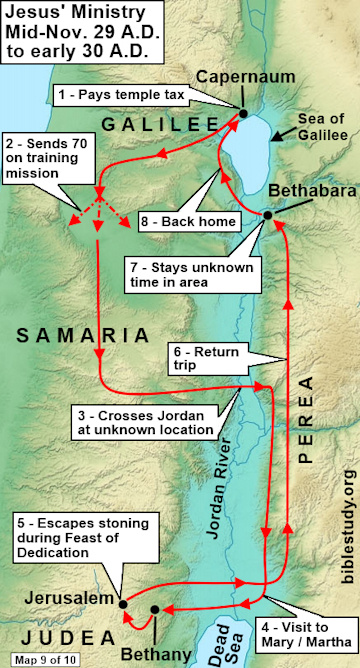
Jesus and the disciples stay in Jerusalem for an unknown period after observing the Feast of Tabernacles. They then make their way back to Capernaum. While in the city Peter is approached by those who collect the temple tax and asked whether Jesus planned to pay it or not.
Now after coming to Capernaum, those who received the tribute money came to Peter and said, "Does not your Master pay tribute?" And he said, "Yes." (Matthew 17:24 - 25).
The tax, which was voluntary in the first century and justified by Exodus 30:11 - 16, was requested of every Israelite male twenty years old or older. The tax was half a shekel (or two drachmas) per male and was used to support the service and maintenance of Jerusalem's temple.
Peter, after informing Jesus of the request, is told to cast his fishing line into the Sea of Galilee. The fish he catches miraculously has a coin in his mouth which he uses to pay the tax they both owe!
Who Are the Greatest?
The disciples soon begin to dispute among themselves who will be the greatest in God's kingdom (Matthew 18:1 - 5, Mark 9:33 - 37, Luke 9:46 - 48). Although this is the first time such jostling for authority under Jesus rears its ugly head, it sadly is not the last!
Then He (Jesus) came to Capernaum; and when He was in the house, He asked them (his disciples), "What were you discussing among yourselves on the way here?" But they were silent because, while on the way, they had discussed who would be the greatest. (Mark 9:33 - 34).
The issue of authority and power will soon come up again when the mother of James and John attempts to have her sons granted important positions under Christ (Matthew 20:20 - 28, Mark 10:35 - 45). Even during the solemn observance of Jesus' last Passover the disciples indulged in debate about which of them should be considered the greatest (Luke 22:24 - 30)!
The foundation of the disciples' in-fighting was the belief that Jesus would very soon set up an earthly kingdom which would rule the earth through a restored Israelite kingdom (see Acts 1:6).
"They asked the question (regarding authority) because they supposed, in accordance with the common expectation of the Jews, that he was about to set up a temporal kingdom of great splendor; and they wished to know who should have the principal offices and posts of honor and profit." (Barnes' Notes on the New Testament).
The disciples were seeking authority and rank for its own sake without regard to the skills and character God required for such positions. They, like the world they lived in, wanted to indulge in the vanity of being considered "great ones" by others (Matthew 20:25).
Jesus' response was to get right to the point. Positions of responsibility in God's kingdom will not be based on heredity, wealth, how influential a person is, favoritism or any other carnal criteria. They will be based on a person's character, with those possessing the greatest hearts of humility, service and love given the greatest positions!
And after calling a little child to Him, Jesus set him in their midst, and said, "Truly I say to you, unless you are converted and become as little children, there is no way that you shall enter into the kingdom of heaven.
"Therefore, whoever shall humble himself as this little child, he is the greatest in the kingdom of heaven." (Matthew 18:2 - 4).
Forbidding Good Works
The Apostle John, while the Lord is teaching about God's Kingdom, interjects that the disciples had forbid someone not in their group from casting out demons in His name. Jesus responds by stating such a good work should not be forbidden.
"Do not forbid him; for no one who does a work of power in My name can easily speak evil of Me. And the one who is not against you is for you." (Mark 9:39 - 40, see also Luke 9:49 - 50).
Jesus continues his correction by warning his disciples about offending those who are spiritually "little children" and tells them about God's loving concern for every person (Matthew 18:6 - 14, Mark 9:42 - 50). He also instructs them on how to resolve disagreements between people (Matthew 18:15 - 17) and gives believers the authority to make binding decisions regarding disputes (verses 18 - 20).
Peter asks how many times he should forgive someone and gets an unexpected answer from the Lord.
Then Peter came to Him and said, "Lord, how often shall my brother sin against me and I forgive him? Until seven times?" Jesus said to him, "I do not say to you until seven times, but until seventy times seven. (Matthew 18:21 - 22).
Christ then offers the parable of the unforgiving servant (Matthew 18:23 - 35).
Leaving Capernaum
Jesus and the disciples leave Capernaum and the Galilee region for Samaria (Luke 9:53 - 53, Matthew 19:1, Mark 10:1).
Fire From Heaven?
James and John, as the group travels through Samaria, are rebuked for impulsively wanting to destroy a Samaritan village with fire because of their rejection of the Lord!
And He sent messengers before His face. And as they went, they came to a village of Samaritans to prepare for Him; But they did not receive Him, because His face was as if He were going to Jerusalem.
And seeing this, His disciples James and John said, "Lord, will You have us call fire to come down from heaven and consume them, as Elijah did?" But He turned and rebuked them, and said, "You do not understand of what spirit you are . . ." (Luke 9:52 - 55).
Three Unique Encounters
As the group continues their travels they run into three individuals. The first, after stating he will follow Jesus wherever he goes, is told the Lord has no permanent place to stay (Luke 9:57 - 58). The second person is asked to follow Jesus but begs to bury his father first. He is told the gospel must be his greatest priority.
Then He said to another, "Follow Me." And he said, "Lord, allow me first to go and bury my father." But Jesus said to him, "Let the dead bury their own dead, but you go and preach the kingdom of God." (Luke 9:59 - 60)
The third person promises to follow the Lord but first wants to say goodbye to his relatives. He is told that his dedication cannot be divided and that he must set his heart solely to do God's will.
And another also said, "I will follow You, Lord, but allow me first to bid farewell to those who are at my house." But Jesus said to him, "No one who sets his hand to the plow, and looks back at the things behind, is fit for the kingdom of God." (Luke 9:61 - 62).
Training 70 Disciples
Jesus sends seventy of his disciples (not the 12 apostles trained earlier in the year) on an evangelistic training mission to prepare the way for him in cities he will soon visit (Luke 10:1 - 24). This training possibly took place as the group traveled south through parts of Samaria.
Before the disciples leave, however, he instructs them on what they should and should not do while on their journey. He also stresses that those who accept or reject them are also accepting or rejecting both him and God the Father.
The one who hears you hears Me; and the one who rejects you rejects Me; and the one who rejects Me rejects Him Who sent Me (Luke 10:16).
Return of the 70
The seventy return to the Lord and report on their evangelism (Luke 10:25 - 37). The Lord, after the men rejoice over the authority they had over demons, then reveals something that offers more proof that he is a member of the Godhead.
"I was watching when Satan fell from heaven like lightning." (Luke 10:18).
The event Jesus referenced is Satan the devil being cast down to the earth, along with his demons, after they tried to force God off his throne (see Revelation 12:4). The Lord then praises God and informs the disciples they are blessed to see his ministry as many Old Testament people longed to be able to do so.
In the same hour Jesus rejoiced in the Spirit, and said, "I praise You, O Father, Lord of heaven and earth, that You did hide these things from the wise and intelligent, and did reveal them to babes. Yes, Father, for it was well pleasing in Your sight to do so." . . .
And He turned to His disciples and said privately, "Blessed are the eyes that have seen the things that you see. For I tell you, many prophets and kings have desired to see the things that you see, and have not seen them; and to hear the things that you hear, and have not heard them." (Luke 9:21, 23 - 24).
Jesus then gives his famous Good Samaritan parable (Luke 10:25 - 37).