Meaning of Numbers: The Number 153
The English phrase "hundred and fifty and three" used for the number 153, is recorded 1 time in 1 King James Bible verses.
The meaning of the number 153 centers around the New Testament event sometimes referred to as the miraculous draught or catch of fishes (John 21:1 - 11). It is only mentioned in the Gospel of John.
This amazing miracle involving 153 was performed by Jesus, after his resurrection from the dead, in his next to last appearance with his eleven disciples before ascending into heaven.
The miracle of fishes took place on Jesus' eighth of nine post-resurrection appearances. It began when Peter decided he wanted to go back to his pre-conversion job of being a fisherman (John 21:2 - 3). Upon hearing his plans, several of the other disciples went with him to fish on the Sea of Tiberias (Sea of Galilee). The men fish for an entire night and catch nothing.
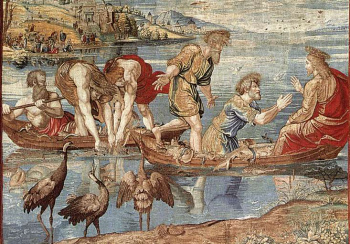
In the morning, a man on the shore (they did not know it was Jesus) yells to the disciples and asks if they caught anything. They answer no. They are then told to drop their net on the right side of the ship. When they try to bring the net out of the water, it is so full of fish that it requires being dragged to the shore! The disciples now realize it was Jesus talking to them. On shore, Peter counts a total number of 153 "great fish" in the net.
Then Jesus said to them, "Children, do you have any food?" They answered Him, "No." And He said to them, "Cast the net to the right side of the ship, and you shall find some." Then they cast the net, but they did not have the strength to draw it in because of the multitude of fish . . .
But the other disciples came in a small ship, dragging the net full of fish; for they were not far from land, but about two hundred cubits away. Now then, when they came up to the land, they saw a fire of coals spread, and fish lying on it, and bread.
Jesus said to them, "Bring some of the fish that you have just caught."
Simon Peter went up to the shore and drew the net to the land, full of large fish, one hundred and fifty-three; and although there were so many, the net was not torn. (John 21:5 - 6, 8 - 11, HBFV).
Symbolizing abundance, 153 can even represent an overflow blessing from God. The Bible states the disciples marveled at the fact that their net held together even though it contained so many large fish (John 21:11)!
Additionally, the catching of 153 fish happened only after Christ became involved in the work. This is a subtle (or perhaps not so subtle!) reminder that without Christ the disciples' (and any believer's) attempts to accomplish something great on their own will fail, but that with Jesus all things are possible (John 15:5).
Lastly, the 153 fishes is reminiscent of a previously abundant catch Peter, Andrew, James and John experienced when they were first called to follow Christ and become fishers of men (and not food). Given the disciples were trying to go back to their pre-conversion employment when the miracle occurred, it likely reminded them that they now worked for God whose will it still was for them to catch men and not fish.
Appearances of Number One Hundred Fifty Three
Jerome, the fourth century A.D. Catholic priest and theologian, theorized that the 153 fishes in the Bible, caught by the disciples, represented all the species of fish. He then stated its meaning is that there was enough room within the church for all the "races" of man (Biblical Numerology, chapter 6). Augustine also believed that this fish miracle represented all kinds of men being saved by the gospel "net."
The Tetragrammaton and 153
The Tetragrammaton (Greek for "four letters") refers to the four consonants (YHWH or YHVH in English) used to represent God's name in the Old Testament's original manuscripts.

According to the 1906 Jewish Encyclopedia, this hallowed proper name for God is recorded 5,410 times in the Bible. The encyclopedia states that the book of Genesis contains 153 occurrences of the Tetragrammaton. Its first appearance, where it is translated as "Lord" in the King James, is the following.
These are the generations of the heavens and of the earth when they were created, in the day that the Lord (YHWH / YHVH) God made the earth and the heavens . . . (Genesis 2:4, KJV).
A Fiery Answer!
It took 153 men, three groups of fifty soldiers plus one captain (51), for King Ahaziah to have Elijah brought to him. The first group of soldiers received a miraculous answer to their demands.
So he (Ahaziah) sent to him (Elijah) a commander of fifty with his fifty (51 men total). And he went up to him. Then, behold, he sat on the top of a hill. And he spoke to him, "Man of God! The king has said, 'Come down.' "
And Elijah answered and said to the commander of fifty, "If I am a man of God, then let fire come down from the heavens and burn up you and your fifty." And there came down fire from the heavens and burned up him and his fifty (2Kings 1:9 - 10, HBFV).
The second group of 51 soldiers, who apparently didn't learn the lesson of what happened to the first group, were also greeted with a fiery answer (2Kings 1:11 - 12). When a third group of soldiers, making 153 total sent to Elijah, they humbly request their lives be spared.
And the third commander of fifty came up and fell on his knees before Elijah, and begged him, and said to him, "Man of God, I pray you, let my life and the life of these fifty, your servants, be precious in your sight" (2Kings 1:13, HBFV).
Elijah honors their requests, visits the king and informs him he will die from his injuries due to his rejection of God (2Kings 1:16 - 17).
Number 153 and Personal Blessings
We discover something quite interesting about 153 when we look at how many people Jesus personally blessed. The book of Mark records Christ, on three occasions, personally blessed three people. These events were the healing of a man with an unclean spirit (Mark 1:23), healing a man who was deaf (Mark 7:32) and making whole another who was blind (Mark 8:22).
Matthew, however, writes that on 23 occasions Jesus blessed a total of 47 people. Some of those whom he blessed included a leper (Matthew 8:2), a non-Israelite woman and her daughter (Matthew 15:22), Mary Magdalene (Matthew 27:56) and Joseph of Arimathea (Matthew 27:57).
Luke writes that on 14 occasions 94 people were blessed. They include the seventy disciples sent out to preach and heal (Luke 10:1), ten lepers cleansed at the same time (Luke 17:12) and Zaccheus (Luke 19:2).
Lastly, the apostle John records eight incidents where nine people were helped by Jesus. Three of these people include Nicodemus (John 3:1), the woman accused of adultery (John 8:11) and Lazarus (John 11). All told, the Lord directly blessed 153 people in forty-eight separate incidents!
More Info on Biblical Meaning of 153
The Hebrew word rob, Strong's Concordance #H7230, is recorded 153 times in 147 Hebrew Old Testament verses. It is found the most in 2Chronicles (27 times) followed by the Psalms (17) and then both Proverbs and Ezekiel (12 each). The word, which means abundance, is usually translated as "plenty," multitude," "abundance" or "great" in the King James.
Destroy thou them, O God; let them fall by their own counsels; cast them out in the multitude (rob) of their transgressions; for they have rebelled against thee (Psalm 5:10, KJV).
Better is a little with righteousness than great (rob) revenues without right (Proverbs 16;8, KJV).
There are 4 words and phrases in the Bible's original languages that are recorded exactly 153 times.
Interestingly, the number 153 is equal to adding the first seventeen digits or 1 + 2 + 3 + 4 + 5 + 6 + 7 + 8 + 9 + 10 + 11 + 12 + 13 + 14 + 15 + 16 + 17.
153 is also the product of 9 x 17. If we add the individual digits (1 + 5 + 3) we end up with 9. If we add the cube of each of the individual digits (1 x 1 x 1) + (5 x 5 x 5) + (3 x 3 x 3), the result is 1 plus 125 plus 27 or 153.